How Exchanges Make Money on Crypto Withdrawals: Understanding the Spread
– Crypto exchanges often include a spread, which can reduce your payout when selling. You can buy Bitcoin on Paybis to see transparent pricing in action.
– Spreads are separate from trading fees and are not always disclosed clearly. Use the Bitcoin Cash Calculator to estimate your real costs before transacting.
– Comparing the quoted price to the market price can help spot hidden costs. If you’re new to wallets, the Paybis Bitcoin Wallet guide explains what to look for.
– On a $1,000 sale, a typical 0.5–1.5% spread translates to $5–$15 lost before any stated fees apply.
– Paybis displays the service fee, processing fee, and network fee as separate line items before you confirm a transaction.
Crypto assets can increase or decrease in value. Paybis is a payment gateway, not an investment service. This content is for informational purposes only and does not constitute financial advice.
You sold $1,000 of Bitcoin, but your bank account shows only $950. The missing $50 wasn’t a network glitch or a bank error. It was the spread. The exchange collected it before you clicked confirm.
Most casual crypto buyers focus on visible fees. The spread is invisible. Exchanges embed it in the exchange rate itself, capturing the gap between the real market price and the price they offer you. This guide shows you exactly how spreads work, how to calculate the dollars you lose on every withdrawal, and what to check before you confirm any crypto transaction.
The Crypto Spread: Your Invisible Transaction Cost
How Exchanges Set Crypto Prices
Bitcoin doesn’t have one fixed price. At any given moment, there’s a price buyers are willing to pay (the bid price) and a price sellers are willing to accept (the ask price). According to market mechanics research, the bid price is the highest amount a buyer will pay for a crypto asset, and the ask price is the lowest amount a seller will accept. The gap between these two numbers is the spread. For a deeper look at how these two figures interact, the Paybis guide on bid price vs. ask price breaks down the mechanics clearly.
Exchanges and market makers use this gap as their profit margin. Market makers maintain liquidity by continuously offering buy and sell orders. Without them, the crypto market would be less liquid, with larger price swings and slower trade execution. The spread is the compensation they earn for taking on that risk.
The practical result is that when you buy crypto, you pay a slightly higher price than the real market figure. When you sell, you receive a slightly lower one. The exchange captures the difference on both sides.
Crypto Spreads & Fees Explained
The spread differs from the trading fee. These are two separate costs that often stack on top of each other.
- Spread: The difference between the market price and the price the exchange offers you. Exchanges embed it in the exchange rate, and it rarely appears as a separate line item.
- Trading fee (service fee): A direct percentage charge that the exchange applies to your transaction amount and usually shows on the confirmation screen.
- Network fee: Paid to blockchain miners for verifying your transaction. The blockchain network sets this fee, not the exchange.
Exchanges openly charge the trading fee as an advertised percentage, while embedding the spread as a hidden markup in market pricing. Most platforms profit more from spreads than from stated fees, which explains why “low fee” platforms can still leave you with less money than expected. If you’re just getting started, the beginner’s guide to using Bitcoin covers these cost concepts in plain language.
How Exchanges Profit from Spreads
Spotting Unfair Buy-Sell Prices
You can see the bid-ask spread by attempting to buy and immediately sell the same asset. Buy Bitcoin at $70,350 on an exchange, then immediately try to sell it back. The platform might quote you $69,650. That $700 gap isn’t a market move. The exchange is collecting on both sides of the transaction.
For casual buyers making a single withdrawal, this often shows up as receiving less cash than expected when selling crypto. The reason is that platforms can structure costs in different ways. Some charge visible transaction fees, some build their margin into the exchange rate through a spread, and many use a combination of both. As a result, a platform with lower advertised fees may still deliver a lower payout if its spread is wider.
Understanding Exchange Transaction Fees
Explicit fees are the charges shown on the confirmation screen. These are usually presented as fixed amounts or percentages, making them easier to compare across platforms.
Across the industry, spreads on crypto purchases and sales commonly range from around 0.5% to 1.5%, although some services advertise lower rates under certain conditions. Many platforms also charge separate transaction, payment processing, or convenience fees on top of the spread. In practice, a $1,000 transaction could incur a visible fee of around 1% to 2% while also including an exchange rate markup that is not immediately obvious.
These published figures are often starting points rather than hard limits. During periods of high market volatility or lower liquidity, spreads can widen further. That is why the final amount received is often a more useful comparison metric than the advertised fee alone.
The Lack of Spread Disclosure
Most exchanges don’t label the spread as a separate cost. Instead, they build it into the exchange rate shown at the top of the checkout screen. You see a Bitcoin price that is slightly worse than what you’d find on CoinMarketCap, but no line item says “spread: $12.50.”
Several major platforms don’t publish their spread practices publicly at all, revealing the real total only at checkout, after you’ve already entered your card details. By that point, you’ve invested several minutes in the process and committed to completing the transaction.
Real Example: Why Your $1,000 Bitcoin Withdrawal Shows Less
Coinbase Withdrawal: Spot Hidden Fees
Here’s how costs stack up on a $1,000 Bitcoin sale compared to a $200 sale, using Coinbase’s published fee structure. Bitcoin’s price at the time of writing sits at approximately $77,000 per coin, per Fortune’s market reporting.
| Cost Component | $200 Withdrawal | $1,000 Withdrawal |
|---|---|---|
| Starting amount | $200.00 | $1,000.00 |
| Coinbase sell-side spread (~0.50%) | $1.00 | $5.00 |
| Network fee (estimate) | ~$1.50–$3.00 | ~$1.50–$3.00 |
| Total deducted | ~$2.50–$4.00 | ~$6.50–$8.00 |
| Cash received | ~$196.00–$197.50 | ~$992.00–$993.50 |
| Effective cost | ~1.25–2.00% | ~0.65–0.80% |
The gap between what you expected and what you received isn’t labeled “spread” anywhere on the confirmation screen. It’s primarily the exchange rate markup and network fees. For help understanding how to sell crypto to a Visa or MasterCard card, the Paybis support guide on card withdrawals walks through the exact steps, including what fees appear at each stage.
The Hidden Cost of Your Withdrawal
The cost of hidden spreads scales with transaction size. On a $200 sale, a 2% spread costs $4. On a $5,000 sale, the same 2% spread costs $100. Casual buyers making occasional larger withdrawals lose substantially more in absolute terms than they realize, even if the percentage looks small. You can use the Bitcoin Cash Calculator to model these costs at different transaction sizes before committing.
Are You Paying Too Much for Crypto? Find Out
First Step: Verify Market Price
The market price of any cryptocurrency reflects the volume-weighted average across active trading pairs worldwide, as CoinMarketCap explains. Think of it like the wholesale price of a product before the retailer adds its markup. Exchanges offer you the retail price, which includes their margin.
Check the CoinMarketCap price for any asset before initiating a withdrawal or sale. Then compare that number against what the exchange shows you. The gap between those two figures is a rough estimate of the spread being applied. If the exchange price is 2% below the CoinMarketCap figure on a sell, you’re losing 2% before any stated fees apply.
Calculate Your Crypto Loss
The math is straightforward. Take the market price at the moment you’re selling. Subtract the exchange’s quoted price (what you’ll actually receive per unit). Divide that difference by the market price and multiply by 100. That percentage is your spread cost.
For example: the market price is $77,000 per BTC, and the exchange offers you $76,230. That’s a $770 difference. Divided by $77,000 and multiplied by 100, your spread is 1%. On a 0.01 BTC sale, that’s $7.70 lost to spread alone, before any service or network fee. For context on how much Bitcoin different budgets can actually purchase, the guide on how many Bitcoin you can buy for $100 puts spread impact into practical perspective.
Find the Best Crypto Withdrawal Spread
Here’s how typical spreads compare across major platforms:
| Exchange | Estimated Spread | Additional Fees |
|---|---|---|
| Coinbase (Retail) | ~0.50% | Network fees vary |
| Cash App | 0% (Auto Invest, Round Ups, direct deposit, or buys over $2,000): 1.5%–2.5% (standard purchases) | Variable network fee for external wallet withdrawals |
| Kraken (Instant Buy) | Variable (based on market volatility, asset type, order size, VIP status, and account activity) | 1% trading fee (instant and recurring trades): 1.5% (custom orders) |
| Uphold (BTC/ETH) | 1.4% to 1.6% | Higher for altcoins |
| Paybis | Transparent pricing | 1.49% service + 4.5–8.5% processing + network |
Sources: Coinbase fee schedule, Cash App bitcoin fees page, Kraken fee schedule
Identifying Excessive Spread Costs
A spread above 2% on major cryptocurrencies like Bitcoin or Ethereum is high. Spreads on smaller altcoins run naturally wider because lower trading volume increases the cost of maintaining liquidity.
When combining gateway fees, interchange costs, and exchange rate spreads, total costs on card-based crypto purchases at payment gateway platforms can range from 6% to 9% per transaction. Comparing that figure against exchange-native fee structures helps set a reasonable benchmark. The Coin Bureau Paybis Review provides useful context for where transparent pricing platforms fall within this range.
Avoid Surprise Crypto Withdrawal Fees
Your Two Key Withdrawal Fees
Every crypto withdrawal involves at least two costs: a platform fee (the service or processing charge) and a network fee (paid to blockchain miners). These are fundamentally different in origin and behavior.
The exchange sets the platform fee. Paybis charges a service fee starting at 1.49%, waived on your first card transaction per account. The processing fee applies to card transactions over $50 and ranges from 4.5% to 8.5% depending on currency, as detailed in Paybis’s fee type documentation. The three fees shown before you confirm are the service fee, processing fee, and network fee with no additional charges surfacing at checkout.
The blockchain network sets the network fee based on current demand and congestion. No exchange controls this cost. During high-traffic periods on the Bitcoin network, this fee can spike significantly. This Paybis video on converting ETH to cash demonstrates how these fees appear in real time during a sell transaction, which makes the cost structure much easier to understand than reading a fee schedule.
Spotting Hidden Processing Fees
Exchanges frequently bury processing fees for card transactions in terms of service rather than showing them prominently before checkout. A platform might show a low service fee of 0.50% on the headline while charging a 4% to 8% processing fee that only appears on the final confirmation screen.
Test the calculator before you commit. Enter $100, then $500, then $2,000, and watch how the total changes. If the platform shows only “estimated fees” without itemization, or reveals the real total only at checkout after you’ve entered payment details, that’s a signal costs may be buried. It’s also worth knowing how to spot warning signs more broadly — the Paybis guide on how to spot and avoid crypto scams covers red flags that overlap with deceptive fee practices.
Hidden Costs of Converting Crypto to Cash
Converting crypto to cash can involve additional costs beyond the exchange fee. Fiat conversion spreads apply if your bank uses a different currency than your sale proceeds. Some banks also charge for incoming transfers from crypto platforms, treating them as international wire receipts. On top of those, the exchange’s sell-side markup and the blockchain network fee both reduce your final balance before the cash appears in your account. Paybis’s help documentation on selling crypto covers the full process, including where each cost type appears in the transaction flow.
Stop Overpaying for Crypto Withdrawals
Avoid Hidden Crypto Withdrawal Fees
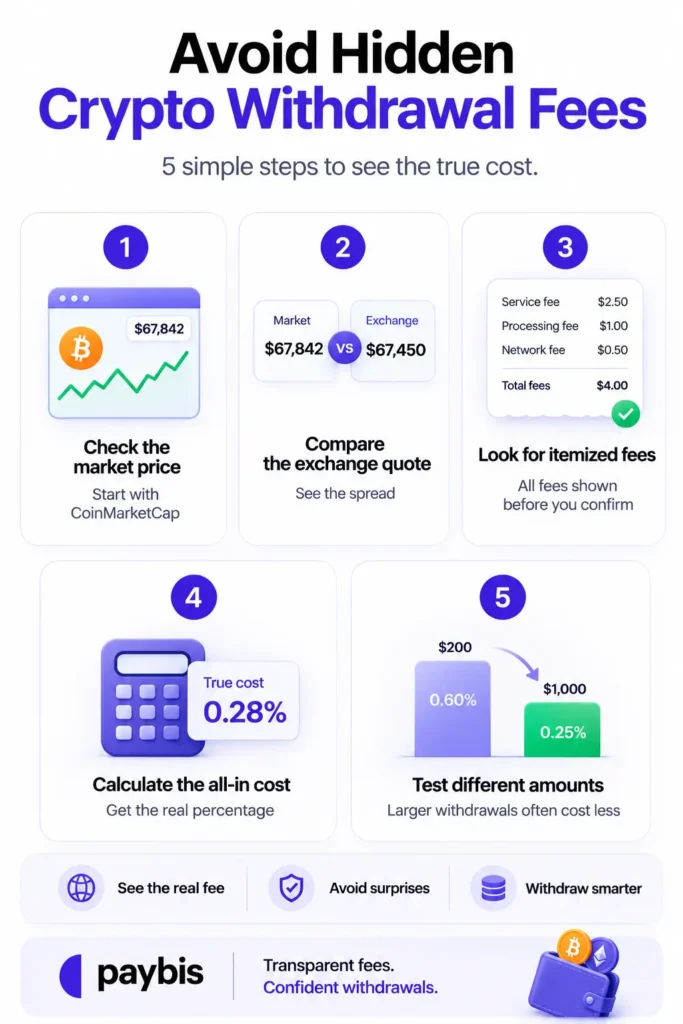
Before confirming any crypto sale or withdrawal, run through this checklist:
- Check the market price. Look up the current Bitcoin or Ethereum price on CoinMarketCap before entering the exchange.
- Compare to the exchange quote. The difference between these two numbers approximates the spread being applied.
- Look for an itemized fee breakdown. The confirmation screen should show service fee, processing fee, and network fee as separate line items before you click confirm.
- Total the all-in cost. Add all three fees and divide by your transaction amount to get the true percentage cost.
- Test different amounts. Fees often scale non-linearly. A $200 withdrawal may carry a higher effective percentage than a $1,000 one.
This Paybis US withdrawal guide shows the exact screens and fee display a US customer sees during a withdrawal, removing the guesswork about what “transparent fees” looks like in practice.
Know Your Total Crypto Withdrawal Costs
Exchanges are businesses. Running a compliant, 24/7 crypto platform requires licensing across multiple jurisdictions, payment processor relationships, fraud prevention infrastructure, and customer support teams. These costs are covered through fees and spreads. Platforms advertising “zero fees” collect their revenue through wider spreads instead. There is no cost-free crypto exchange. The only question is whether that cost is visible before you confirm or hidden until afterward. The spread fluctuates with market conditions: when trading volume is high and liquidity is deep, spreads narrow; during volatile periods or major news events, spreads widen.
How to Reduce Crypto Exchange Spreads
The most effective way to reduce spread costs is to choose platforms that show the spread explicitly rather than hiding it in the exchange rate. Three practical approaches:
- Use the fee calculator before signing up. If a platform won’t show you the final amount before you enter payment details, that signals buried costs.
- Compare net received, not stated fees. The only honest comparison metric is how much cash you actually receive for a fixed amount of crypto, inclusive of all fees and spread. Paybis’s Kraken vs. Binance fee guide covers how professional interfaces and simpler buy/sell tools carry different fee structures for different types of users.
- Consider your payment method. Bank transfers typically carry lower processing fees than card transactions, though settlement takes longer. Paybis supports selling crypto via bank transfer, Neteller, or Skrill for different payout preferences. Paybis’s MoonPay on-ramp comparison covers how net received differs across platforms when all costs including spread are factored in.
Calculate Your Crypto Spread Cost
Paybis displays three fees upfront before you enter payment details: a service fee starting at 1.49% (waived on your first card transaction), a processing fee of 4.5%–8.5% for card transactions over $50 depending on currency, and a network fee, all shown as separate line items before you confirm. If you’re ready to get started, you can create an account and complete identity verification in approximately 2 minutes.
The platform operates in 180+ countries with 90+ cryptocurrencies and 20+ payment methods. Paybis holds 31,519+ Trustpilot reviews with a rating of 4.1 or “Great,” and has reported no security breaches since its 2014 launch, with FinCEN (Financial Crimes Enforcement Network) registration and FINTRAC (Financial Transactions and Reports Analysis Centre of Canada) registration confirming its compliance standing.
For users who want to verify costs before committing, Paybis displays the complete fee breakdown, service fee, processing fee, and network fee, before any transaction is confirmed. Create an account, complete identity verification in approximately 2 minutes, and reach 24/7 human support with average response times of 1 to 2 minutes if anything comes up. For a step-by-step walkthrough of the registration process, the guide on how to create and verify an account covers every stage in detail.
Key Terminology
- Bitcoin (BTC): The first and largest cryptocurrency, designed to let people send and receive digital money without relying on a bank or central authority. It operates on a blockchain, a public ledger that records all transactions.
- Market price: The current average price at which a cryptocurrency is trading across major exchanges. It serves as a benchmark for comparing the rate offered by a platform before buying or selling.
- Execution price: The actual price at which your transaction completes. This can differ from the market price displayed elsewhere due to the spread applied by the exchange at the moment of execution.
- Transaction fee: A charge applied when buying, selling, or transferring cryptocurrency. Depending on the platform, this may include service fees, payment processing fees, or network fees required to complete the transaction.
- Liquidity: The availability of buyers and sellers in the market at any given time. Higher liquidity generally means tighter spreads because more participants are willing to transact at prices close to the market figure.
FAQ
Is the Spread the Only Fee I Pay?
No. The spread is one of at least three cost components on most platforms. The others are the explicit service fee (a stated percentage or fixed charge) and the network fee (paid to blockchain miners), and all three stack together to determine your total cost.
Can I Negotiate the Spread?
Individual retail users cannot negotiate the spread on standard buy or sell transactions. High-volume institutional traders can sometimes access tighter spreads through OTC desks, but these require minimum thresholds that typically start at $100,000, with some premium desks setting minimums of $250,000 or higher.
How Do I Know If an Exchange Has a Hidden Spread?
Compare the price shown in the exchange’s calculator against the current CoinMarketCap price for the same asset. If the exchange’s sell price is lower than the CoinMarketCap figure, that difference approximates the spread, and a gap larger than 1.5% on a major coin like Bitcoin warrants a closer look.
Why Is the Price on Google Different from My Exchange?
Aggregators like CoinMarketCap show a volume-weighted average across multiple exchanges, while your exchange shows the execution price, which includes the spread markup. The exchange buys from you at a price below that average on a sell, or sells to you above it on a buy, and keeps the difference.
Do Network Fees Change the Spread?
Network fees and spreads are separate costs and don’t directly affect each other. However, during high-congestion periods on the Bitcoin or Ethereum network, network fees rise independently of the spread, which increases your total transaction cost. Platforms that include network fees in their all-in quote give a more accurate picture of what you’ll actually pay.
Disclaimer: Don’t invest unless you’re prepared to lose all the money you invest. This is a high‑risk investment and you should not expect to be protected if something goes wrong. Take 2 mins to learn more at: https://go.payb.is/FCA-Info