How to Buy Crypto in France: A Step-by-Step Guide
- Buying Bitcoin or other cryptocurrencies in France is fully legal and regulated under MiCA, the EU’s unified crypto framework
- SEPA bank transfer is the most cost-effective payment method for French buyers
- France taxes crypto gains at a flat 30% rate (PFU), one of the simplest tax structures in Europe
- On Paybis, your first purchase of each cryptocurrency with a card carries a 0% service fee
- Paybis supports credit and debit card purchases with 24/7 human support and a 1-2 minute response time
France is one of the most crypto-active countries in Europe. Millions of French residents hold digital assets, and the regulatory framework is now among the clearest on the continent. MiCA, the EU’s Markets in Crypto-Assets regulation, came into full effect in December 2024 and covers every platform operating across all 27 member states.
If you’re buying for the first time, the process is simpler than most people expect. Pick a regulated platform, verify your identity, and make your purchase.
This guide walks through every step in plain language.
Is it legal to buy crypto in France?
Yes. Buying, holding, and selling cryptocurrency is completely legal in France. Platforms operating in the EU must comply with MiCA, the EU’s crypto regulatory framework, which came into full effect in December 2024.
France was actually ahead of most EU countries on crypto regulation. The AMF (Autorité des Marchés Financiers) introduced a PSAN registration framework in 2019, which required crypto service providers to meet anti-money laundering and KYC standards before operating in the country.
MiCA has since replaced and expanded that framework at the EU level. Any platform serving French users now operates under the same unified rulebook that applies across all 27 EU member states. For you as a buyer, that means any licensed platform has been vetted for compliance, consumer protection, and financial stability.
What do you need before buying crypto in France?
To buy crypto in France, you need a government-issued ID, a payment method, and an email address. Most platforms complete identity verification in under 10 minutes.
Here’s what to have ready:
- Government-issued ID: Passport or national identity card (CNI)
- A working email address: For account creation and transaction records
- A payment method: Credit card, debit card, or a bank account for SEPA transfers
- A phone number: Most platforms use SMS verification during signup
You don’t need a crypto wallet before your first purchase. Most beginners buy directly on a platform and keep their crypto there initially. Moving to a self-custody wallet becomes relevant once you’re holding larger amounts.
How do you buy crypto in France step by step?
The process has four steps: choose a regulated platform, verify your identity, select your crypto and amount, then complete your purchase.
Here’s what each step looks like in practice.
Step 1: Choose a platform
Look for a platform that is MiCA-compliant and supports SEPA transfers or card payments in euros. Paybis operates across 180+ countries, supports purchases in EUR, and has real human support available 24/7 with a response time of 1 to 2 minutes.
Step 2: Create and verify your account
Sign up with your email, set a password, and complete KYC verification. You’ll upload a photo of your ID and take a selfie. The process takes around 5 to 10 minutes on most platforms.
Step 3: Choose your crypto and amount
Decide what you want to buy and how much you want to spend in euros. You don’t need to buy a whole Bitcoin. Every cryptocurrency is divisible, so you can start with €50 if that’s where you’re comfortable.
Step 4: Select your payment method and confirm
Choose between card payment or SEPA transfer. Review the fees before confirming. Once the transaction processes, your crypto lands in your platform account or gets sent to a wallet address you specify.
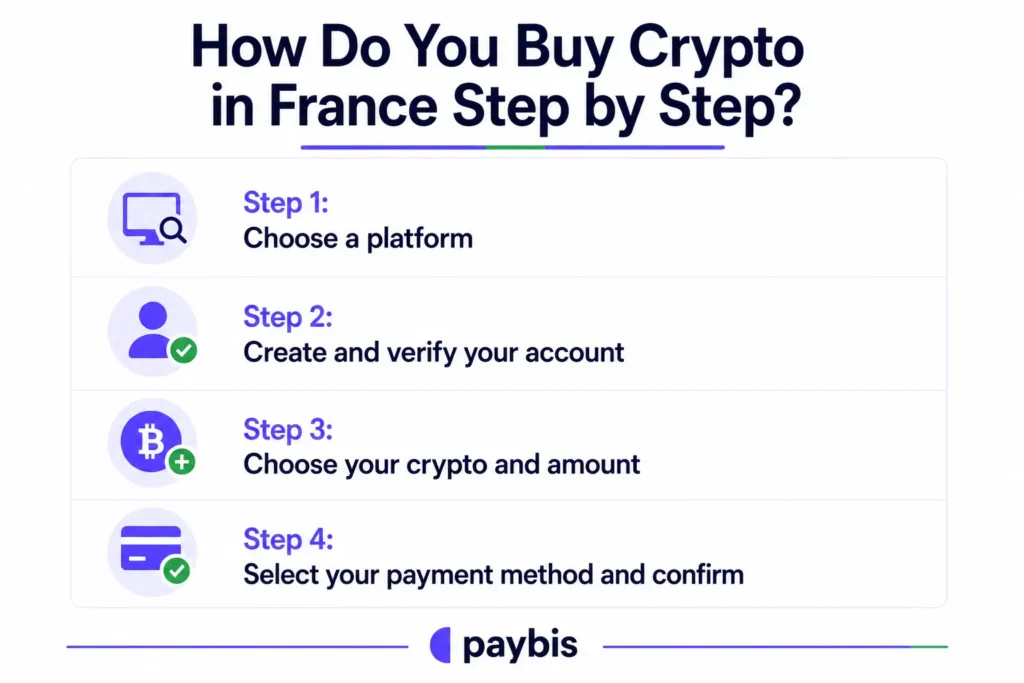
The first purchase takes the longest because of KYC. Every purchase after that is much faster.
What payment methods can you use in France?
French buyers have three main options on Paybis: credit card, debit card, and SEPA bank transfer. SEPA is the most cost-effective for larger amounts. Card is the fastest for instant purchases.
Here’s how each one works:
Credit card: The fastest option. Your purchase goes through in minutes, which matters when prices are moving. Fees are higher than SEPA, typically between 4.5% and 8.5%, depending on the card type and currency. Some French banks flag crypto purchases on credit cards, so it’s worth checking with yours before you try.
Debit card: Works the same way as a credit card in terms of speed. Fees sit in the same range. Most French Visa and Mastercard debit cards are accepted on major platforms.
SEPA transfer: The standard bank transfer system used across the eurozone. Slower than card (transfers typically take 1 business day), but significantly cheaper for larger amounts. If you’re buying over €500, SEPA is usually the better choice in terms of fees.
What cryptocurrencies can you buy in France?
French residents can buy 90+ cryptocurrencies on Paybis, including Bitcoin, Ethereum, USDT, Solana, XRP, and Litecoin.
Bitcoin and Ethereum account for the majority of purchases across Europe by volume. Beyond those two, the market in France has followed broader European trends toward stablecoins and layer-1 alternatives.
The most commonly bought cryptocurrencies in France:
- Bitcoin (BTC): The largest by market cap and the most widely held
- Ethereum (ETH): The backbone of most decentralised applications
- USDT (Tether): A stablecoin pegged to the US dollar, widely used for preserving value in euros without converting back to fiat
- Solana (SOL): One of the fastest blockchains with growing adoption across Europe
- XRP: Used for cross-border payments, popular across EU markets
- Litecoin (LTC): An older alternative to Bitcoin with faster settlement times
If you’re buying for the first time, Bitcoin and Ethereum are the natural starting point. They have the deepest liquidity and the widest support across every major platform.
Do you pay taxes on crypto in France?
Yes. France taxes crypto gains at a flat 30% rate under the Prélèvement Forfaitaire Unique (PFU). This flat rate applies to capital gains from crypto disposals and covers both income tax and social charges.
France has one of the simplest crypto tax structures in Europe. Unlike progressive income tax systems, where your rate depends on your total annual income, the PFU applies a single 30% rate to all crypto gains regardless of what you earn otherwise.
Here’s how it works:
- Taxable event: Any disposal of crypto for euros, other assets, or goods triggers a taxable event
- Rate: 30% flat on the net gain (12.8% income tax + 17.2% social charges)
- Calculation: Proceeds minus your cost base, calculated using the weighted average cost method across your entire holding of that coin
- Threshold: Gains below €305 per year are exempt
One important distinction: crypto-to-crypto trades are not taxable in France. Swapping Bitcoin for Ethereum does not trigger tax. Only the conversion to euros or spending on goods and services does. This is meaningfully different from Canada, the UK, and the US.
Reporting goes on the annual income declaration (formulaire 2086). Every taxable sale must be declared, with the acquisition price and sale price in euros.
How do you store crypto safely in France?
You have two options: keep it on the platform where you bought it (custodial), or move it to a private wallet you control (self-custody). Which makes sense depends on how much you’re holding and how comfortable you are managing your own keys.
Custodial storage (on-platform)
The platform holds your private keys on your behalf. Convenient, beginner-friendly, and comes with account recovery if you lose access. The tradeoff is that your funds are exposed to the platform’s security posture. If the exchange has problems, your access to funds could be affected.
Paybis has served 5M+ users since 2014 with a Trustpilot score of 4/5 across 30,000+ reviews. For most beginners, starting here is a reasonable approach.
Self-custody (your own wallet)
You hold the private keys. For larger positions, a hardware wallet keeps your keys completely offline.
Most experienced holders operate by one rule: ownership of crypto is determined by who holds the private keys. The bigger your position, the more that matters.
What fees should you expect when buying crypto in France?
On Paybis, the service fee is 1.49% from your second purchase of the same cryptocurrency onward. Your first purchase of each crypto carries a 0% Paybis service fee. The processing fee ranges from 4.5% to 8.5% depending on your payment method.
Here’s how the fee structure breaks down:
| Fee Type | Amount |
|---|---|
| Paybis service fee (1st purchase per asset) | 0% |
| Paybis service fee (subsequent purchases) | 1.49% |
| Processing fee (card or SEPA) | 4.5% to 8.5% |
| Network fee | Dynamic, based on real-time blockchain conditions |
Beyond the platform fee, watch for:
- Spread: The difference between the buy and sell price. Some platforms advertise no fees but widen the spread to compensate.
- Network fee: Paid to the blockchain when you move crypto to an external wallet. Varies by network and current congestion.
The clearest way to compare platforms: check how much crypto you actually receive for a fixed euro amount, not just the stated fee percentage. Our guide on hidden crypto fees covers every charge worth knowing about.
Bottom Line
Buying crypto in France is legal, regulated under MiCA, and more accessible than it’s ever been. SEPA keeps deposits cheap. The flat 30% PFU means you always know what you’ll owe at tax time. The framework is clear on all three fronts.
The process is four steps. Pick a MiCA-compliant platform, verify your identity, choose your payment method, and make your first purchase. Paybis gives you 0% service fee on your first buy of each cryptocurrency, support from a real person within 1 to 2 minutes, and access to 90+ cryptocurrencies across web, iOS, and Android.
Simple. Fast. Human.
Buy crypto in France today. Paybis supports EUR purchases with card and SEPA. Real support, real fast. Start here.
FAQ
Do I need to be a French resident to buy crypto on Paybis?
No. Paybis operates in 180+ countries and does not restrict access based on residency. French residents and visitors alike can create an account and buy crypto. Identity verification is required regardless of where you’re based.
Is my first purchase really free of the Paybis service fee?
Yes. The 0% Paybis service fee applies to your first purchase of each individual cryptocurrency. Buy Bitcoin for the first time and you pay no Paybis service fee on that transaction. Buy Ethereum for the first time and the same applies, even if it’s your tenth overall transaction on the platform. From the second purchase of any given crypto onward, the standard 1.49% service fee applies. The processing fee from your payment method applies to every transaction.
Are crypto-to-crypto swaps taxable in France?
No. France’s tax rules only trigger on conversions to euros or spending on goods and services. Swapping Bitcoin for Ethereum is not a taxable event under French law. This makes France meaningfully different from countries like Canada, the UK, and the US, where every crypto-to-crypto trade is treated as a disposal.
Disclaimer: Don’t invest unless you’re prepared to lose all the money you invest. This is a high‑risk investment and you should not expect to be protected if something goes wrong. Take 2 mins to learn more at: https://go.payb.is/FCA-Info