
Is Crypto Legal in Europe? The Short Answer and the Full Picture
- Crypto is legal across Europe. There is no EU-wide ban on buying, holding, or trading cryptocurrency.
- MiCA, the EU’s crypto regulation framework, came into full force in December 2024. It sets the rules for crypto platforms, not crypto users.
- Bitcoin and Ethereum are both fully legal to buy and hold in all EU member states.
- Platforms serving EU users must now hold a CASP licence. Using an unlicensed exchange puts your funds at risk.
- Crypto is not legal tender in the EU. You cannot demand that a merchant accept it as payment.
- Tax rules on crypto vary by country within the EU. Gains are generally taxable, but the rates and rules differ.
Crypto is legal in Europe. That is the short answer.
The full picture is more interesting. Europe did not just tolerate crypto. It built the most comprehensive regulatory framework for it in the world. Since December 2024, the EU’s Markets in Crypto-Assets Regulation has set clear rules for who can offer crypto services, how they must treat users, and what rights you have as a customer. For anyone buying, holding, or trading crypto in Europe, that framework matters a great deal.
Here is what it actually means for you.
Is Crypto Legal in Europe?
Crypto is legal across all EU member states. There is no ban on buying, holding, selling, or trading cryptocurrency anywhere in the European Union. This has been the case for years, and MiCA did not change it.
What MiCA did change is the rules around crypto platforms. Before December 2024, a crypto exchange could operate across Europe with little more than a basic AML registration in one country. Now, any platform serving EU users must hold a CASP licence under MiCA. That licence requires a full review from a financial regulator and comes with strict rules on how the platform must handle your funds and treat you as a customer.
So the legal question is really two separate ones. Is owning crypto legal in Europe? Yes, completely. Is operating a crypto platform legal in Europe without proper authorization? No, and the penalties are significant. Understanding which side of that line you are on as a user is what the rest of this article is about.
What Changed When MiCA Came Into Force?
Before MiCA, crypto in Europe operated in a patchwork. Different EU countries had different rules. An exchange licensed in one country could serve customers in another with no additional authorization. Users in different countries had different levels of protection depending entirely on where their platform happened to be registered.
MiCA ended that in December 2024. One unified regulation now applies across all 27 EU member states. Every crypto exchange serving EU users must obtain CASP authorization from a national regulator. That regulator reviews the platform’s governance, capital, security, and compliance before granting a licence. Once authorized, the platform operates under enforceable rules that protect users.
For users, the practical changes are significant. Licensed platforms must keep your crypto separate from their own funds. They cannot use your assets for their own purposes. They must show you fees before you confirm a transaction. They must have a process for handling complaints. And if a platform becomes insolvent, your assets are not treated as the company’s property.
None of these protections existed consistently across Europe before MiCA. They do now.
Is Bitcoin Legal in Europe?
Bitcoin is fully legal to buy, hold, sell, and trade in every EU member state. The same applies to Ethereum and the vast majority of other cryptocurrencies. MiCA specifically excludes Bitcoin and Ethereum from the asset-side rules that cover token issuers because both are decentralized assets with no identifiable issuer.
What that means in practice is simple. No EU regulator can tell you that you are not allowed to buy Bitcoin or hold it in a wallet. The rules apply to the platforms facilitating those transactions, not to the assets themselves or to you as the buyer.
The only relevant legal question around Bitcoin in Europe is tax. Capital gains from selling Bitcoin are taxable in most EU countries, though the rates and rules vary from one country to the next. Some countries apply a flat rate. Others use progressive income tax rates. A few have exemption thresholds for small gains. None of that makes Bitcoin illegal. It makes it an asset you are expected to declare, the same way you would declare gains from selling shares or property.
To understand how Bitcoin works before or after you buy it, the Paybis guide to how Bitcoin works is a good starting point.
Are There Any Crypto Restrictions in Europe?
Crypto is legal, but that does not mean everything is permitted. There are real restrictions worth knowing about.
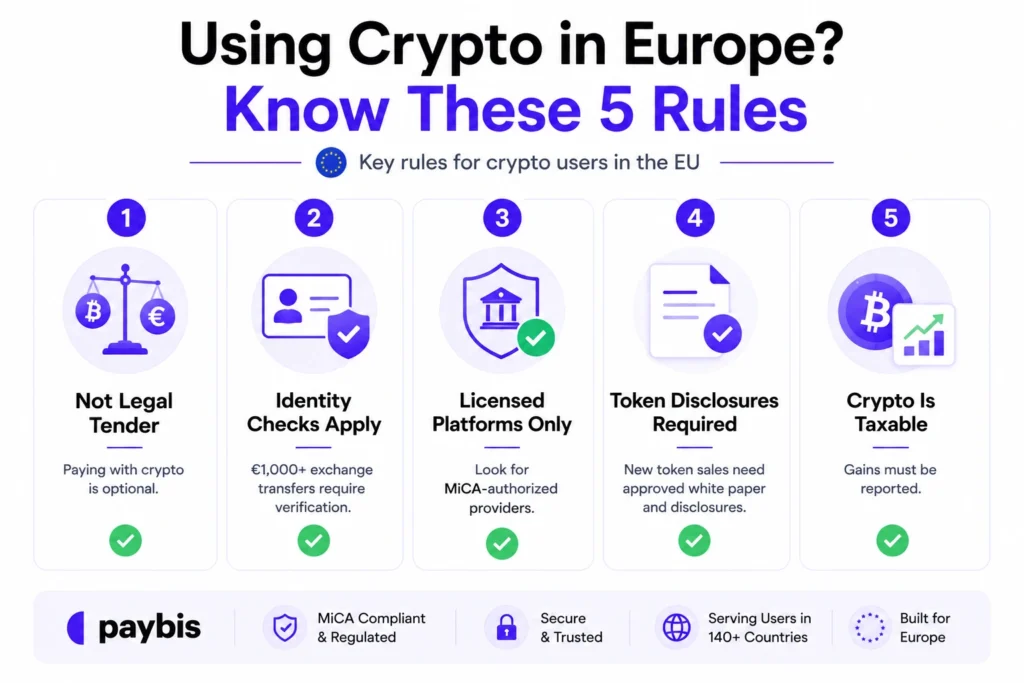
- You cannot use crypto as a means of settling debts. Crypto is not legal tender in the EU. A merchant can choose to accept Bitcoin as payment, but they are not legally required to. You have no right to pay a bill or settle a debt in cryptocurrency if the other party does not want it.
- Anonymous large transactions are restricted. Under EU AML rules and the Travel Rule, crypto transactions above €1,000 between exchanges require sender and recipient information to be passed between platforms. This is not a ban on privacy. It is a requirement that applies at the institutional level, not to personal wallet activity.
- Unlicensed platforms cannot legally serve EU users. Since MiCA came into force, any platform offering crypto exchange, custody, or similar services to EU clients without CASP authorization is operating illegally. That is a restriction on platforms, but it affects users too. Using an unlicensed exchange means you lose all the protections MiCA was designed to give you.
- Some token offerings are now regulated. Under MiCA, new crypto-assets offered to EU investors require a published white paper with defined disclosures. Participating in a token sale that does not meet these requirements carries a risk that was harder to measure before the regulation existed.
- Tax obligations are mandatory. Failing to declare crypto gains is not a grey area. Tax authorities across the EU treat unreported crypto income as tax evasion, the same as any other unreported income.
Does Crypto Regulation Vary by Country Within the EU?
Yes, but less than it used to. MiCA created a single framework that applies across all 27 member states. The rules covering crypto platforms, token issuers, and user protections are the same everywhere.
What still varies by country is tax treatment. Germany, for example, exempts crypto gains from tax if you have held the asset for more than one year. Spain treats crypto gains as capital gains with progressive rates depending on the amount. The Netherlands taxes crypto as part of its box 3 wealth tax system, calculated on assumed returns. Each country has its own approach, and the differences are real enough to matter if you are making significant gains.
Some countries also move faster than others on enforcement. Germany’s BaFin, the Netherlands’ AFM, and Latvia’s Bank of Latvia have been among the more active regulators in the CASP authorization process. They are applying the same MiCA rules as everyone else, but they have built up crypto expertise faster.
For a broader look at how crypto legality works across different countries, the Paybis guide to where crypto is legal globally covers the international picture.
What Does European Crypto Regulation Mean for Users?
For anyone buying or holding crypto in Europe, the practical effect of MiCA comes down to one thing: platform choice matters more than it used to.
A licensed CASP keeps your funds in a separate account. If the platform fails, your crypto is not treated as company property. An unlicensed platform has no such obligation. The difference is not theoretical. It is the difference between having a legal claim to your assets in an insolvency and being an unsecured creditor hoping for scraps.
Beyond that, licensed platforms must show you fees before you confirm a transaction, must have a complaints process you can use, and must not use your assets for their own purposes. These are enforceable rights, not promises in a terms and conditions document.
The simplest thing you can do before using any crypto platform in Europe is to check whether it holds a valid CASP licence. Most national regulators publish their authorized entity registers online. The check takes under a minute and tells you whether the platform you are about to use has been reviewed and approved by a financial regulator.
When you are ready to buy crypto through a licensed, regulated platform, Paybis covers over 90 cryptocurrencies across 190+ countries.
Is Paybis Licensed to Operate in Europe?
Paybis holds the MiCA CASP licence and the Payment Institution (PI) licence under PSD2, both issued by the Bank of Latvia in May 2026. That makes Paybis a fully authorized Crypto-Asset Service Provider under the EU’s unified regulatory framework, with the CASP licence covering all 27 EU member states and the broader EEA through MiCA passporting.
These are full licences issued after a regulatory review, not registrations or notifications. Client crypto assets are held separately from Paybis’s own funds. Fees are shown upfront before you confirm any transaction. And 24/7 live chat support is available if something goes wrong.
On top of the EU licences, Paybis holds FCA authorization in the UK, FinCEN registration in the US, FINTRAC registration in Canada, and VASP registration in Poland.
Paybis has been operating since 2014 and has served 6.9 million+ users across 190+ countries. You can buy Ethereum and 90+ other cryptocurrencies through a platform that is authorized to operate wherever you are in Europe.
Bottom Line
Crypto is legal in Europe. Buying, holding, and trading is permitted across all EU member states, and MiCA has now put proper rules around the platforms that make that possible. What MiCA changed is not whether you can own crypto. It changed what protections you are entitled to when you use a regulated platform to do it. For users in Europe, the most important thing to understand is that those protections only apply if the platform you are using is actually licensed.
FAQ
Is it legal to own crypto in the EU?
Yes. Owning, buying, selling, and trading cryptocurrency is fully legal across all EU member states. There is no ban on crypto ownership anywhere in the European Union. MiCA, the EU’s crypto regulation framework, sets rules for platforms and issuers, not for individual users. The only legal obligations for users relate to tax, which varies by country, and to using licensed platforms when buying or selling.
Do I need to pay tax on crypto in Europe?
In most EU countries, yes. Crypto gains are typically treated as capital gains or income and are taxable. The rates and rules vary significantly between countries. Germany exempts long-term gains after one year. Spain applies progressive capital gains rates. The Netherlands uses a wealth tax approach. Whatever country you are in, declaring crypto gains is a legal obligation. For specific advice on your situation, a tax professional familiar with your country’s rules is the right resource.
Is it safe to use a crypto exchange in Europe?
It depends on the exchange. Since MiCA came into force in December 2024, licensed CASP platforms are required to hold your funds separately from their own, show fees upfront, and maintain proper complaint procedures. Unlicensed platforms operating in the EU have none of these obligations. Before using any exchange, it is worth checking that it holds a valid CASP licence or national regulatory authorization. Most EU national regulators publish their authorized entity lists publicly.
Is Bitcoin a legal currency in Europe?
No. Bitcoin is a legal asset in Europe, meaning you can buy, hold, and sell it freely. But it is not legal tender. Merchants are not required to accept it as payment. The distinction matters: legal does not mean universally accepted. A handful of businesses across Europe voluntarily accept Bitcoin for payments, but there is no legal obligation on anyone to do so.
What happens if I use an unlicensed crypto exchange in the EU?
Using an unlicensed platform means you lose the protections that MiCA was designed to give you. Your funds are not required to be held separately, there is no regulated complaint process you can use, and if the platform collapses, your legal position as a creditor is weak. The platform itself is operating illegally and faces fines and potential shutdown by regulators. The safest approach is to verify licensing before depositing any funds.
Disclaimer: Don’t invest unless you’re prepared to lose all the money you invest. This is a high‑risk investment and you should not expect to be protected if something goes wrong. Take 2 mins to learn more at: https://go.payb.is/FCA-Info