
Is Your Crypto Exchange Regulated? How to Check
- “Regulated” means an exchange holds a licence from a financial regulator, and that status appears on an official public register.
- In the EU, you verify a platform on the ESMA register of authorised CASPs. US users check FinCEN, and UK users check the FCA.
- A genuine licence comes with a named regulator and a reference number you can look up.
- An unregulated platform offers none of the fund protections that come with a licence.
- If you want a platform you can verify in minutes, you can buy crypto on Paybis with a card or bank transfer.
You picked an exchange, funded an account, and maybe bought some crypto. Then a thought lands: is this platform actually allowed to operate, or are you trusting it on faith?
That question has a clean answer, and finding it takes about two minutes. Regulators publish public registers of every licensed platform, so you never have to take an exchange’s marketing at its word. You look it up yourself.
This guide shows you exactly how to check, register by register, and what the warning signs of an unregulated platform look like. If you would rather start fresh on a platform you can verify in minutes, you can buy crypto on Paybis with a card or bank transfer.
What Does It Mean for an Exchange to Be “Regulated”?
A regulated exchange holds a licence from a financial regulator and submits to that regulator’s oversight. The word means a real authorisation, not a marketing slogan.
It helps to separate two terms that often get used as if they mean the same thing.
- Registration usually means a company told a regulator it exists and meets basic anti-money laundering rules. It is the lighter standard.
- Authorisation means a regulator examined the company’s finances and security before granting a licence to operate. It is the higher one.
The difference decides what protection you actually get. A fully authorised exchange has to safeguard your money in ways a lightly registered one never promised. The crypto license glossary entry covers what a licence involves and who issues it.
How Do You Check If an Exchange Is Regulated?
You find the exchange on the public register kept by its regulator. Confirm the licence type and that the exchange’s legal entity matches the name on the register.
Verifying an exchange follows the same path almost everywhere. Here is the routine.
- Find the legal entity name. Scroll to the exchange’s footer or its legal page. The licensed company is often named differently from the brand on the homepage.
- Identify the regulator. The same page should name the authority that issued the licence and give a reference number.
- Open that regulator’s public register. Every serious financial regulator publishes a searchable list of the firms it licenses.
- Search and match. Look up the entity name or licence number, then check that the licence is current and covers the service you want to use.
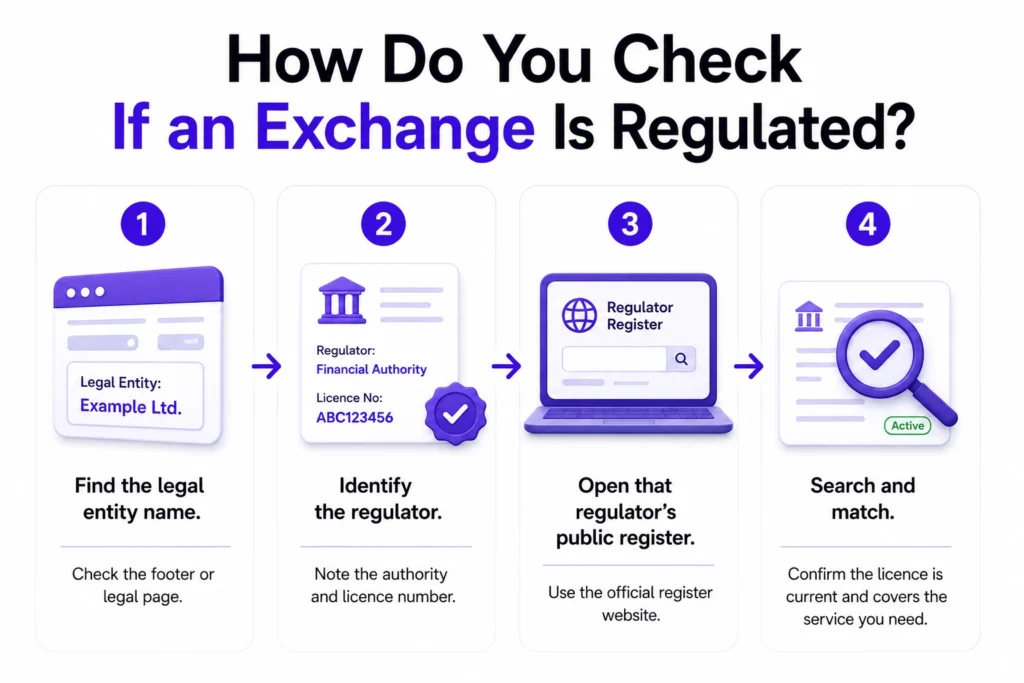
If any step comes up empty, that gap is your answer for now. A licensed platform makes every one of these checks easy.
Where Do You Check, Region by Region?
Where you check depends on where the exchange is licensed. EU platforms appear on the ESMA register, US platforms on FinCEN’s, and UK platforms on the FCA register.
Each region runs its own register, so the right place to look changes with the exchange’s home base.
- In the EU: The ESMA interim CASP register lists every platform with full MiCA authorisation, at esma.europa.eu. The independent tracker at casptracker.eu makes the same data easier to search.
- In the US: FinCEN publishes its Money Services Business register online. State-level Money Transmitter Licences are listed by each state’s banking department.
One detail saves confusion. A licence can cover some services and not others, so confirm the platform is authorised for the thing you want to do, whether that is buying or storing your coins. The CASP glossary entry explains how those service categories work.
What Should the Exchange Itself Show You?
A regulated exchange shows its credentials openly. Look for a named regulator and a licence reference number, usually in the footer or on a dedicated regulatory page.
The exchange’s own site gives you a clue before you even reach a register. Licensed platforms tend to display their status proudly, because it reassures the people they want as customers.
- A named regulator. The page should name the actual authority, such as the Bank of Latvia or Ireland’s Central Bank.
- A licence or registration number. A reference you can paste straight into the register.
- A clear legal entity. The registered company that sits behind the brand name.
When a platform talks about being “fully compliant” with no regulator or number attached, treat that wording as marketing until you can verify it.
What Are the Red Flags of an Unregulated Exchange?
The biggest red flags are a licence you cannot verify and vague compliance claims with no regulator named. Pressure to deposit quickly is another.
Once you know what a real licence looks like, the warning signs stand out.
- No register match. The platform names a regulator, yet you cannot find the entity on that regulator’s list.
- Vague credentials. Words like “compliant” or “regulated” with no licence type or number behind them.
- Withdrawal friction. Reports of long holds or extra hurdles when users try to take their money out.
- Pressure tactics. Urgency around bonuses or limited-time deposits that push you to skip your own checks.
A single red flag might be innocent on its own. Either way, slow down and verify before you move any funds.
What Happens to Your Funds If Your Exchange Is Not Regulated?
On an unregulated platform, you lose the protections that licensing provides, such as fund segregation and a formal complaints process. In the EU, unlicensed platforms also have to stop serving clients after July 1, 2026.
The reason all this checking matters comes down to what sits behind the licence. A regulated exchange has to keep your money separate from its own and answer to a supervisor. An unregulated one gives you neither of those.
In Europe, the stakes rose sharply in 2026. The grandfathering window that let unlicensed platforms keep operating closes on July 1, 2026, with no extension. After that date, any exchange serving EU clients without authorisation is operating outside the law and is expected to wind down. If your platform is missing from the authorised list, the safe move is to transfer your crypto to a licensed platform or your own wallet before the window shuts.
The CASP-authorised exchanges guide and the MiCA-licensed exchanges guide both carry the current list of authorised platforms.
Is Paybis Regulated, and How Can You Verify It?
Yes. Paybis holds MiCA CASP authorisation from the Bank of Latvia, and you can confirm it on the ESMA register like any other licensed platform.
If you want to run the check on Paybis yourself, here is what you will find:
- MiCA CASP authorisation from the Bank of Latvia, which passports across all 27 EU member states.
- PSD2 Payment Institution (PI) licence, also from the Bank of Latvia.
- FinCEN registration in the US. Paybis also holds FINTRAC registration and a VASP registration in Poland.
To confirm it, search the ESMA register for the authorising entity, or read the regulatory details shown on the Paybis site. From there, you can buy crypto and send it to a wallet you control, with every fee shown before you confirm.
Bottom Line
Whether an exchange is regulated is one of the few things in crypto you can confirm for yourself in minutes. Find the regulator, open its register, and search for the platform. The answer is either there or it is not.
Make that check a habit before you deposit anywhere, and most of the risk takes care of itself. If you want a licensed platform you can verify on the ESMA register today, you can buy crypto on Paybis with a card or bank transfer in minutes.
About Paybis
Paybis is a licensed cryptocurrency exchange and on and off-ramp, operating since 2014. It holds MiCA CASP authorisation and a PSD2 Payment Institution licence from the Bank of Latvia. On top of that, it carries FinCEN registration in the US. It also holds FINTRAC registration and a VASP registration in Poland.
The platform serves 7 million users across 180+ countries and supports 90+ cryptocurrencies through 22 payment methods. To date it has handled over $5.5 billion in volume.
On Trustpilot, Paybis holds a 4/5 rating across more than 30,000 reviews. Its mobile apps score 4.6 on the Apple App Store and 4.4 on Google Play. Live chat runs 24/7 and usually replies within 1 to 2 minutes. Paybis is available on web and on mobile through iOS and Android.
FAQ
How long does it take to check if an exchange is regulated?
Usually a couple of minutes. You find the regulator and licence number on the exchange’s site, open that regulator’s public register, and search for the entity. If the platform is licensed, it appears with its status and the services it is allowed to provide.
Can an exchange claim to be regulated when it is not?
Yes, which is exactly why verifying matters. Some platforms use words like “compliant” or “regulated” loosely without holding an actual licence. The public register settles it, because a genuine authorisation always appears there.
Is a registered exchange the same as a regulated one?
Not exactly. Registration usually means a company met basic anti-money laundering checks, while authorisation means a regulator reviewed it in full and granted a licence. Authorisation is the stronger standard and carries the fund-protection rules that registration alone leaves out.
What should I do if my exchange turns out to be unregulated?
Move your funds to a platform that holds a licence, or to a wallet you control. Withdraw your crypto and your cash balance, then close the account. In the EU, this is especially urgent for any platform that misses the July 1, 2026 authorisation deadline.
Disclaimer: Don’t invest unless you’re prepared to lose all the money you invest. This is a high‑risk investment and you should not expect to be protected if something goes wrong. Take 2 mins to learn more at: https://go.payb.is/FCA-Info