PayPal Crypto Regulations And Compliance: What You Need To Know
Key Takeaways: KYC and AML checks are federal and global legal requirements that prevent fraud and unauthorized use of your payment accounts. They protect you. Paybis verifies your identity typically within 15 minutes with a photo ID and selfie. You complete this once. The net received is shown before you complete your purchase. No surprises at checkout. Paybis operates in 180+ countries. PayPal as a payment method on Paybis is available for customers in the European Economic Area (excluding Hungary, Iceland, and Croatia) and the UK. Want to explore crypto options? You can buy Bitcoin with Paybis or learn what Bitcoin dominance is before you start.
You want to buy Bitcoin with PayPal, but identity verification requests feel invasive. We’ll show you why those checks actually protect your money, and how to complete them in about 2 minutes on a fully compliant platform.
Buying crypto with PayPal is fast and convenient, but it requires navigating Know Your Customer (KYC) and Anti-Money Laundering (AML) regulations. If you want to understand how Bitcoin works before diving in, that context helps make sense of why these compliance steps exist. This guide covers the exact documents you need, how your data is protected, and how to complete the process on a platform registered with FinCEN, FINTRAC, and certified PCI DSS Level 1.
Why Crypto Platforms Require Identity Verification
Understanding KYC And AML Rules
KYC and AML are not bureaucratic obstacles invented by crypto platforms. They are legal requirements every regulated financial service must follow.
KYC is the process of confirming who you are, the digital equivalent of showing your driver’s license when you open a bank account. Chainalysis explains that KYC links each transaction to a real, verified person. AML, or Anti-Money Laundering, is the broader framework of rules designed to prevent criminals from using financial services to convert illegally obtained funds. GBG’s KYC and AML guide confirms that non-compliance exposes platforms to substantial fines and the loss of operating licenses.
For you as a buyer, KYC verification does something specific. It creates accountability by linking your identity to your transactions. CoinTelegraph’s breakdown of crypto KYC confirms that verified platforms create accountability at every transaction. KYC Chain’s compliance guide adds that mutual accountability makes verified exchanges meaningfully safer for every user on the platform.
The practical outcome: identity verification is an important fraud-prevention layer, but effective security requires multiple measures, including continuous monitoring, multi-factor authentication, and behavioral analytics working together. If you’re weighing your options, this overview of the safest crypto exchanges and their security features is worth reading before you choose a platform.
PayPal Native Crypto vs. Paybis: Compliance and Features Compared
Regional Availability And Transaction Limits
PayPal’s crypto service, enabled through a partnership with Paxos Trust Company, is available primarily in the US and UK for crypto holdings. PayPal has expanded its PYUSD stablecoin to approximately 70 countries as of early 2026, as ValueTheMarkets reports. For users in Latin America, Southeast Asia, Africa, or Eastern Europe, PayPal’s native crypto options are limited.
Paybis operates in 180+ countries. PayPal as a payment method on Paybis is available for customers in most European Economic Area countries (excluding Hungary, Iceland, and Croatia) and the UK. If you want to understand the full scope of PayPal crypto purchase limits before committing to either platform, that guide breaks down the specifics in detail.
Custodial Wallets vs. Self-Custody
This is the most important structural difference between the two options.
PayPal’s native crypto service uses a custodial model. When you buy crypto through PayPal, PayPal holds your private keys through its arrangement with Paxos. You depend on their systems to retrieve your funds. PayPal supports transfers to external wallets and exchanges with a $25,000 weekly limit, though new purchases have a 48-hour hold before transfer.
Paybis sends cryptocurrency directly to any external wallet address you provide, giving you full control over your funds. Alternatively, the Paybis custodial wallet holds your crypto until you are ready to move it. When you are ready to take full self-custody, you withdraw to your own external wallet at any time. Understanding why Bitcoin has value can help clarify why self-custody matters so much to long-term holders.
Here is a side-by-side comparison:
| Feature | PayPal Native Crypto | Paybis | Why It Matters |
|---|---|---|---|
| Regional availability | Primarily US, UK (PYUSD expanding to ~70 countries) | 180+ countries | Critical for non-US/UK users |
| KYC requirements | Government ID, SSN (US users), proof of address | Typically photo ID + selfie | Streamlined verification process |
| Wallet type | Custodial only (Paxos holds keys) | Reportedly custodial wallet with external withdrawal option | External withdrawals reportedly give direct control |
| Fee transparency | Spread embedded in exchange rate + transaction fee | Fees reportedly itemized before confirmation | Reportedly see exact total before confirming |
| Cryptocurrencies | Bitcoin, Ethereum, Litecoin, Bitcoin Cash, PYUSD | Reportedly 90+ cryptocurrencies | Reportedly broader selection |
| Processing speed | Instant for crypto purchase | Reportedly payment instant; crypto delivery 5–15 minutes | Both reportedly fast for purchases |
Required Documents And Verification Timeframes
What You Need For PayPal
To buy or hold crypto through PayPal’s native service, you typically need your full name, address, and date of birth already on your PayPal account, plus a government-issued ID (passport or driver’s license). For US users, PayPal may request your SSN under certain account conditions. Proof of address such as a utility bill may also be required depending on your region and account history.
What You Need For Paybis
Paybis verification is designed to be fast. According to Paybis’s KYC documentation, you need:
- A valid government-issued photo ID (passport, driver’s license, or national ID card)
- A selfie to confirm you are the person in the document
That is it for most users. Verification typically completes in 2-5 minutes for most users, and you only go through this process once. The Paybis KYC verification walkthrough shows the exact screen-by-screen process. A detailed KYC process overview from TradingFinder provides additional context if you want to see the full flow before starting. Complex cases requiring manual review may take up to 15 minutes.
Users consistently report the experience as faster than expected. Joon Huh described the onboarding on Trustpilot:
“Onboarding: Fast and transparent. Identity verification is well explained with clear progress indicators, reducing anxiety.” – Joon Huh on Trustpilot
Fee Transparency: What You Actually Pay
Hidden fees are one of the most common complaints about crypto platforms. Paybis shows every fee component before you confirm payment.
Here is the exact fee structure for a Paybis transaction, per Paybis fee documentation:
- Service Fee: Starts from 1.49% (your first card transaction carries 0% Service Fee)
- Processing Fee: 4.5-8.5% for card transactions over $50 (rate depends on currency)
- Network Fee: Variable based on blockchain demand. This fee goes to miners who process transactions, and Paybis does not control it. The Paybis help documentation on external fees explains exactly what falls outside platform control.
After your first transaction, a $500 purchase would cost approximately $531-$555 total: Service Fee $7.45 (1.49%) + Processing Fee $22.50-$42.50 (4.5-8.5%) + Network Fee variable by current blockchain conditions.
PayPal’s native crypto fees work differently. PayPal embeds a spread in the rate plus charges a transaction fee that varies by purchase size, ranging from approximately 2.3% for small amounts to around 1.5% for purchases above $1,000. The spread is embedded within the exchange rate rather than displayed as a separate line item. For PYUSD, PayPal charges no fee to buy or sell, but fees apply when converting PYUSD to other cryptocurrencies.
Paybis shows the itemized total before you click confirm. What you see is what you pay. If you’re also comparing platforms more broadly, the best Bitcoin trading platforms guide provides a useful wider-market perspective on fee structures.
“I especially appreciate the transparent fee structure, no hidden costs or surprises.” – Vladimir Z. on G2
The 99Bitcoins Paybis review and the FXEmpire Paybis analysis both independently confirm that fee disclosure before payment confirmation is a consistent platform feature.
How We Protect Your Data And Funds
Regulatory Registrations And Security Standards
Paybis holds the following active regulatory registrations and certifications, which you can verify independently through Paybis compliance documentation:
- FinCEN (US Money Services Business): US entity #31000272911973, PL entity #31000277275964
- FINTRAC (Canada): PL entity C100000816, CA entity C100000646, registration M22061209
- VASP Registration, Revenue Chamber in Katowice, Poland: RDWW-805
- PCI DSS Level 1 compliant: The highest standard for handling credit card data
These registrations mean Paybis is subject to regular audits and compliance requirements from multiple regulatory bodies. The platform has operated since 2014 with no security breaches, serving 5M+ retail users across 180+ countries. The Paybis security overview on YouTube walks through exactly what security measures protect your transactions. Paybis holds 30,780+ Trustpilot reviews rated “Great”.
“I’ve been using Paybis for over a year now. I’m brand new this crypto stuff, but this company has been straightforward, easy to use, and reliable.” – MOOSE on Trustpilot
What Happens If A Transaction Is Rejected?
Transactions are sometimes rejected for security and compliance reasons. This is not a penalty. It is the same logic your bank applies when it declines a transaction that looks unusual.
If your transaction is rejected, here is what happens according to Paybis rejected transaction support documentation:
- Funds are not lost. The authorization hold on your card is released.
- Card holds resolve per your bank’s timeline. Most banks reflect the change within a few business days.
- Try again after 24 hours. Contact support if you need guidance on next steps.
- Live support is available immediately. 24/7 chat connects you to a human in approximately 15 seconds.
How To Buy Crypto With PayPal On Paybis
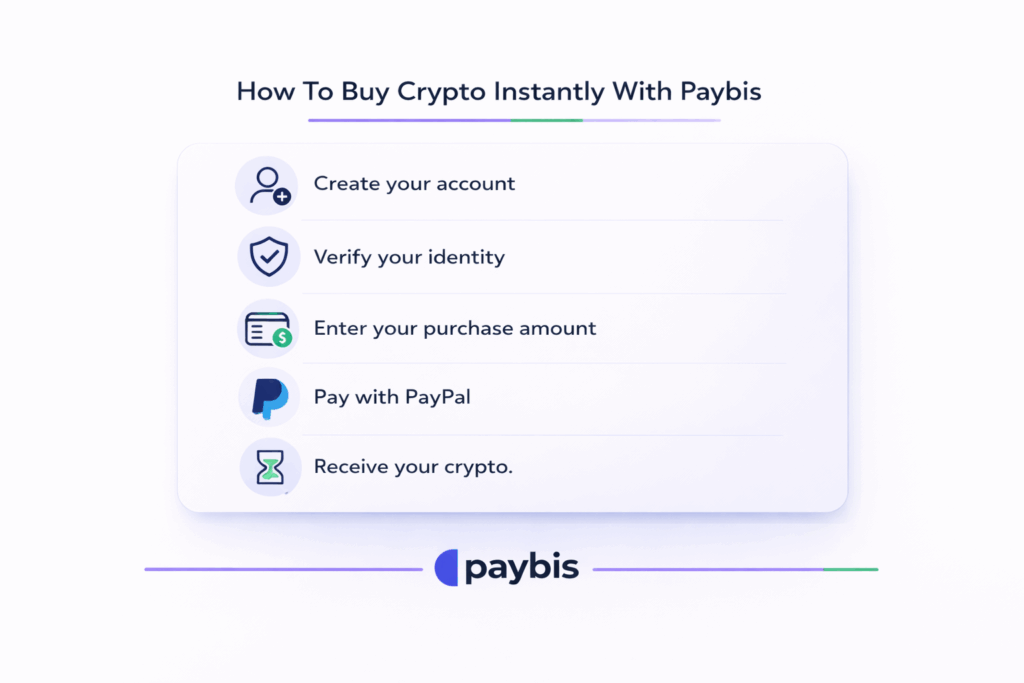
The full process from account creation to crypto in your wallet takes most users under 15 minutes. Here is exactly how it works, as shown in the Paybis PayPal beginner guide:
- Select your amount: Use the Paybis calculator to enter how much you want to spend. Every fee (Service, Processing, Network) is shown before you proceed.
- Verify your identity: Upload a government-issued photo ID and take a selfie. This takes about 2 minutes and is a one-time requirement.
- Pay with PayPal: Choose PayPal as your payment method and complete the payment. The payment itself processes instantly.
- Receive your crypto: Paybis sends your crypto to your chosen wallet address. Delivery typically takes 5-15 minutes after payment confirmation.
One important note: crypto transactions are irreversible once confirmed on the blockchain. Verify your wallet address carefully before confirming. Paybis wallet transfer documentation explains the steps and common precautions in detail. If you’re thinking about how frequently to make purchases after you get started, the guide on how often you should buy Bitcoin covers different strategies worth considering.
“I value the feature that allows me to buy crypto with my card and have it sent directly to my wallet, offering a streamlined and direct process that removes unnecessary steps and complexity.” – Denis I. on G2
Ready to start? Create your Paybis account, complete the 2-minute identity verification, and see your full cost breakdown before you confirm a single payment.
Key Terminology
- KYC (Know Your Customer): The identity verification process required by law for financial platforms. For crypto, this means providing a government-issued photo ID and a selfie to prove you are who you say you are.
- AML (Anti-Money Laundering): The framework of laws and rules designed to prevent criminals from using financial services to disguise illegally obtained funds. Regulated crypto platforms follow AML rules by monitoring transactions and verifying user identities.
- Custodial Wallet: A wallet where the platform holds the private keys to your crypto on your behalf. Paybis provides a custodial wallet option, and users can withdraw to any external self-custody wallet at any time.
- Network Fee: The fee paid to blockchain miners to process and confirm your transaction. This fee is not set by Paybis or PayPal. It varies based on how busy the blockchain network is at the time of your transaction.
- PCI DSS Level 1: The highest security certification standard for platforms that handle credit card data, meaning Paybis card payment infrastructure meets the strictest global data protection requirements.
FAQ
How long does Paybis identity verification take?
Verification takes about 2 minutes for most users with a valid government-issued photo ID and a selfie. You complete this process once.
Does Paybis show fees before I pay?
Yes. The Service Fee (from 1.49%), Processing Fee (4.5-8.5% for card transactions over $50), and Network Fee all display before you confirm. Your first card transaction carries a 0% Service Fee.
Does Paybis show fees before I pay?
Yes. The Service Fee (from 1.49%), Processing Fee (4.5-8.5% for card transactions over $50), and Network Fee all display before you confirm. Your first card transaction carries a 0% Service Fee.
Is Paybis available in my country for PayPal purchases?
Paybis operates in 180+ countries. PayPal as a payment method is currently available for customers in the European Economic Area (excluding Hungary, Iceland, and Croatia) and the UK.
What happens to my money if my transaction is rejected?
The authorization hold on your card is released, with your bank typically reflecting the change within a few business days. Contact 24/7 live support for immediate help or try again after 24 hours.
Disclaimer: Don’t invest unless you’re prepared to lose all the money you invest. This is a high‑risk investment and you should not expect to be protected if something goes wrong. Take 2 mins to learn more at: https://go.payb.is/FCA-Info