How to Buy Crypto in the UK: A Step-by-Step Guide (2026)
- Buying bitcoin or other cryptocurrencies in the UK is fully legal. Platforms must be registered with the FCA for anti-money laundering compliance
- The UK’s full crypto licensing regime was passed by Parliament in February 2026, but does not come into force until October 2027
- HMRC taxes crypto gains at 18% for basic rate taxpayers and 24% for higher rate taxpayers, above a £3,000 annual allowance
- Crypto-to-crypto swaps are taxable in the UK. Swapping Bitcoin for Ethereum counts as a disposal
- On Paybis, your first purchase of each cryptocurrency carries a 0% service fee, and support responds in 1 to 2 minutes
The UK has one of the most active crypto markets in Europe. According to the FCA’s own research, around 12% of UK adults held crypto assets in 2024. That number has been rising every year.
The regulatory picture is changing, too. Parliament passed the Financial Services and Markets Act 2000 (Cryptoassets) Regulations 2026 in February, which will bring crypto under the same licensing framework as traditional financial services. The full regime kicks in October 2027, but the direction is clear: the FCA is building a comprehensive rulebook, and the platforms operating in the UK today are already working toward it.
For buyers, the process itself has always been straightforward. Pick a platform, verify your identity, fund your account, and buy. This guide covers each step, what payment methods work in the UK, how HMRC taxes your gains, and how to store what you buy.
Before we get into it, Paybis is FCA-registered and lets you buy Bitcoin, Ethereum, USDT, and Solana, and other 90+ other cryptocurrencies with a credit or debit card in minutes, with real human support available around the clock.
Is it legal to buy crypto in the UK?
Yes. Buying, holding, and selling crypto is legal in the UK. Platforms serving UK users must be registered with the FCA under the Money Laundering Regulations, and the FCA has been regulating crypto financial promotions since 2023.
The UK left the EU in 2020. MiCA, the EU’s crypto regulation that came into force in December 2024, does not apply here. The UK is building its own framework under the FCA.
That framework is now law. The Financial Services and Markets Act 2000 (Cryptoassets) Regulations 2026 was made by Parliament on 4 February 2026. The FCA’s application gateway for crypto firms opens on 30 September 2026, and the full licensing regime comes into force on 25 October 2027.
Until then, platforms must be on the FCA’s AML register to operate legally in the UK. Any platform that isn’t on that register is operating outside UK law.
What do you need before buying crypto in the UK?
To buy crypto in the UK, you need a government-issued ID, a payment method, and an email address. Verification typically takes 5 to 10 minutes.
Here’s what to have ready:
- Government-issued ID: Passport or UK driving licence
- A working email address: For account creation and transaction records
- A payment method: Credit card, debit card, or bank transfer
- A phone number: Most platforms require SMS verification
You don’t need a crypto wallet before your first purchase. Buying directly to a platform account is how most UK buyers start. Moving to self-custody becomes relevant once your holdings grow.
How do you buy crypto in the UK step by step?
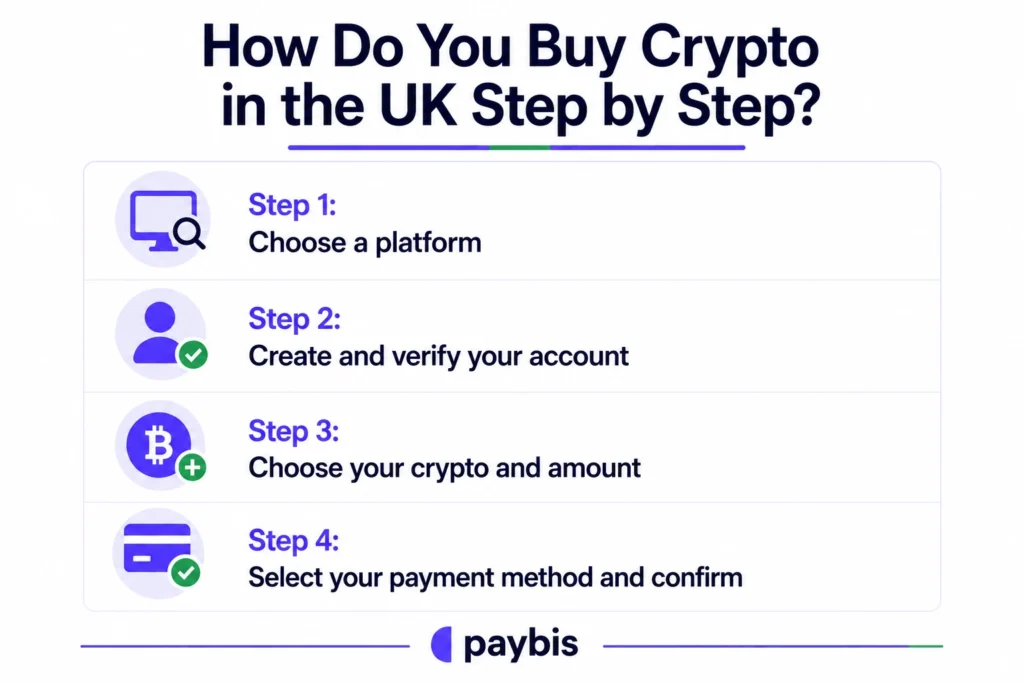
Four steps: choose an FCA-registered platform, verify your identity, select your cryptocurrency and amount, then complete your purchase.
Step 1: Choose a platform
Look for a platform that is on the FCA’s crypto register. Paybis is FCA-registered, supports GBP purchases with credit and debit cards, and has 24/7 human support with a 1 to 2 minute response time.
Step 2: Create and verify your account
Sign up with your email and complete KYC. You’ll upload a photo of your ID and take a selfie. The process takes 5 to 10 minutes on most platforms.
Step 3: Choose your crypto and amount
Decide what you want to buy and how much you want to spend in GBP. Every cryptocurrency is divisible. You can start with £30 if that’s where you’re comfortable, and buy a fraction of a coin rather than a whole one.
Step 4: Select your payment method and confirm
Choose your card or bank transfer, review the fees, and confirm. Your crypto lands in your platform account or gets sent to a wallet address you specify. The first purchase takes the longest because of KYC. After that, it takes minutes.
Buy crypto easily. Buy it fast. Paybis is FCA-registered and supports GBP purchases across 90+ cryptocurrencies, with real human support available 24/7.
What payment methods can you use in the UK?
UK buyers can use a credit card, a debit card, or a bank transfer on Paybis. Card purchases go through in minutes. Bank transfers are slower but cheaper for larger amounts.
Credit card
The fastest option. Your purchase processes immediately, which is useful when markets are moving. Fees typically run between 4.5% and 8.5%. Some UK banks decline crypto purchases on credit cards, so it’s worth a quick check before you try.
Debit card
Works the same way as a credit card in terms of speed. Most UK Visa and Mastercard debit cards are accepted. Fees sit in a similar range to credit cards.
Bank transfer
Slower than card, typically taking 1 business day, but the most cost-effective option for purchases above £500. For larger amounts, the fee difference relative to card payments adds up. See our full breakdown of payment methods for buying crypto to compare every option side by side.
What cryptocurrencies can you buy in the UK?
UK residents can buy 90+ cryptocurrencies on Paybis, including Bitcoin, Ethereum, USDT, Solana, XRP, and Litecoin.
The UK is one of the largest crypto markets in Europe by volume. Bitcoin and Ethereum account for the majority of purchases, but demand for stablecoins and established altcoins has grown steadily.
The most commonly bought cryptocurrencies in the UK:
- Bitcoin (BTC): The largest by market cap and the most widely held globally
- Ethereum (ETH): The foundation of most decentralised applications and smart contracts
- USDT (Tether): A stablecoin pegged to the US dollar, widely used for holding value without converting back to GBP
- Solana (SOL): One of the fastest blockchains, with a growing developer and user base in Europe
- XRP: Used for cross-border payments, popular across UK and EU markets
- Litecoin (LTC): An older alternative to Bitcoin with faster transaction settlement
For first-time buyers, Bitcoin and Ethereum are the standard entry point. They have the deepest liquidity and the longest track record.
Do you pay taxes on crypto in the UK?
Yes. HMRC treats crypto as property. Capital Gains Tax applies when you sell, trade, or spend it. The rates changed on 30 October 2024 and now sit at 18% for basic rate taxpayers and 24% for higher and additional rate taxpayers.
The annual CGT allowance for 2025/26 and 2026/27 is £3,000. Gains below that threshold in a given tax year are not taxed. If your total disposals in a year exceed £50,000, you must report them to HMRC even if your gain falls under the allowance.
Here’s what triggers a taxable event in the UK:
- Selling crypto for GBP: The gain over your cost basis is taxable
- Swapping one crypto for another: Trading Bitcoin for Ethereum counts as disposing of Bitcoin. The GBP value at the time of the swap is used to calculate the gain
- Spending crypto: Using crypto to pay for goods or services is treated as a disposal
- Receiving crypto as income: Payment for work in crypto is taxed as income at your marginal rate
Holding crypto and transferring it between your own wallets are not taxable events.
HMRC uses three specific cost basis rules in this order: the same-day rule, the 30-day bed and breakfasting rule, and Section 104 pooling. You cannot choose which coins you sold to minimise your gain.
From 1 January 2026, CARF requires all UK crypto exchanges to automatically report user transaction data to HMRC. First reports cover the full 2026 calendar year and are due to HMRC between January and May 2027. Undeclared crypto gains are becoming significantly harder to conceal.
Report crypto gains on your Self Assessment tax return. The online filing deadline is 31 January following the tax year. Our guide on Bitcoin taxes covers the calculation method in detail.
How do you store crypto safely in the UK?
You have two options: keep it on the platform where you bought it (custodial), or move it to a wallet you control (self-custody). Both work. The choice comes down to how much you hold and your appetite for managing your own keys.
Custodial storage (on-platform)
The platform holds your private keys. Convenient, beginner-friendly, and recoverable if you lose access. Paybis has served 5M+ users since 2014, with a Trustpilot score of 4/5 across 30,000+ reviews. For most first-time buyers, starting here makes sense.
The risk is platform-side. If an exchange has security issues or becomes insolvent, your access to funds could be affected. This is why asset segregation matters when choosing a platform.
Self-custody (your own wallet)
You hold the private keys. A software wallet like MetaMask works well for smaller amounts. For larger holdings, a hardware wallet keeps your keys entirely offline. Our guide to custodial and non-custodial wallets explains the tradeoffs in full.
The principle most experienced holders follow: whoever holds the private keys owns the crypto. The more you accumulate, the more that matters.
What fees should you expect?
On Paybis, the service fee is 0% on your first purchase of each cryptocurrency, and 1.49% on subsequent purchases of the same coin. The processing fee ranges from 4.5% to 8.5% depending on your payment method.
| Fee Type | Amount |
|---|---|
| Paybis service fee (1st purchase per asset) | 0% |
| Paybis service fee (subsequent purchases) | 1.49% |
| Processing fee (card or bank transfer) | 4.5% to 8.5% |
| Network fee | Dynamic, based on real-time blockchain conditions |
Beyond those, watch for:
- Spread: The gap between the buy and sell price. Some platforms advertise zero fees but compensate by widening the spread.
- Network fee: Charged by the blockchain when you move crypto to an external wallet. Varies by network and congestion at the time.
- Withdrawal fee: Some platforms charge a fee to send crypto to an external address.
The clearest comparison method: check how much crypto you receive for a fixed GBP amount, not just the headline fee rate. Our guide on hidden crypto fees breaks down every charge worth knowing about.
Bottom Line
Buying crypto in the UK in 2026 is legal, well-supported by established platforms, and getting more regulated by the month. The FCA’s full licensing regime is coming in October 2027. CARF means HMRC now gets exchange data automatically. And the tax rules are clear: 18% or 24% CGT, a £3,000 annual allowance, and crypto-to-crypto swaps are taxable disposals.
The process itself takes four steps. Choose an FCA-registered platform, verify your identity, fund your account, and make your first purchase. On Paybis, that means 0% service fee on your first buy of each cryptocurrency, 90+ coins available across web, iOS, and Android, and a real person available to help in under 2 minutes.
Simple. Fast. Human.
Buy crypto in the UK today. Paybis is FCA-registered. Credit and debit card supported. Real support, real fast.
FAQ
Does the UK use MiCA?
No. The UK left the EU in 2020 and MiCA does not apply here. The UK is building its own regulatory framework under the FCA. The Financial Services and Markets Act 2000 (Cryptoassets) Regulations 2026 was passed by Parliament in February 2026, and the full licensing regime comes into force on 25 October 2027. Until then, platforms must hold FCA registration under the Money Laundering Regulations to operate legally.
Can HMRC see my crypto transactions?
Yes. As of 1 January 2026, all UK crypto exchanges must collect and report user transaction data to HMRC under CARF. First reports, covering the entire 2026 calendar year, are due between January and May 2027. HMRC also has the power to assess up to 20 years of historical gains for deliberate non-disclosure, with penalties reaching up to 200% of tax owed.
Is crypto-to-crypto trading taxable in the UK?
Yes. HMRC treats every crypto-to-crypto swap as a disposal. When you trade Bitcoin for Ethereum, HMRC calculates the GBP value of the Bitcoin at the time of the trade and compares it to your cost basis. Any gain is subject to Capital Gains Tax. This is different from France, where crypto-to-crypto swaps are not taxable.
What is the minimum amount I can buy on Paybis in the UK?
Paybis sets a minimum purchase of around £20 to £30 depending on the cryptocurrency. You don’t need to buy a whole unit of any coin. Bitcoin, Ethereum, and every other major cryptocurrency are fully divisible, so you can start with whatever amount fits your situation.
What happens if I buy crypto and the price drops?
A capital loss. If you sell crypto for less than you paid, HMRC allows you to record the loss and carry it forward to offset future gains. Losses can be carried forward indefinitely. You still need to report them on your Self Assessment return to register them with HMRC.
Disclaimer: Don’t invest unless you’re prepared to lose all the money you invest. This is a high‑risk investment and you should not expect to be protected if something goes wrong. Take 2 mins to learn more at: https://go.payb.is/FCA-Info