Solana vs Ethereum in 2026: Speed, Fees, and Which One Fits Your Goals
Key Takeaways
- Ethereum holds $55.6 billion in DeFi TVL, representing 68% of the global DeFi market. Solana holds around $8 billion.
- Solana processes 5,000+ TPS at $0.00025 per transaction. Ethereum L1 handles 15–30 TPS at $0.10–$0.30 per transaction.
- Solana’s weekly DEX volume of $11.49 billion exceeds Ethereum’s $7.62 billion. More trades happen on Solana. More capital sits on Ethereum.
- Ethereum has 31,869 active developers. Solana has 17,708. Both numbers are growing.
- Ethereum L1 has never experienced unplanned downtime. Solana’s last major outage was February 2024.
- You can buy Ethereum and buy Solana on Paybis with fees shown upfront before you confirm.
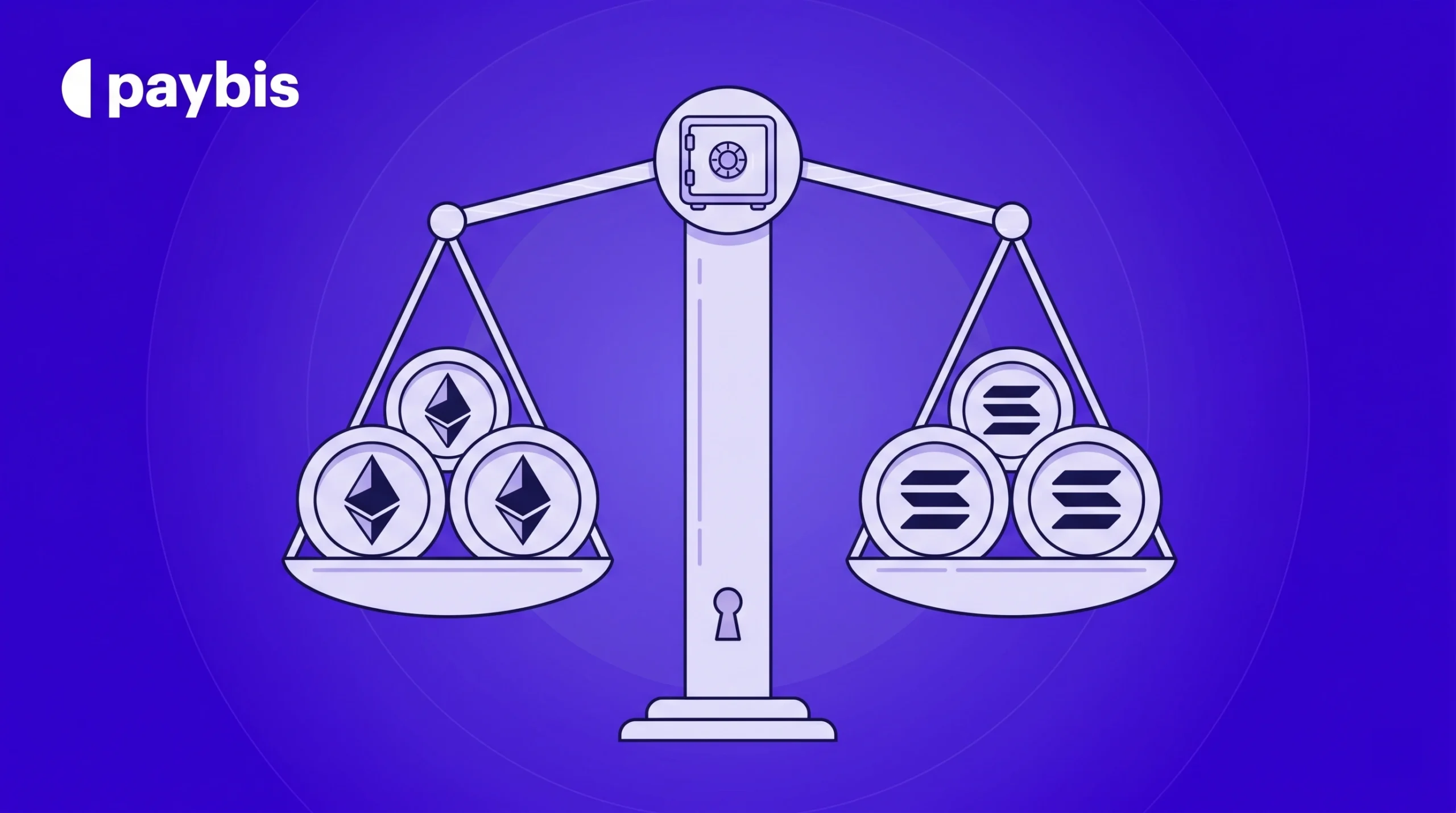
Two years ago, the Solana vs Ethereum debate was a contest. In 2026, it became a division of labor. Ethereum is where large DeFi positions and institutional capital sit. Solana is where daily trading activity and consumer applications run. Both are growing and have significant ecosystems. The question worth asking is which one fits what you are actually trying to do.
This comparison covers speed, fees, DeFi size, developer activity, and what the data says about each chain’s trajectory in 2026.
What Is the Core Difference Between Ethereum and Solana in 2026?
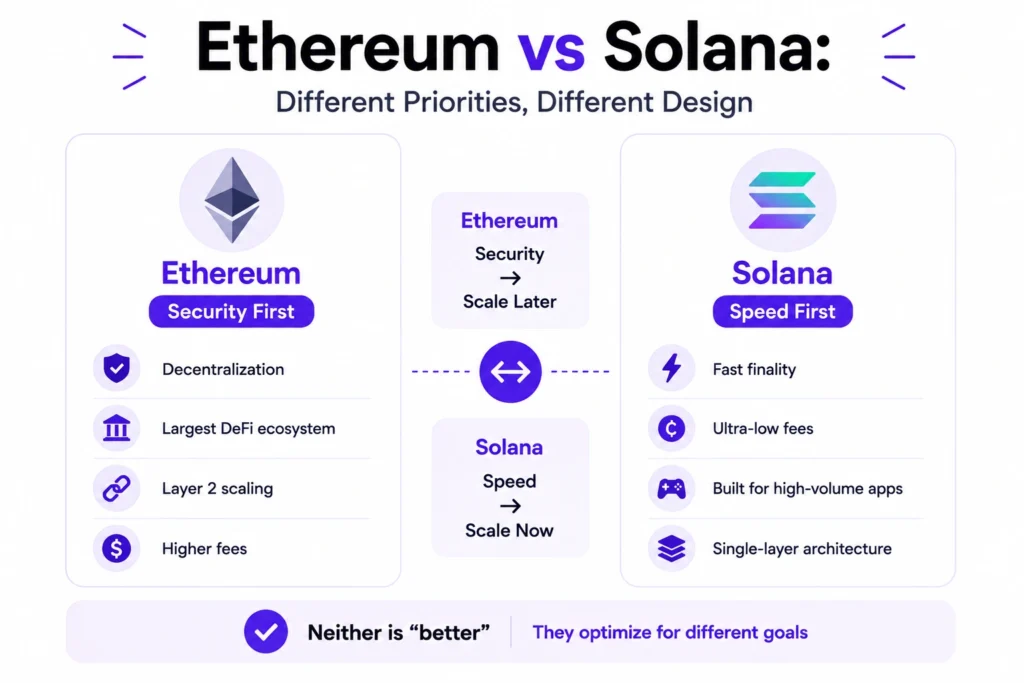
Ethereum was built around a belief: that the most important property of a financial network is that it cannot be stopped or controlled. Security and decentralization came first. Speed and cheap transactions were problems to solve later, through Layer 2 networks like Arbitrum and Base that process transactions quickly and settle the results back to Ethereum.
That decision is now nine years old. It is also why $55.6 billion in DeFi capital currently sits on Ethereum. People who trust a network with large amounts of money tend to prioritize that it will still be there tomorrow.
Solana started from a different place. The internet runs fast and is cheap. A blockchain should, too. Anatoly Yakovenko designed a single-layer network where execution, settlement, and storage all happen in one place, without the complexity of routing transactions through separate layers. The result is $0.00025 in fees and finality in under 150 milliseconds. Fast enough for an on-chain order book. Fast enough for a game. Fast enough to charge someone a fraction of a cent for a single interaction. The Alpenglow upgrade in 2026 pushed that finality window down further. The Firedancer validator client gave the network a second independent implementation of its software, reducing the risk that a single bug can take the whole thing down.
Neither approach is wrong. They reflect different priorities, built by different teams for different visions of what a blockchain should be.
Which Is Faster and Cheaper in 2026?
On raw speed and cost, Solana wins clearly. Here is what the numbers look like side by side:
Solana:
- 5,000–5,500 transactions per second
- Average fee: $0.00025 per transaction
- Finality: 100–150 milliseconds (Alpenglow upgrade)
- Fees stay flat during congestion due to local fee markets
Ethereum:
- 15–30 transactions per second on L1
- L1 fees: $0.10–$0.30, spiking higher during high demand
- L2 fees: often under $0.05 after Pectra and Fusaka upgrades
- Full finality on L1 takes several minutes
Even the cheapest L2 options on Ethereum are 100 to 1,000 times more expensive than Solana. For small, frequent transactions, that gap is significant. For large, infrequent transactions where finality and security matter more than cost, the comparison looks different.
Which Has the Larger Ecosystem?
This depends entirely on how you measure size. The data tells two different stories depending on which metric you look at.
Where Ethereum leads:
- DeFi TVL: $55.6 billion (68% of the global $94B DeFi market)
- EigenLayer restaking: $16.25 billion alone
- Weekly DEX volume: $7.62 billion
- Daily active addresses: 530,000
Where Solana leads:
- Weekly DEX volume: $11.49 billion
- Daily active addresses: 3.6 million
- DeFi TVL: ~$8 billion (growing, but a fraction of Ethereum’s)
One way to frame it: Ethereum is the deposit ledger. Solana is the trading floor. Both descriptions are accurate.
NFTs, consumer apps, payments, and DePIN projects are where Solana has established clear dominance. Institutional DeFi, regulated financial products, and large-capital deployments remain Ethereum’s territory.
Which Has More Developer Activity?
Ethereum leads on developer count. Electric Capital’s data puts Ethereum’s active developer count at 31,869, compared to Solana’s 17,708. Both numbers have grown consistently. Ethereum’s lead reflects its nine-year head start and the depth of tooling, documentation, and infrastructure built around EVM-compatible development.
Solana’s developer growth rate has been one of the more notable stories in the ecosystem over the past two years. The combination of lower fees, faster transactions, and improved tooling around Rust and the Solana Virtual Machine has attracted builders focused on consumer-facing applications and high-throughput use cases.
The practical effect of the developer count on a user’s choice between chains is indirect. A larger developer community means more applications, more tooling, and more liquidity. On both metrics, Ethereum maintains a meaningful lead, though Solana is closing the gap in specific verticals.
How Has Each Network Performed on Reliability?
Ethereum L1 has never experienced unplanned downtime. That record, maintained across nine years of operation and multiple periods of extreme market stress, carries significant weight for institutions managing large capital positions. Settlement finality that can be relied upon absolutely is a different kind of asset than one that performs well most of the time.
Solana’s reliability history is more complicated. Between 2021 and 2023, the network experienced multiple significant outages. The most recent major incident occurred on February 6, 2024, when the mainnet halted for approximately five hours after a bug triggered a cascade of failures requiring validators to coordinate a manual restart. Since then, Solana has maintained 99.9%+ uptime through 2024 and 2025. The Firedancer validator client, which provides a second independent implementation of the protocol, is designed to reduce the risk of a single software bug taking down the entire network.
For users making everyday DeFi trades, the current reliability record is strong enough to be a minor consideration. For institutions or developers building applications where downtime is genuinely costly, Ethereum’s unbroken uptime record remains a differentiating factor.
How Have Ethereum and Solana Performed in 2026?
As of mid-2026, here is where both assets stand:
Ethereum:
- Price: $2,300–$2,400
- Market cap rank: #2
- Spot ETFs: available, with growing institutional inflows
- Major upgrades: Pectra and Fusaka; “Lean Ethereum” roadmap
- Active developers: 31,869
Solana:
- Price: $82–$89
- Market cap rank: #7
- Spot ETFs: available
- Major upgrades: Alpenglow (fast finality), Firedancer (validator client)
- Active developers: 17,708
Both chains are in active development, and both have meaningful institutional access through regulated ETF products. This article does not offer investment advice. Both assets carry risk, and past performance does not indicate future results. A financial adviser familiar with your circumstances is the right resource for decisions about allocation.
How Do Ethereum and Solana Differ by Use Case?
The data points to clear patterns in how each chain is actually being used.
Solana is dominant in:
- Retail DeFi trading (weekly DEX volume: $11.49B)
- Consumer applications and mobile-first crypto
- NFT minting and trading
- DePIN (decentralized physical infrastructure networks)
- Micropayments and high-frequency interactions
The sub-cent transaction cost makes all of this viable. At $0.00025 per transaction, frequent small interactions are economical in a way they simply are not on Ethereum L1.
Ethereum is dominant in:
- Large-capital DeFi positions ($55.6B TVL)
- Regulated financial products and institutional deployments
- Applications built on the deepest developer ecosystem in crypto
- Settlement for Layer 2 applications
The $55.6 billion in TVL sitting on Ethereum reflects capital placed there deliberately by users and institutions who prioritize security and finality over speed.
In practice, both chains coexist within the same broader market. Many applications and users interact with both rather than committing exclusively to one.
Where Can You Buy Ethereum and Solana?
Both Ethereum and Solana are available on Paybis across 22 payment methods, including card, SEPA, Klarna, Apple Pay, Google Pay, and PayPal.
You can buy Ethereum with fees shown before you confirm the transaction. The same applies when you buy Solana. There is no hidden fee revealed at the last step. You can also buy Bitcoin and 90+ other cryptocurrencies on the same platform.
Paybis has operated since 2014, holds the MiCA CASP licence covering all 27 EU member states, and serves 6.9 million+ users across 190+ countries. Verification takes under two minutes for amounts above $1,000, and 24/7 live chat is available if you need help at any point.
Bottom Line
Ethereum and Solana are the two leading smart contract platforms in 2026, and the data shows them winning at different things. Ethereum holds the capital. Solana drives the activity. The $55.6 billion in Ethereum DeFi TVL and the 31,869 active developers reflect an ecosystem built for depth and security. Solana’s 3.6 million daily active addresses, $11.49 billion in weekly DEX volume, and sub-cent fees reflect a chain built for speed and consumer use. Both are growing. Both have institutional access through spot ETFs. What each one is used for follows from its architecture.
FAQ
Is Solana faster than Ethereum in 2026?
Yes. Solana processes 5,000 to 5,500 transactions per second with finality in 100 to 150 milliseconds. Ethereum L1 processes 15 to 30 transactions per second with full finality taking several minutes. Ethereum’s L2 networks offer faster soft finality but still settle to the L1, which adds time for applications where final settlement matters. For everyday transactions, both chains are fast enough that users rarely notice the difference in practice. For high-frequency applications like on-chain order books, Solana’s speed is a genuine architectural advantage.
Does Ethereum have more DeFi than Solana?
By a significant margin, yes. Ethereum holds approximately $55.6 billion in DeFi TVL as of early 2026, compared to Solana’s approximately $8 billion. Ethereum also accounts for 68% of the global DeFi market’s total value locked. On trading volume, the picture is different: Solana’s weekly DEX volume of $11.49 billion exceeds Ethereum’s $7.62 billion. More trades happen on Solana. More capital sits on Ethereum. Both statements are accurate and they reflect two different things about the respective ecosystems.
How do Ethereum and Solana differ for beginners?
Both are accessible to beginners through the same exchanges and wallet interfaces. Solana’s lower transaction fees make small-scale experimentation cheaper, which reduces the cost of learning through trial and error. Ethereum’s larger ecosystem means more tutorials, documentation, and support resources exist. For someone exploring DeFi with small amounts, Solana’s fee structure reduces the cost of each interaction. For someone who wants access to the widest range of established applications, Ethereum’s ecosystem is larger. Many users end up active on both over time.
Does Solana have a spot ETF in 2026?
Yes. Solana spot ETFs are available in 2026, giving institutional and retail investors regulated access to SOL exposure without holding the asset directly. Ethereum’s spot ETFs have been available since 2024 and have seen meaningful institutional inflows. The availability of regulated ETF products for both chains has contributed to increased institutional participation in both ecosystems.
Will Solana overtake Ethereum?
In terms of DeFi TVL, Solana has not overtaken Ethereum and the gap remains large. In terms of daily active users and DEX volume, Solana has already surpassed Ethereum by those measures. Which metric you weight most heavily determines how you frame the competition. The more useful framing for most people is probably less about overtaking and more about which chain grows the specific applications they care about.
Disclaimer: Don’t invest unless you’re prepared to lose all the money you invest. This is a high‑risk investment and you should not expect to be protected if something goes wrong. Take 2 mins to learn more at: https://go.payb.is/FCA-Info