Swapping Crypto When Markets Are Volatile: Timing Strategy for Beginners
Key Takeaways:You do not need professional trading skills to swap crypto safely during market chaos. Use dollar-cost averaging (DCA) to exit positions gradually, choose platforms that show all fees upfront, and swap volatile assets into stablecoins like USDT to lock in value. The two biggest traps are swapping during breaking news (when slippage spikes above 5%) and using platforms that hide costs in the spread. This guide covers practical timing signals, DCA mechanics, and how to avoid hidden fees.
When Bitcoin drops 10%+ in a single day, the instinct to move into a stablecoin (a crypto designed to hold a steady $1 value, like USDT) is right. But most beginners lose money during that swap, not to the market, but to hidden fees, bad timing, and platforms that show one price and charge another. If you want to act fast, the Bitcoin calculator lets you see your exact swap value before you commit, and you can buy BTC with PayPal to move into safety quickly. For Ethereum holders, the Ethereum calculator works the same way.
This guide breaks down exactly how to swap safely when prices move fast, without reading a single trading chart.
Explaining Sudden Crypto Value Changes
How to Read Volatility Indicators
Volatility is simply how much a price moves over a set period. For crypto, the easiest number to watch is the 24-hour percentage change, displayed on apps like CoinMarketCap and CoinGecko right next to every coin’s price. No charts needed.
If Bitcoin moves 3% in a day, that’s typical volatility for crypto markets. If it moves 10%+ in a single session, that is a signal to pause before making any swap decision. Our guide on how often Bitcoin value changes gives a useful baseline for what “normal” looks like across different market conditions.
Everyday vs. Wild Price Moves
Changelly’s volatility guide defines clear volatility bands for crypto:
| Daily Move | Volatility Level | Typical Swap Considerations |
|---|---|---|
| Under 2% | Very low | Generally suitable for routine swaps |
| 2–5% | Medium | Standard conditions – proceed with awareness of price movement |
| 5–10% | High | Consider reviewing fees and timing carefully |
| 10%+ | Extreme | May warrant delaying or using a gradual strategy |
A 2025 slippage analysis from FinanceFeeds confirms that moves above 10% in a single session significantly increase the gap between the price you see and the price you actually receive when a transaction settles.
When to Avoid Swapping During Volatility
Spotting Sudden Crypto Drops
Slippage is the difference between the price you see on screen and the price your swap actually executes at. Think of it like ordering a taxi: the app shows $10, but by the time the driver confirms and you arrive, surge pricing has pushed the fare to $12.
This happens because market prices move continuously. During the brief window between your swap request and its confirmation on the blockchain, the price can shift. During normal conditions, traders on centralized exchanges typically set a slippage tolerance between 0.5% and 1%. During extreme volatility, S&P Global research shows execution slippage can reach 5% or more on a single trade. Kraken’s guide to slippage explains that this gap scales directly with market speed and blockchain congestion.
A real example from our own weekly crypto digest: someone traded $50.4 million USDT and received only $36,200 back due to extreme slippage from an oracle failure. While this is an extreme institutional example, it illustrates how slippage scales with chaos.
Avoid Swaps During Big News
Regulatory announcements, central bank decisions, and exchange collapses all trigger surges in swap activity. When the FTX collapse hit in November 2022, Cogent Economics research documented abnormal negative returns of over 13% in the three days surrounding the event. Network congestion during that period meant swap transactions were delayed, executed at worse prices, or failed outright. Understanding why crypto users switch platforms during these moments is instructive; reliability and fee transparency become the deciding factors when markets move fast.
When major news breaks, consider waiting for the initial surge of transactions to clear before initiating your swap to avoid potential delays or wider spreads.
Avoid Risky Swaps in Slow Markets
Weekend and holiday trading typically experiences a 20-25% drop in volume. Lower volume means fewer buyers and sellers to match your swap, which widens the gap between what you expect and what you receive.
Weekend crypto momentum research confirms that altcoins experience sharper price movements on weekends precisely because institutional liquidity has stepped back. If your swap is not urgent, waiting for higher-volume trading periods may produce better rates. Our guide on how often you can buy and sell Bitcoin on exchanges explains how trading windows affect execution quality.
Dollar-Cost Averaging for Volatile Markets
DCA: Swap Safely in Volatile Markets
Dollar-cost averaging (DCA) means splitting a large swap into multiple smaller ones spread over time, rather than doing everything at once. BitPay’s DCA explainer describes the core principle: by spreading out your transactions, you avoid the single worst moment and instead capture an average price across multiple moments.
Applied to swapping, this might look like converting a fixed amount, such as $50 of Bitcoin to USDT, on a regular weekly schedule during a downturn, rather than converting everything in one panic-driven transaction. Here is how that plays out visually:
You never catch the exact top, but you also never hit the exact bottom. Your average exit price is steadier than a single transaction ever could be.
Set Up Automatic Crypto Buys
Automating swap intervals removes the hardest part of the process: the emotional decision to act. Automated transactions execute on schedule regardless of market sentiment, removing the human tendency to hesitate at exactly the wrong moment.
Setting a calendar reminder or using a scheduled transaction feature means your strategy executes even when the market looks most frightening.
DCA: No More Timing Guesswork
The psychological benefit of DCA is that it reframes the goal. Instead of finding the “perfect” moment to swap everything, you simply follow a schedule. You sell more when prices are higher and less when they have dropped further, smoothing out the damage a single bad moment can do to your overall position. If you’re still building your understanding of the asset you’re holding, our guide covering everything you need to know about buying Bitcoin is a solid foundation before you start planning a DCA exit strategy.
Get the Best Swap for Volatile Markets
Instant Crypto Swap: The Simple Steps
A swap on a transparent platform follows four steps:
- Enter your amount: Type in how much crypto you want to swap and select the destination asset (e.g., BTC to USDT).
- Review the full cost: Check the service fee, processing fee, and network fee (the cost miners charge to confirm your transaction on the blockchain) before confirming.
- Confirm and pay: Approve the transaction with your second-factor authentication.
- Receive your assets: Your swapped crypto arrives in your wallet once the blockchain confirms the transaction.
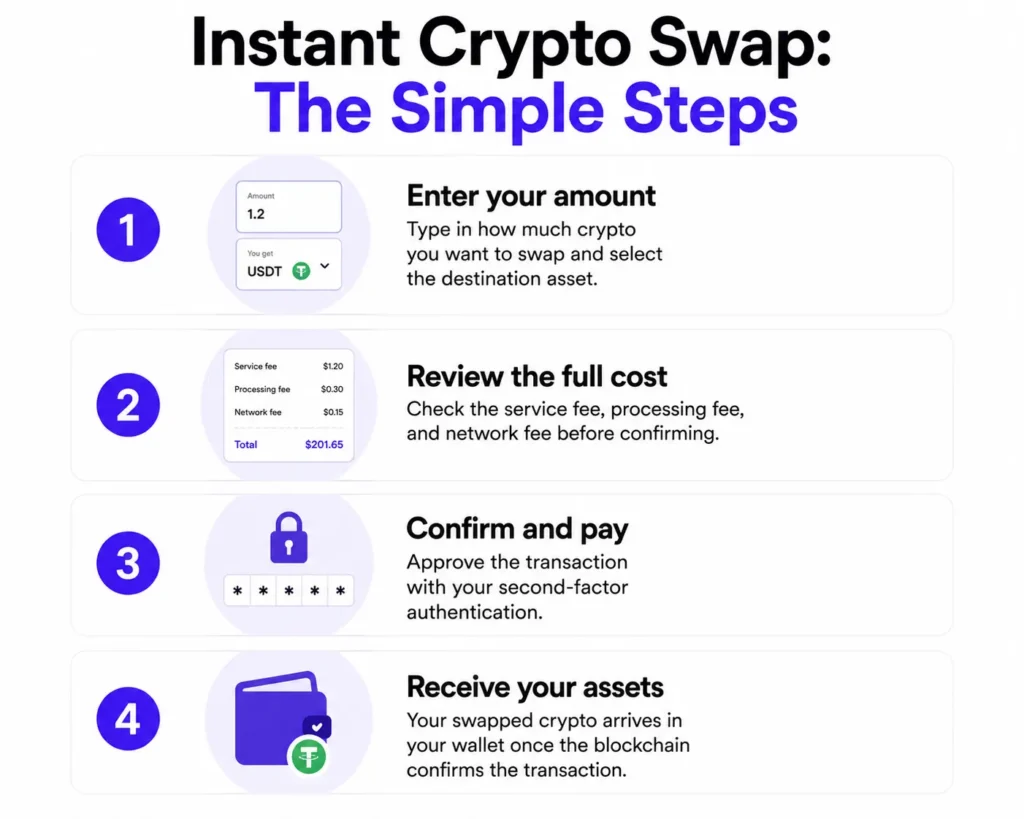
For a complete visual walkthrough, our swap crypto guide covers every step.
How Limit Swaps Guarantee Your Rate
Fixed-rate (limit) swaps let you set the specific price you want before the transaction executes. The swap only goes through if the market hits your target. Limit orders set a specific price, ensuring the trade only executes at your desired price or better, thus controlling slippage.
The trade-off is time: a limit swap may not execute immediately, or at all, if the market never reaches your target.
When Are Instant Swaps Best?
When we lock in your rate for a set window (15 minutes on Paybis), the price you see at checkout is the price you pay, even if the market moves during that window. Instant swaps work best when speed matters more than achieving a specific price target. If Bitcoin is falling and you want to reach the safety of USDT immediately, waiting for a limit order to fill could mean losing more to the market than you would have paid in slippage. We process transactions in under one minute, with full blockchain settlement typically completing within 10-15 minutes depending on network conditions, making Paybis well-suited to this use case.
Practical Tips for Swapping During Price Swings
Plan Your Budget and Avoid Panic Swaps
Decide how much you want to swap before opening any app. During volatility, the temptation is to convert everything immediately. Set a fixed amount in advance and stick to it, regardless of how the market moves while you are transacting.
Holding through volatility (HODLing) is valid for those who can tolerate a 20-40% temporary drop. The risk of panic swapping is selling at the bottom of a crash, then watching prices recover while you are sitting in USDT. The middle path is DCA: swap a portion, hold a portion, and stay within a budget set before the market started moving. Our cryptocurrency investment risks guide is a useful starting point for thinking through your exposure limits.
Know Total Swap Costs Upfront
Hidden spreads are a major source of unexpected costs during volatile swaps. A $1M test swap investigation found that platforms claiming zero commissions routinely embed 2-3% spreads during volatile periods. While trading fees typically range from 0.1% to 0.6%, hidden exchange fees like spread markups and inflated withdrawal charges often exceed advertised rates significantly. Our breakdown of the safest crypto exchanges and their security features is worth reviewing when you’re evaluating which platform to trust with time-sensitive swaps.
The table below shows how fee structures differ between transparent platforms and those that hide costs in the spread:
| Fee Type | Transparent Platform (e.g., Paybis) | Hidden Spread Platform |
|---|---|---|
| Service fee | Shown upfront (from 1.49%) | Embedded in spread, not disclosed |
| Processing fee | Shown upfront (4.5–8.5% for cards) | Not itemized |
| Network fee | Shown upfront (varies by blockchain) | Rolled into rate |
| Total visible before confirming | Yes | No |
We show the service fee, processing fee, and network fee before you confirm any swap, with zero surprise charges at checkout. Our fee transparency breakdown details exactly how this works.
Hold Stablecoins for Steady Value
Swapping one volatile asset for another during a crash (Bitcoin to Ethereum, for example) does not reduce risk if both assets are falling together. The safest destination is a stablecoin like USDT or USDC, because it locks in your current value regardless of what the rest of the market does. Our stablecoin rankings guide breaks down which options are most reliable by stability and liquidity.
Paybis: Know Your Crypto Costs Upfront
Avoid Surprises: Live Swap Rates
We replace the overwhelming order books and chart interfaces found on complex exchanges with a single calculator: enter the amount you want to swap, and we show exactly how much of the destination asset you receive. No candlestick charts. No maker/taker terminology. No 600-pair dropdown menu.
“Paybis makes buying crypto almost as easy as online shopping – quick, straightforward, and with peace of mind.” – Christine K. on G2
Know Your Total Swap Cost Upfront
Before you confirm any swap, we show three separate line items: the service fee (starting from 1.49%), the processing fee (4.5-8.5% depending on currency and payment method for card transactions over $50), and the network fee (set by blockchain miners and updated automatically based on current demand). The total appears on screen before you click confirm.
“Transparent fee structure with no hidden costs – all fees are displayed upfront before confirmation.” – Vladimir Z. on G2
Your first credit or debit card purchase carries no Paybis service fee, though payment processing and network fees still apply. This makes it a low-stakes way to test the swap process during a calm market before you need to move fast under pressure.
Quick Support During Crypto Volatility
When a swap fails during a market crash, waiting 48 hours for an email reply is not an option. We provide 24/7 live chat support with an average response time of 1-2 minutes. A human agent responds to help with your specific transaction, not a chatbot routing you to FAQ articles.
With 30,780+ Trustpilot reviews and a 4.1 rating, operating across 180+ countries with 20+ payment methods including PIX (Brazil) and Skrill, we built Paybis for users who need a swap to work the first time, every time.
Ready to see your exact swap cost before committing? Use the Paybis calculator to enter your amount, check all three fees upfront, and execute your swap in under a minute.
Key Terminology
- Slippage: The difference between the price shown when you initiate a swap and the price at which it actually executes. It increases during high volatility and low liquidity, ranging from under 1% in normal conditions to 5%+ during extreme market events.
- Stablecoin: A cryptocurrency designed to maintain a fixed value, typically $1 USD (examples: USDT, USDC). Swapping into a stablecoin during a market crash locks in your current value without requiring you to convert back to traditional currency first.
- Network Fee: The cost charged by blockchain miners to process and confirm your transaction. This fee is not controlled by the swap platform and fluctuates based on how congested the blockchain is at the time of your swap.
- Dollar-Cost Averaging (DCA): A strategy of splitting a total swap into smaller, regularly scheduled transactions rather than executing all at once. It reduces the impact of any single bad price moment and removes emotional decision-making from the process.
- Liquidity: The availability of buyers and sellers for a given asset at a given time. Low liquidity (common on weekends, holidays, or during market panics) leads to wider slippage because fewer counterparties are available to match your swap at the expected price.
FAQ
When Should You Act on Volatile Crypto?
Act when the 24-hour price move exceeds 10% and you want to lock in value by swapping to a stablecoin. Consider waiting for the initial surge of activity to settle after major news breaks, when network congestion and slippage tend to spike.
What Happens If My Swap Fails During High Volatility?
If we reject a swap for security or compliance reasons, we do not charge you and automatically return your funds to your original payment source. Pre-authorization is cancelled instantly, and your bank typically processes the refund within 1-3 business days. Contact our 24/7 live chat for an update within 1-2 minutes.
How Do You Manage Pending Swap Orders?
Check whether your target price is still realistic given current market conditions. If the market has moved far past your target, cancel the order and reset your price rather than waiting indefinitely.
What Is Your Swap Timing Checklist?
Before any volatile swap: (1) Check the 24-hour move percentage on CoinMarketCap. (2) Confirm the platform shows all three fees before you confirm. (3) Set a fixed amount to swap. (4) Choose a stablecoin as the destination. (5) If unsure, split the swap into smaller DCA amounts over multiple sessions.
Disclaimer: Don’t invest unless you’re prepared to lose all the money you invest. This is a high‑risk investment and you should not expect to be protected if something goes wrong. Take 2 mins to learn more at: https://go.payb.is/FCA-Info