Privacy Coins in 2026: Monero, Zcash and Dash Compared
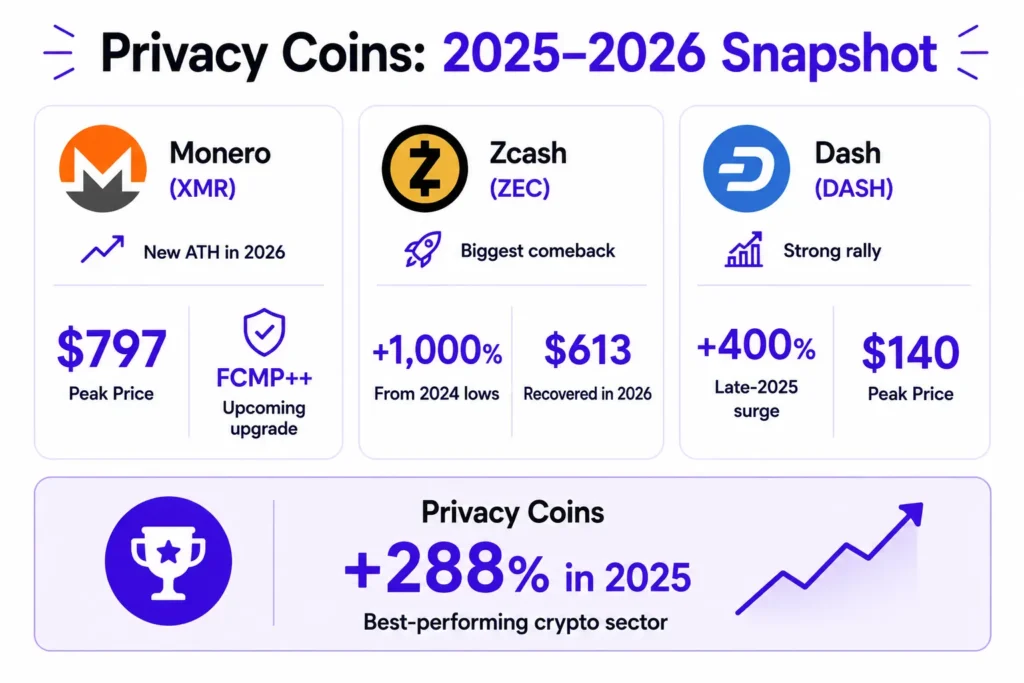
- Privacy-focused cryptocurrencies gained 288% in 2025, the strongest performing sector in crypto that year.
- Monero (XMR) enforces privacy on every transaction by default. No opt-out exists. It hit a new all-time high near $797 in January 2026.
- Zcash (ZEC) offers optional privacy through zk-SNARK technology. It surged past $585 in May 2026 after Multicoin Capital and Arthur Hayes both disclosed major positions.
- Dash is primarily a payments coin with optional, bolt-on privacy. Its privacy features are considered significantly weaker than either Monero or Zcash.
- Regulation is the defining risk. Monero has been delisted from most regulated exchanges. EU rules phasing in by 2027 will further restrict privacy coin availability on licensed platforms.
- You can track Zcash and Monero prices on Paybis.
Something changed for privacy coins in 2025. They gained 288% across the year, outperforming every other sector in crypto. That does not happen by accident. Behind the number is a specific anxiety that has been building for years: surveillance is everywhere, central bank digital currencies are spreading, KYC requirements are tightening across every platform. And a growing number of people decided they wanted money that could not be easily watched.
The three coins at the centre of that story are Monero, Zcash, and Dash. They are grouped together under the label “privacy coins,” but they represent three different answers to the same question. How much privacy should money have, who decides, and what are the trade-offs?
What Are Privacy Coins and Why Do They Exist?
A privacy coin is a cryptocurrency designed to make transactions difficult or impossible to trace. Bitcoin’s blockchain is fully public: every transaction, amount, and address is permanently visible to anyone who looks. Privacy coins use different cryptographic methods to break that trail.
The case for building them is partly philosophical and partly practical. The philosophical argument holds that financial privacy is a fundamental right. Cash between two people is private by default, and the same should apply to digital money. The practical reasons are more specific: visible transaction histories let wallets be targeted based on their contents, and business relationships become legible to competitors and adversaries.
Regulators take a different view. Anti-money laundering frameworks are built on the assumption that financial flows can be traced when required, and privacy coins that prevent that tracing are treated as obstacles to compliance. That tension has defined how these coins are regulated and who can access them.
How Does Monero Achieve Privacy?
Monero is the most thorough privacy coin in existence. On Monero, privacy is not a setting or a mode. It is the only way the network operates. Every transaction is private, without any action required from the user and with no mechanism to make it otherwise.
Three cryptographic technologies work together to achieve this.
- Ring Signatures hide the sender by mixing their transaction output with several other outputs from the blockchain, making it impossible to determine which of the included outputs is the actual source.
- RingCT (Ring Confidential Transactions) conceals the transaction amount. On Bitcoin, amounts are publicly visible. On Monero, the value transferred is cryptographically hidden while the network can still verify that no coins were created from nothing.
- Stealth Addresses mean that every transaction generates a one-time address for the recipient. The recipient’s actual address never appears on the blockchain. Even if someone knows your Monero address, they cannot see which transactions belong to you.
The result is a transaction record that is nearly impossible to analyze externally. That combination of features is why Monero attracts both the most privacy-focused users and the most intense regulatory scrutiny of any coin in this comparison.
Monero also uses the RandomX proof-of-work algorithm, specifically designed to be mined on CPUs and resistant to ASICs, which supports its goal of decentralization.
You can track the live XMR price and convert your holdings with the Paybis Monero calculator.
How Does Zcash Achieve Privacy?
Zcash takes a different approach. It launched in 2016 with the goal of making privacy mathematically provable rather than probabilistic. Its core technology, zk-SNARKs, stands for Zero-Knowledge Succinct Non-Interactive Arguments of Knowledge. The name is dense but the idea is elegant: you can prove that a transaction is valid without revealing any of its contents.
Where Monero makes privacy mandatory, Zcash makes it optional. The network supports two types of transactions: transparent and shielded. Transparent transactions work like Bitcoin, fully visible on the public blockchain. Shielded transactions use zk-SNARKs to hide the sender, recipient, and amount.
The practical reality in 2026 is that most Zcash users use transparent transactions, not shielded ones. This matters for privacy because the strength of Zcash’s shielded pool depends on how many users are in it. If most transactions are transparent and only a small fraction are shielded, the anonymity set for shielded users shrinks.
The optional privacy model has made Zcash more palatable to regulators than Monero. It also created a pathway for institutional interest. The SEC held a Zcash roundtable in 2025, the kind of engagement that Monero does not receive. In 2026, Zcash remains listed on Coinbase and Robinhood, platforms where Monero has been removed.
The Zcash price and the Zcash calculator are both available on Paybis for tracking your ZEC holdings.
How Does Dash Approach Privacy?
Dash was never really designed as a privacy coin in the same sense as Monero or Zcash. It launched in 2014 as a payments-focused cryptocurrency with fast transactions, and PrivateSend, its privacy feature, was added as an optional layer on top of that payments infrastructure.
PrivateSend uses CoinJoin, a process where multiple users’ transactions are mixed together to obscure the trail. It is a straightforward obfuscation technique compared to the cryptographic approaches of Monero and Zcash. Coin mixing can be partially reversed by blockchain analytics firms with sufficient data, and the mixing history of coins can itself flag them for additional scrutiny on some exchanges.
In 2026, Dash is more accurately described as a payments coin that happens to have a privacy option than a genuine privacy coin. Its partnership with Alchemy Pay in late 2025 extended fiat access to 173 countries through 300 payment channels, reinforcing that payments utility rather than privacy is its primary identity.
For anyone whose priority is genuine transaction privacy, Dash’s PrivateSend does not provide the same level of protection as Monero’s default privacy or Zcash’s shielded transactions.
How Do the Three Compare on Actual Privacy?
The honest comparison puts them on a clear spectrum:
| Monero | Zcash | Dash | |
|---|---|---|---|
| Privacy model | Mandatory for all | Optional (shielded/transparent) | Optional bolt-on |
| Core technology | Ring Signatures, RingCT, Stealth Addresses | zk-SNARKs | CoinJoin (PrivateSend) |
| Sender hidden | Yes, always | Only in shielded mode | Partially |
| Amount hidden | Yes, always | Only in shielded mode | No |
| Recipient hidden | Yes, always | Only in shielded mode | Partially |
| Analytics resistance | Strongest | Strong in shielded mode | Weakest |
The architectural difference matters more than it might look on paper. Monero’s privacy operates at the protocol level, which means every transaction automatically contributes to the anonymity pool of every other user. Zcash’s shielded pool is only as strong as the number of people who choose to use it, and most users choose transparent mode. Dash’s CoinJoin mixing is the most susceptible to analysis of the three, and it can be at least partially reversed by blockchain analytics firms with enough data.
For fungibility, meaning the property that makes every unit of a currency equivalent to every other unit, Monero is the strongest. Every XMR coin is identically private in its history. ZEC in the shielded pool approaches fungibility. DASH has the weakest fungibility, because mixed and unmixed coins can be distinguished.
What Is the Regulatory Situation in 2026 for Privacy Coins?
Regulation is the defining risk for all three coins, and the landscape in 2026 is harsher than it was two years ago.
Monero has been delisted from most regulated exchanges, including Binance and Kraken across several regions. The pattern is consistent: when regulators move on privacy coins, XMR is first.
Under MiCA’s accompanying Anti-Money Laundering Regulation (AMLR) in the EU, licensed crypto service providers face custodial bans on privacy coins being phased in by 2027. For Monero, this extends restrictions already in place. For Zcash, the picture is less clear because its transparent layer may give exchanges a compliance argument that Monero cannot make. EU-based users of both coins should expect tighter access through regulated platforms over the next two years.
Japan, South Korea, India, and various other jurisdictions have imposed exchange-level restrictions on privacy coins. The countries with the lightest regulatory touch on them tend to be jurisdictions with lighter crypto oversight generally.
One point worth stating clearly: using privacy coins to evade sanctions or launder money is illegal in most jurisdictions. The regulatory scrutiny privacy coins attract exists specifically because of that association, even though the majority of privacy coin users have entirely legitimate reasons for wanting financial privacy.
Zcash’s institutional engagement and optional privacy model have given it more regulatory runway than Monero. As of May 2026, Coinbase, Robinhood, and other major US platforms still list ZEC, while XMR has been removed.
What Has Happened to Each Coin in 2025 and 2026?
Privacy coins as a sector gained 288% in 2025, making it the strongest performing crypto sector of that year.
- Monero reached a new all-time high near $797 in January 2026, its first new high since 2018. The move reflected genuine demand as financial surveillance concerns intensified globally. After that peak, XMR corrected and trades around $343 in mid-2026. The upcoming FCMP++ upgrade (Full Chain Membership Proofs) is expected to further strengthen Monero’s privacy guarantees by expanding the anonymity set beyond the current ring signature approach.
- Zcash had the most dramatic ride. ZEC surged over 1,000% from its 2024 lows to $744 in November 2025. Governance turbulence followed in early 2026, when Electric Coin Company leadership resigned, sending ZEC back toward $244. Then Multicoin Capital publicly disclosed a major position on May 6, 2026, and the coin hit a fresh high above $585 immediately afterward. Arthur Hayes subsequently named Zcash as his largest crypto holding outside Bitcoin. ZEC reclaimed $613 by late May 2026.
- Dash climbed 400% during October and November 2025, reaching a peak around $140, before correcting to approximately $35 in early 2026. The Alchemy Pay partnership extended its payments reach significantly, but DASH’s price trajectory has been less driven by privacy demand and more by general altcoin market cycles.
Where Can You Buy Privacy Coins?
Paybis supports ZEC, XMR, and DASH across its payment methods, including credit card, debit card, Apple Pay, Google Pay, PayPal, and Skrill.
You can buy Zcash, buy Monero, and buy Dash on Paybis with fees shown before you confirm. All three are available alongside 90+ other cryptocurrencies.
Given the regulatory dynamics described above, the availability of privacy coins on licensed platforms may change over time. Paybis holds the MiCA CASP licence covering all 27 EU member states, which means its offerings are subject to the evolving EU framework on privacy coins. Check current availability on the platform before initiating a purchase.
The existing Paybis guide to Zcash price prediction provides additional historical context on ZEC’s trajectory.
Bottom Line
Monero, Zcash, and Dash share the “privacy coin” label, but they are built on different principles. Monero enforces privacy universally and by design. Zcash offers it as a choice, backed by more mathematically sophisticated cryptography than most privacy solutions. Dash is a payments network that happens to have a privacy option. The protection each provides reflects that order, and so does the regulatory treatment: Monero faces the most pressure, Zcash is negotiating a more nuanced position, and Dash is largely treated as a payments coin. In 2026, the sector attracted both significant returns and significant institutional attention. Whether that access persists through licensed platforms will depend on how the EU’s AMLR framework develops heading into 2027.
This article is for informational purposes only. Privacy coins carry significant regulatory risks including exchange delistings and legal restrictions in certain jurisdictions. This is not financial advice.
FAQ
What is the difference between Monero and Zcash privacy?
Monero makes every transaction private by default. There is no way to make a Monero transaction public. The privacy is enforced at the protocol level through Ring Signatures, RingCT, and Stealth Addresses. Zcash offers a choice: transactions can be transparent, like Bitcoin, or shielded using zk-SNARK cryptography that hides the sender, recipient, and amount. The practical trade-off is that Monero provides more consistent privacy because it applies to all transactions, while Zcash’s shielded pool is only as strong as the number of users who choose to use it.
Is Dash actually a privacy coin?
Dash describes itself as a payments cryptocurrency and its privacy feature, PrivateSend, is an optional add-on rather than a core architectural feature. PrivateSend uses CoinJoin transaction mixing, which provides less robust privacy protection than Monero’s or Zcash’s approaches. Blockchain analytics firms can partially reverse CoinJoin mixing with sufficient data. Many analysts and privacy researchers consider Dash a payments coin with optional privacy rather than a genuine privacy coin.
Why have privacy coins been performing well in 2025 and 2026?
The gains came from a combination of macro anxiety and specific catalysts. Growing adoption of CBDCs raised concerns about state-level financial surveillance, and stricter KYC requirements across regulated platforms pushed some users toward assets that preserve transaction privacy. On top of that, Multicoin Capital’s ZEC disclosure and Arthur Hayes naming Zcash as his largest non-Bitcoin holding brought institutional attention to the sector that it rarely receives. The narrative that financial privacy is a legitimate demand gained more mainstream acknowledgment in 2025 than in any prior year.
Can privacy coins be used legally?
Yes. Using privacy coins for legitimate purposes, including holding them as an asset, using them for private commerce, or protecting financial information from surveillance, is legal in most jurisdictions. What is illegal is using privacy coins to evade sanctions, launder money, or fund criminal activity. Regulatory scrutiny targets the latter use cases, but the regulatory consequences can affect all users of these coins through exchange delistings and access restrictions regardless of their intent.
What is the regulatory risk of holding privacy coins in Europe?
The EU’s AML regulation under MiCA phases in custodial bans on privacy coins for licensed platforms by 2027, tightening access that is already restricted for Monero. Zcash’s situation is less certain because its transparent transaction layer may give exchanges a compliance argument. European users holding either coin should expect their options through regulated platforms to narrow over the next two years and should monitor regulatory developments closely.
Disclaimer: Don’t invest unless you’re prepared to lose all the money you invest. This is a high‑risk investment and you should not expect to be protected if something goes wrong. Take 2 mins to learn more at: https://go.payb.is/FCA-Info