Swapping Crypto in Emerging Markets: Payment Methods and Local Options
Key Takeaways:Swapping crypto in emerging markets is fastest when you use a locally supported payment method. On Paybis, you can buy Bitcoin with a bank account, use PIX in Brazil, M-Pesa in Kenya, or Webpay in Chile to access 90+ cryptocurrencies. You can also buy Bitcoin with PaySafe Card or buy Bitcoin with ACH transfer depending on your region. Identity verification takes under 2 minutes, and transactions process in under 1 minute. Fees start from 1.49% Service Fee, plus a Processing Fee of 4.5-8.5% for card transactions over $50, plus a Network Fee that varies by blockchain congestion. All three appear on-screen before you confirm. Paybis operates in 180+ countries with 20+ payment methods and 24/7 live human support.
Why Local Payment Methods Matter for Crypto Swaps
Limited Payment Choices for Crypto
Western developers built most major crypto exchanges for Western bank accounts. If your primary payment tool is PIX in Brazil, M-Pesa in Kenya, or Webpay in Chile, platforms often block you outright or route you to expensive international wire transfers that take days to clear.
Crypto adoption in emerging markets is accelerating faster than the infrastructure supporting it. Brazil now has 20.6% crypto adoption, and Sub-Saharan Africa placed four countries in the global top 20 for the first time in 2025. The demand is there. The local payment access is not available on most platforms. If you’re exploring the top crypto on-ramp solutions, local payment method support is one of the most important criteria to evaluate.
The Impact of Regional Crypto Limits
Geographic blocks happen for specific reasons: regulatory licensing gaps, missing payment processor relationships, and platforms that simply haven’t invested in local market access. The cost is real. Remittance services charge 6.5% on average in 2025, while crypto-based transfers can cost as little as 1%. That gap matters every time you send money to family abroad, but only if your platform accepts your local payment method.
Local Payments: Speed vs. Fee
| Method | Speed | Typical Platform Availability |
|---|---|---|
| International wire transfer | 3–5 business days | Most exchanges |
| Local payment (PIX, M-Pesa) | Seconds to minutes | Select exchanges only |
| Visa/Mastercard debit | 2–3 seconds (authorization), 1–3 business days (settlement) | Most exchanges |
For most first-time buyers, getting Bitcoin today rather than Thursday is worth more than saving 1-2% on fees.
Best Crypto Payment Options for Your Country
How to Buy Crypto with PIX in Brazil
The Banco Central do Brasil created PIX as Brazil’s instant payment system, launching it fully on November 16, 2020. PIX moves Brazilian real instantly, 24/7, including weekends and public holidays. It is a government-backed payment rail, not a cryptocurrency.
When you buy crypto with PIX on Paybis:
- Select PIX as your payment method in the Paybis calculator.
- Scan the QR code or copy the PIX key Paybis generates.
- Open your bank app and confirm the payment.
- Receive your crypto in under 1 minute after confirmation.
Paybis officially supports PIX for Brazilian users buying crypto. As Stripe notes, businesses receive PIX funds instantly, which is exactly what makes it ideal for time-sensitive crypto purchases. If you’re newer to the space and wondering how often you should buy Bitcoin, PIX makes it easy to act on a regular schedule without friction.
M-Pesa: Fast Crypto Swaps in Kenya
M-Pesa’s 2007 launch by Vodafone and Safaricom brought mobile money to East Africa. The name combines “M” for mobile and “Pesa,” the Swahili word for money. It now has 51 million customers across seven countries, making it the most widely used financial tool in the region.
Paybis supports M-Pesa as a direct payment method for crypto purchases. For Kenyan users, this means you move mobile money directly into crypto without needing a traditional bank account at all.
How to Buy Crypto with Webpay in Chile
Transbank operates Webpay, Chile’s dominant online payment network. Chilean consumers use it as their standard debit-linked payment method for online purchases. We accept Webpay on Paybis, giving you a direct path to buy crypto with your everyday payment tool without converting to an international card first. You can also buy Bitcoin with PaySafe Card as an alternative if Webpay is unavailable for your specific transaction.
Asia’s Local Crypto Payment Methods
On-chain crypto activity grew 69% year-over-year in Asia-Pacific through June 2025, with major adoption in India, Vietnam, and the Philippines. Paybis supports region-specific methods including Astropay for Southeast Asian markets, giving users in the Philippines and Indonesia an accessible entry point. For newcomers wondering how to make money with cryptocurrency, having a reliable local on-ramp is the essential first step.
Which Platforms Support Local Payment Methods?
Paybis: 20+ Payment Methods Across 180+ Countries
We built Paybis specifically to solve geographic friction. The FX Empire Paybis review confirms it is “one of the most globally accessible exchanges, accepting users from over 180 countries and regions worldwide,” with region-specific methods including PIX, Khipu, Webpay, Astropay, SPEI, and PSE.
| Criteria | Paybis | Binance | Coinbase |
|---|---|---|---|
| PIX (Brazil) | Yes (direct) | Limited | Yes |
| M-Pesa (Kenya) | Yes (direct) | P2P only | No |
| Webpay (Chile) | Yes | No data | No data |
| Countries served | 180+ | Wide but fragmented | Fewer countries |
| Verification speed | Under 2 minutes | Inconsistent | Hours to days |
| Human support | 24/7, under 2 min response | Bot-dependent | Automated bots |
| Fees shown upfront | Yes, before checkout | Not always | Spread often hidden |
Binance and Coinbase: Restricted Regions
Binance offers low trading fees (0.1% for makers) but requires you to navigate complex trading interfaces, and geographic availability is uneven across Latin America and Africa. Its M-Pesa integration is peer-to-peer only, not a direct exchange feature. Coinbase is the largest US-based exchange by trading volume but operates in fewer markets globally. For a broader comparison, see our guide to the best Bitcoin trading platforms.
Before signing up anywhere, ask one question: does this platform actually work where I live, with the payment method I have, today? Verify your country’s eligibility directly on the Paybis supported countries page before you create an account.
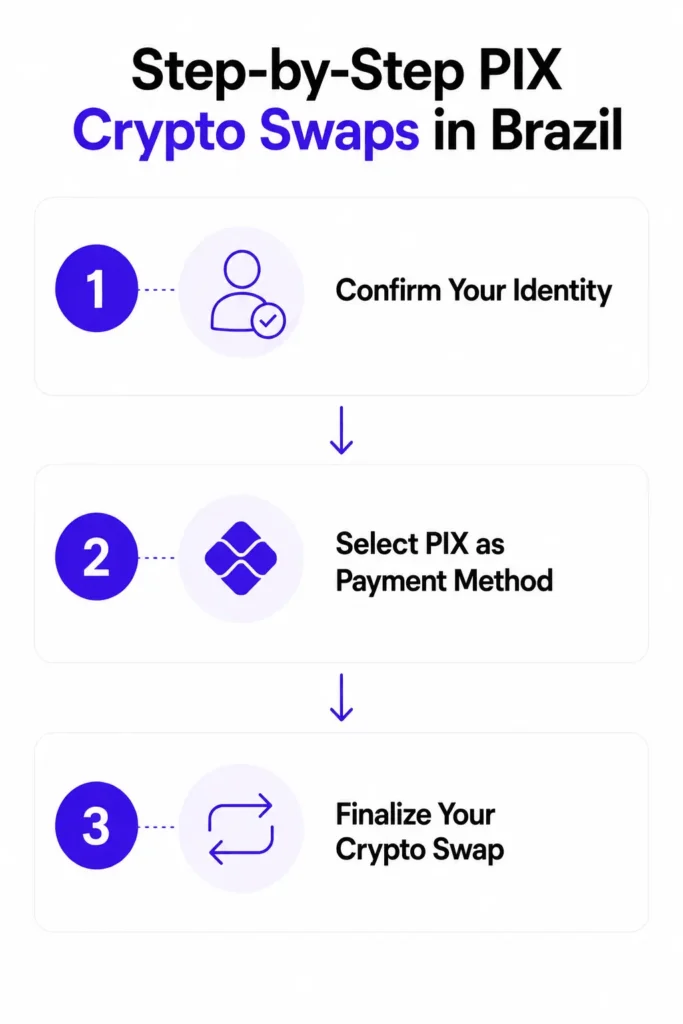
Step-by-Step PIX Crypto Swaps in Brazil
This is the complete process for a first-time buyer in Brazil purchasing Bitcoin with PIX. The Paybis beginner’s guide video gives you a visual walkthrough before you begin:
Step 1: Confirm Your Identity
- Go to paybis.com and create an account.
- Upload a photo of your government-issued ID (national ID or passport).
- Take a selfie for the liveness check.
- We typically complete verification in under 2 minutes, as confirmed in the FX Empire review.
Step 2: Select PIX as Payment Method
- Enter the BRL amount you want to spend in the Paybis calculator.
- Select Bitcoin (or your preferred crypto) as the destination.
- Choose PIX from the payment method dropdown.
- Paybis generates a PIX QR code or key.
- Open your Brazilian bank app, scan the QR code or paste the PIX key, and confirm.
The Paybis crypto calculator tutorial shows exactly how the fee breakdown appears before you confirm.
Step 3: Finalize Your Crypto Swap
Once you confirm the PIX payment in your bank app, funds transfer instantly to Paybis. We process your crypto in under 1 minute and deliver it to your Paybis wallet or your specified external wallet address. You receive an email confirmation immediately. For swapping between two cryptocurrencies within your Paybis wallet, the official Paybis swap guide covers each step.
PIX Swap: Exact Costs and Timing
For a R$1,000 Bitcoin purchase via PIX on Paybis, the Service Fee is 0.99% for PIX transactions. Processing and Network Fees are displayed at checkout, and settlement is near-instant depending on the Bitcoin blockchain. See the full fee structure in the Transparent Fees section below. If you’re weighing how much Bitcoin to hold after your purchase, our guide on how much Bitcoin you should own is a useful starting point.
How to Swap Crypto Using M-Pesa in Africa
M-Pesa Availability by Country
M-Pesa operates in Kenya, Tanzania, Mozambique, and five other African countries, with Kenya as its largest market. For Kenyan users, we list M-Pesa as a supported method for direct crypto purchases. Check the Paybis payment methods page for up-to-date regional availability.
Transaction Limits and Verification
Safaricom’s platform rules and Paybis verification tiers together determine your M-Pesa transaction limits. New accounts with standard identity verification (photo ID plus selfie) transact at standard limits. Larger purchases may require proof of address or source of funds, as anti-money laundering regulations require this documentation. The Simple Flow buy and sell guide walks through the full flow.
M-Pesa Crypto Fees Explained
M-Pesa transactions carry a 0.49% Service Fee and a 4.5% Processing Fee, both shown before checkout. The Network Fee is set by blockchain miners and passed through at cost. See the full fee structure in the Transparent Fees section below. For context on how transaction blocks work on the blockchain, our glossary entry explains the mechanics behind that Network Fee.
What to Do When Crypto Is Region-Blocked
Local Laws Block Crypto Swaps
Some countries restrict crypto by law. Sanctioned countries cannot use Paybis. Within the US, New York and Louisiana have additional state-level restrictions. Brazil and Kenya are supported, along with many countries across Latin America, Africa, and Asia. CoinLedger confirms Brazil treats crypto as a taxable asset. As of June 12, 2025, Brazil introduced a new cryptocurrency tax law under Provisional Measure 1303, imposing a flat 17.5% tax on all capital gains from crypto transactions with no monthly exemption. In Kenya, crypto gains are subject to a 15% Capital Gains Tax, plus a 10% excise duty on exchange transaction fees effective July 1, 2025. Keep records of your purchase and sale prices for tax reporting in both countries.
Check Your Country’s Crypto Eligibility
Verify your country is fully supported before signing up. For Paybis, the supported countries list is publicly available. If your country is listed, you can create an account and purchase without geographic restrictions. If you’re looking for options specifically designed for smaller budgets, our guide to the best platforms to buy crypto under $100 covers accessible entry points across markets.
Payment Rejected? Quick Fixes
Your payment declined? Work through this checklist:
- Bank block: Call your bank and pre-approve crypto transactions on your card. Many banks flag crypto as “high-risk” automatically.
- Card mismatch: Ensure the name on your payment card exactly matches your verified Paybis account name.
- Transaction limit: Check if you hit your daily or monthly cap. Limits reset after 24 hours.
- Still stuck: Contact live chat support for human help.
If your transaction fails, we apply no charge and return funds to your account. You pay nothing on a rejected transaction. For rejected transactions involving an external wallet, the Paybis external wallet swap guide covers specific troubleshooting steps.
Paybis: Easy Crypto for Your Local Needs
Instant 2-Minute ID Verification
We run automated image recognition the moment you upload your government-issued photo ID and selfie. Most users complete verification in under 2 minutes. Compare that to Coinbase, where verification delays of hours or days are a common complaint, or Binance, where ID rejections due to photo quality are frequently reported.
“Paybis is so easy to use compared to many other companies in the same field. It is quick and you get your receipt and information right away.” – Verified user review of Paybis
24/7 Support in Local Languages
We offer live chat support 24 hours a day, 7 days a week, with an average response time of 1-2 minutes in 9+ languages. When something breaks, you reach a human, not a bot that loops through FAQ articles. The Benzinga Paybis review highlights responsive customer service as a key differentiator against larger platforms.
“Paybis offers transactions in a quick and easy format with thorough security measures. I’ve been using their app for quite some time and have had no issues.” – Verified user review of Paybis
Transparent Fees Before Checkout
We show you three line items before you confirm every transaction:
- Service Fee (our margin, starts from 1.49%)
- Processing Fee (payment processor cost, varies by method)
- Network Fee (blockchain cost, varies by congestion)
We display the total before you enter your payment details. The Paybis crypto calculator makes this visible from your first interaction on the homepage, before any signup.
We’ve processed over $1.2 billion in annual volume (last 12 months as of October 2025) with 5 million+ retail users across 180+ countries. We hold 30,900+ Trustpilot reviews with a rating of 4.1 (“Great”). We’re registered with FinCEN (US MSB registration 31000272911973) and FINTRAC (Canada MSB), and certified PCI DSS Level 1, the highest standard for payment processing security.
“Paybis is one of the leading Crypto networks you can for sure trust your transactions will always be swift and safe.” – Verified user review of Paybis
Ready to buy crypto today? Create your Paybis account, complete your 2-minute ID verification, and confirm your total cost before checkout. Fees start from 1.49%, and we display all costs before you confirm.
Key Terminology
- PIX: Brazil’s government-backed instant payment system, created by the Banco Central do Brasil. It transfers Brazilian real in seconds, 24/7, including weekends and holidays. PIX is not a cryptocurrency.
- M-Pesa: A mobile money transfer service operating across Kenya, Tanzania, and several other African countries. Users send and receive money via mobile without a traditional bank account.
- Webpay: Chile’s main online payment network, operated by Transbank. It links directly to Chilean bank accounts for online purchases.
- Wallet: The digital account where your crypto is stored, similar to a bank account for crypto. Paybis offers a built-in wallet, or you can send crypto to your own external wallet.
- Network fee: Blockchain miners charge this fee to process and confirm your transaction. We don’t set it and don’t mark it up. It rises when the network is busy and falls when it is quiet.
- Stablecoin: A cryptocurrency designed to hold a fixed value, typically $1 USD. USDC is widely used, with USDC as another major option. They are useful for international transfers because the recipient knows exactly what they will receive, without exposure to price swings.
- Capital gains tax: The tax owed on profit from selling or swapping crypto. Brazil taxes gains above R$35,000 per month at 15-22.5%. Kenya applies a 15% capital gains tax on gains, plus a 10% excise duty on exchange fees. Consult a local tax professional for advice specific to your situation.
- KYC (identity verification): A legal requirement for financial platforms to confirm who their users are. On Paybis, this means uploading a government-issued ID and taking a selfie. We complete it in under 2 minutes for most users.
FAQ
Which Payment Methods Work Best in My Country?
PIX is the fastest option in Brazil, processing instantly with no fees from the PIX network itself. M-Pesa is a widely used option in Kenya, Tanzania, Mozambique, and several other African countries. Webpay is standard in Chile. Check the Paybis supported payment methods page for the full list by region.
Will My Bank Block My Crypto Purchase?
Many banks automatically flag crypto transactions as “high-risk” and decline them. Call your bank before your first purchase and request they approve crypto-related transactions on your card, or use PIX or M-Pesa, which route through mobile payment networks and are less likely to trigger bank blocks.
How Do I Avoid Crypto Verification Delays?
Use a clear, well-lit photo of your ID against a plain background and match your name exactly to your payment method. Blurry photos and name mismatches are the two most common causes of rejection.
What Non-Bank Options Work for Crypto Swaps?
If your bank blocks your card, use PIX (Brazil), M-Pesa (Kenya and other African countries), Webpay (Chile), Skrill, or Neteller. PIX, M-Pesa, and Webpay bypass traditional card processors. See the Paybis payment methods documentation for availability by country.
What Is My Exact Crypto Swap Cost on Paybis?
Three fees apply to every transaction: Service Fee (from 1.49%), Processing Fee (varies by method), and Network Fee (varies by blockchain). Your first card transaction has a 0% Service Fee. All three appear on-screen before confirmation. See the Transparent Fees section above for the full breakdown by payment method.
Disclaimer: Don’t invest unless you’re prepared to lose all the money you invest. This is a high‑risk investment and you should not expect to be protected if something goes wrong. Take 2 mins to learn more at: https://go.payb.is/FCA-Info