Crypto Swapping Explained: The Complete Guide to Converting Cryptocurrencies
Key Takeaways:A crypto swap is a direct exchange of one digital asset for another using a “you send X, you get Y” model, without requiring an order book, active counterparty, or trading knowledge. Automated Market Makers (AMMs) power most decentralized swaps using the constant-product formula x*y=k to price trades against pooled liquidity. For platforms serving 180+ countries, integrating white-label swap infrastructure inherits pre-acquired FinCEN, FINTRAC, VASP, and FCA compliance coverage and delivers a calculable 0.49% B2B base margin on every transaction, eliminating months of build time. Get started with popular payment options like buy Bitcoin with Paysafe Card, with Paysafe Card, or with BLIK.
Your users want to convert fiat to crypto in one click. Building the liquidity, compliance, and routing infrastructure to make that happen will cost your engineering team two quarters of runway. A production-ready crypto exchange requires substantial engineering investment and months of development time, and that estimate excludes multi-jurisdiction licensing, KYC operations, and processor relationships. Crypto swapping solves the user experience problem. This guide breaks down the mechanics and shows how integrating an embedded exchange compresses months of infrastructure work into hours.
What Is a Crypto Swap?
A crypto swap directly exchanges one cryptocurrency for another without requiring an intermediary to facilitate the trade. From the user’s perspective, it is a single-step process: enter an amount, see the output, confirm. The platform handles pricing, routing, and settlement automatically.
For product teams, this simplicity is the point. A user converting ETH to SOL does not need to understand order types, price levels, or trading mechanics. They see a calculator: send X, receive Y. Paybis’s Embedded Exchange powers this experience across fiat-to-crypto, crypto-to-fiat, and crypto-to-crypto conversions, with a 90%+ transaction success rate and ~99.4% platform uptime. To understand what makes a strong on-ramp experience for your users, see what is an on-ramp and why does your business need one.
Token Swap vs. Crypto Swap: Understanding the Difference
These terms describe different operations, and conflating them creates product architecture mistakes.
A crypto swap exchanges one asset for another, such as ETH to BTC or USDC to SOL, with both assets continuing to exist on their respective chains.
A token swap can refer to the same asset exchange, or to token migration to another blockchain when a project upgrades its protocol. In migration swaps, users exchange old tokens for new ones at a fixed ratio and the original tokens are burned or deprecated.
For platform integrations, the distinction matters. Fiat-to-crypto and crypto-to-crypto conversions use AMM or aggregator routing. Token migration swaps require protocol-specific smart contract interactions with separate security and compliance considerations.
The Core Differences Between Swapping and Trading
Swapping and trading differ structurally. Traditional trading uses a Central Limit Order Book (CLOB), which relies on buy and sell orders submitted by traders and matched by price and time priority. AMMs offer an alternative model: trades execute against a pooled reserve of assets, with pricing set automatically by a mathematical formula.
| Feature | Crypto Swap | Traditional Trade |
|---|---|---|
| Price mechanism | AMM formula (automated pricing) | Order book matching |
| Execution model | Quoted price at submission (subject to slippage) | Depends on available orders |
| User knowledge required | None | Order types, depth, timing |
| Settlement speed | Near-instant | Varies by order fill |
| Counterparty | Liquidity pool | Another trader |
| Slippage exposure | Pool-size dependent | Order book depth dependent |
With an order book, traders see real-time intent through resting orders and depth, which supports technical analysis but adds friction for non-traders. With AMMs, users receive a price quote regardless of active order flow. What they see before confirming is a close approximation of what they get, with slippage on larger trades accounting for the variance.
For platforms targeting first-time crypto buyers, AMM-based swapping removes the learning curve. This directly improves conversion at the onboarding step, which is where most platforms lose users. If you are evaluating payment methods to support, see this overview of top payment methods to buy crypto for a breakdown of what works best by region and user segment.
Why Platforms and Users Rely on Crypto Swapping
Swapping solves three problems order-book trading creates for most crypto users: speed, access, and simplicity.
- Speed: Swap execution is near-instant. The AMM calculates output, the user confirms, and the transaction settles on-chain, with no waiting for a counterparty to fill an order at the requested price.
- Access: AMMs make every listed asset tradeable at any time, including low-liquidity altcoins and new token launches that would have thin order books on a traditional exchange. For DeFi protocols where users need specific governance tokens, this matters significantly.
- Simplicity: No trading knowledge is required. This is the primary reason wallets, neobanks, and DeFi apps default to swap interfaces rather than order books for their retail user base. For newcomers, a guide on how to use Bitcoin for beginners provides helpful context on the broader ecosystem.
Common Swap Scenarios and Use Cases
Understanding where swaps fit in the user journey helps product teams decide which flows to prioritize:
- Portfolio rebalancing: Users move profits from ETH into USDC to lock in value without leaving the platform. Stablecoin demand reflects this pattern: total stablecoin net inflows hit $45.6 billion in Q3 2025, a 324% increase from Q2.
- DeFi protocol access: Users swap from a major asset directly to a specific token needed for liquidity pool participation or governance voting in one step.
- Cross-chain movement: Users hold assets on Ethereum but need them on Base or Polygon. Cross-chain swap infrastructure handles the bridge and conversion in a single transaction.
- Fiat-to-crypto onboarding: First-time users convert USD, EUR, or GBP to Bitcoin or USDC via card or bank transfer. This is the highest-stakes swap type because it is the user’s first touchpoint with the platform.
How Automated Market Makers (AMMs) Power Decentralized Swaps
AMMs replace the order book with a liquidity pool and a pricing formula. Understanding this mechanism is essential for product teams evaluating DEX integrations or building on top of DeFi protocols.
The foundational model, introduced by Uniswap, uses the x*y=k formula, where x is the quantity of token A in the pool, y is the quantity of token B, and k is a constant that must not change as a result of any trade.
Here is how the math works in practice. A pool holds 10 ETH and 40,000 USDC, making k = 400,000. A user swaps 1 ETH. After the 0.30% LP fee deduction (0.003 ETH), x becomes 10.997. To maintain k = 400,000, the new USDC amount must equal 400,000 / 10.997 = 36,374. The pool sends the user 40,000 minus 36,374 = 3,626 USDC. The more ETH flows in, the more expensive each subsequent ETH becomes, adjusting prices mechanically without human market-making.
For product teams, the practical implication is that large trades relative to pool size produce meaningful slippage. A $500 swap in a $10 million pool produces negligible price impact. A $50,000 swap in the same pool produces measurable impact. Enterprise-grade swap infrastructure uses aggregators that split orders across multiple liquidity sources to minimize this.
Understanding Swap Fees: Network, Platform, and Slippage Costs
Every swap transaction carries three distinct cost types. Presenting these transparently before a user confirms separates high-converting swap interfaces from ones that generate chargebacks.
| Fee Type | Who Controls It | Typical Range | Notes |
|---|---|---|---|
| Network (gas) fee | External – blockchain validators | $0.01-$1.00 (L2) / $0.30-$50 (Ethereum mainnet) | Fluctuates with network congestion |
| Platform / LP fee | External – protocol or provider | 0.05%-1.00% | Uniswap’s 0.30% LP fee is standard |
| Slippage | External – market conditions | 0.01%-2.00%+ | Higher for low-liquidity pairs |
| Paybis B2B rate | Paybis – we control this | 0.49% base | Partners set end-user fees above this |
Paybis controls only the B2B partner rate (0.49% base). Network fees, platform/LP fees, and slippage are set by external parties: validators, protocols, and market conditions.\
Network fees are paid in the native currency of the chain. Ethereum gas fees have declined significantly, averaging $0.30-$0.33 on mainnet as of late 2025. Layer-2 solutions reduce this to under $1, though Ethereum mainnet swaps during congestion can still reach $5-$50, making L2 routing essential for small transaction sizes.
Platform fees compensate liquidity providers and the protocol. Uniswap’s standard LP fee is 0.30%, distributed to pool contributors. For a detailed look at how platform fees compare across popular services, see this breakdown of hidden Coinbase fees and how to avoid them with alternatives.
Slippage is the difference between the quoted swap price and the final executed price. It increases with trade size relative to pool depth and varies by the liquidity depth of the token pair. For product teams, slippage tolerance settings are a critical UX decision: too tight and transactions fail, too loose and users receive less than expected.
For B2B platform integrations, the Paybis pricing model is structured differently from on-chain DEX fees. Partner rates start at 0.49% per transaction, and partners set their own end-user fees above that base rate. A partner charging 2% keeps the 1.51% difference on every transaction. Net received is shown at the quote stage before users confirm, and Paybis benchmarks this across 20+ competitors. The platform wins 95% of SEPA sell comparisons and 100% of ACH buy comparisons at all tested transaction sizes.
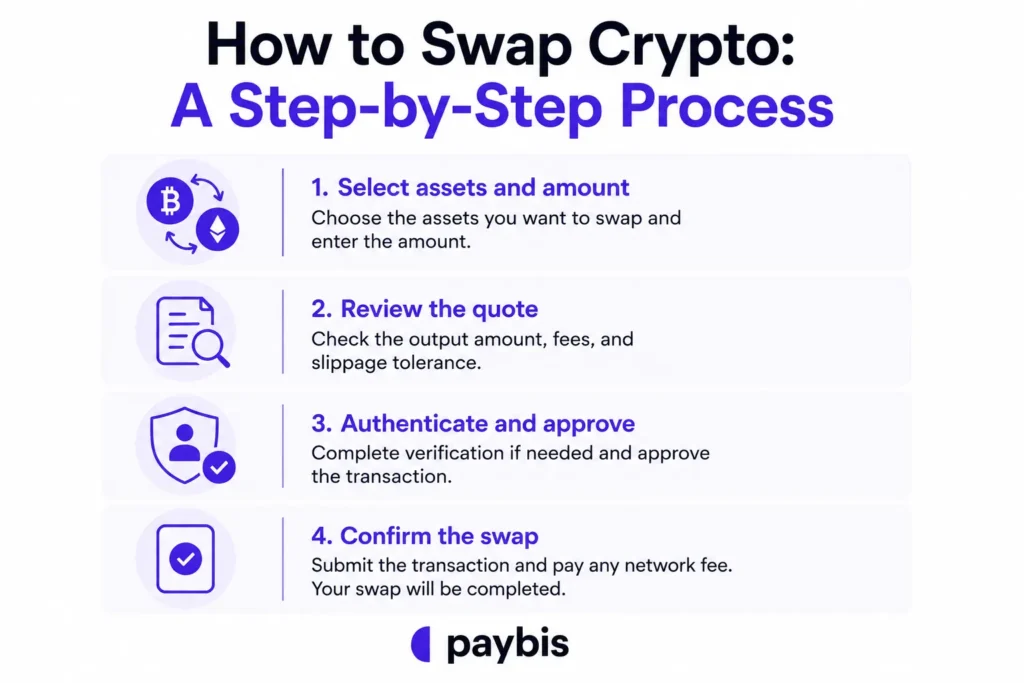
How to Swap Crypto: A Step-by-Step Process
The generalized swap process applies across centralized platforms, DEXs, and integrated wallets, though specific steps vary by venue.
- Select assets and amount: Choose the source asset and destination asset. Enter the amount. The platform calculates the output using its pricing mechanism.
- Review the quote: Check the output amount, fee breakdown, and slippage tolerance before proceeding.
- Authenticate and approve: Platforms may require identity verification. On DEXs, approve the token contract to allow the protocol to spend your tokens. On custodial platforms, confirm via 2FA or your existing session.
- Confirm the swap: Submit the transaction. On-chain transactions require network fee payment. Off-chain or custodial swaps execute immediately upon confirmation.
Swapping via Decentralized Exchanges (DEXs)
Uniswap is the reference implementation for DEX-based swapping. The official Uniswap swap guide walks through the full process: connect a wallet, select tokens, approve the token contract on first use (which requires a separate network fee), then confirm the swap. The “Swap success” confirmation appears once the transaction is included in a block.
The key distinction from centralized platforms: DEXs require no registration. DEX users transact directly from self-custody wallets using smart contracts, with no KYC because no centralized entity processes the transaction. The tradeoff is that users bear full responsibility for verifying token contract addresses, managing gas fees, and understanding slippage settings. For platforms targeting non-technical users, this friction is a conversion liability. For a guide to the wallets that work best for self-custody, see this roundup of best non-custodial wallets.
Swapping via Integrated Wallets
MetaMask’s swap feature aggregates quotes from multiple DEXs to find optimal pricing, similar to DEX aggregators like 1inch. MetaMask charges an additional 0.875% service fee on top of network and LP fees for this aggregation layer. Note that MetaMask now allows users to pay network fees in tokens other than the chain’s native asset on Ethereum mainnet, BNB Smart Chain, Polygon, Arbitrum, and Base, so the requirement to hold ETH for gas no longer applies universally on those networks.
Coinbase Wallet operates similarly with a UI aimed at lower-technical-skill users. Here is the important regulatory nuance: DEX-based and self-custody wallet swaps do not require KYC because no centralized entity processes the transaction. Centralized platforms handling fiat-to-crypto conversions must comply with KYC/AML regulations in their operating jurisdictions. Paybis handles this at the infrastructure level: the no-KYC flow runs background compliance checks that allow 90% of first-time users to transact up to $1,000/year without uploading a document, with full KYC completing in approximately 2 minutes when required.
Choosing the Right Swap Infrastructure for Your Platform
This decision determines whether your engineering team spends the next two quarters building payment rails or shipping product features.
- Option 1: Build in-house. A production-ready crypto exchange costs $93,000-$187,000 and 24-40 weeks minimum. That timeline excludes multi-jurisdiction licensing, KYC operations, processor relationships, and ongoing AML monitoring. Payment processors drop crypto clients frequently, and a single acquirer relationship means one termination ends your revenue.
- Option 2: Integrate DEX aggregators. Building on top of aggregators handles on-chain routing but leaves you responsible for the fiat layer, KYC, compliance infrastructure, and processor relationships for card and bank payment acceptance. It is a partial solution that still requires significant engineering investment for the off-chain components. For a detailed side-by-side of these build vs. integrate tradeoffs, see Paybis vs. Ramp vs. custom build.
- Option 3: White-label embedded exchange. Paybis’s Embedded Exchange and On/Off-Ramp infrastructure compresses the entire build into a URL redirect that deploys in minutes or a full SDK that launches in hours. Partners get fiat-to-crypto, crypto-to-fiat, and crypto-to-crypto conversion, 20+ payment methods, 180+ country coverage, and 90+ cryptocurrencies through a single integration. The compliance layer, KYC, AML monitoring, and processor relationships are already in place across FinCEN (US), FINTRAC (Canada), VASP (Poland), and FCA (UK).
The conversion impact is measurable. Smart Cascade Routing retries failed card transactions across multiple acquirers by BIN (Bank Identification Number) and region, with 3DS (3D Secure) authentication happening once regardless of how many providers the transaction touches. This has increased successful transactions for partners by over 11%. The no-KYC flow up to $1,000/user/year eliminates the step that drives the highest drop-off rate in first-time user onboarding.
“What stands out to me most about Paybis is the remarkable speed and smoothness of the crypto-buying process… The platform itself is clean, user-friendly, and always dependable, making each transaction feel truly effortless.” – Egor N. on G2
“Fees are shown upfront, and transaction speeds were consistently good during my tests.” – Joon Huh on Trustpilot
Smart Contract Risks and How to Mitigate Them
Swapping directly on DEXs exposes users and platforms to smart contract vulnerabilities that managed infrastructure abstracts away. These are not theoretical risks. Total exploit losses hit $1.42 billion across 149 documented incidents in 2024, with access control vulnerabilities accounting for $953.2 million of that total. The OWASP Smart Contract Top 10 (2025) identifies reentrancy as still critical, with $35.7 million in documented reentrancy losses in 2024.
For product teams integrating DEX-based swap infrastructure, the core risks are:
- Malicious token contracts: Users can unknowingly interact with counterfeit tokens that share the name or ticker of legitimate assets. Most retail users will not verify the contract address against official sources.
- Oracle manipulation: Smart contracts relying on on-chain price feeds can be exploited if an attacker temporarily moves the price of an asset. The Cetus Protocol hack in May 2025 resulted in $223 million in losses from an arithmetic overflow in the protocol’s pricing code.
- Reentrancy attacks: Functions that call external contracts before updating internal state can be drained by recursive calls, a vulnerability pattern that remains active across DeFi protocols.
Managed infrastructure like Paybis removes these risks from the user journey by vetting all listed assets, running transactions through audited infrastructure, and implementing MPC-based custody for company-owned and customer-issued wallets. Users do not interact directly with smart contracts. Paybis has operated since 2014 with no security breaches. For a broader look at how exchanges stack up on security, see this guide to safest crypto exchanges and their security features.
“Paybis is a very good crypto exchange, and they have very good customer support and I am glad I can do business with them when I need to use crypto for certain business I need to take care of.” – Douglas Weaver on Trustpilot
If you integrate DEX-based swap flows, you must audit every smart contract dependency, implement token allowlist systems, and communicate slippage and price-impact risks clearly in the UI. For most product teams, this is a significant engineering and security investment that does not differentiate the core product.
Review the Paybis API and On/Off-Ramp documentation to see integration timelines and net-received benchmarks for your specific payment methods and geographies. For volume-based pricing and a custom margin model, sign up to Paybis.
Key Terminology
- Automated Market Maker (AMM): A decentralized exchange protocol that prices assets using a mathematical formula (x*y=k) applied to pooled liquidity rather than matching individual buy and sell orders. Trades execute against the pool, not against another trader.
- Liquidity pool: A smart contract holding reserves of two or more tokens that an AMM draws from to execute swaps. Users who deposit tokens into the pool earn a share of trading fees proportional to their contribution.
- Slippage: The difference between the quoted swap price and the final executed price. Slippage increases with trade size relative to pool depth and is higher for low-liquidity token pairs.
- Net received: The actual crypto or fiat a user receives after all fees and spread are deducted, inclusive of service fees, processing fees, network fees, and exchange margin. Net received is the only all-in metric that enables accurate cross-platform fee comparison.
FAQ
How long does a fiat-to-crypto swap take on Paybis?
First-time card transactions take approximately 10 minutes including verification. Repeat transactions with the same card process in around 30 seconds, with settlement near-instant depending on the blockchain.
What is the minimum transaction size for a Paybis B2B integration?
B2B partner rates start at 0.49% per transaction with no published minimum for On/Off-Ramp. Corporate Ramps carry a minimum of $1,000 and a maximum of $5,000,000 per transaction.
Does Paybis support no-KYC swaps?
Paybis runs background compliance checks that allow 90% of first-time users to transact up to $1,000/year without uploading a document. Identity verification is required above that threshold and completes in approximately 2 minutes.
How many cryptocurrencies does Paybis support for swaps?
Paybis supports 90+ cryptocurrencies natively across the On/Off-Ramp and Embedded Exchange, with 600+ available on demand, across 180+ countries and 20+ payment methods.
Disclaimer: Don’t invest unless you’re prepared to lose all the money you invest. This is a high‑risk investment and you should not expect to be protected if something goes wrong. Take 2 mins to learn more at: https://go.payb.is/FCA-Info