
Your Rights as a Crypto User in the EU Just Changed. Here Is How.
- On 1 July 2026, the MiCA transition period ended. Every platform serving EU crypto users now needs a MiCA CASP licence.
- You now have stronger rights. Licensed platforms must safeguard your funds and disclose risks clearly.
- Only licensed platforms can legally serve you. Unlicensed ones must wind down and stop offering EU services.
- You can check any platform on ESMA’s public register in under a minute.
- Paybis holds MiCA CASP authorisation from the Bank of Latvia, so you can buy Bitcoin and buy Ethereum on a licensed platform.
Something changed for every crypto user in the EU on 1 July 2026. You might not have noticed it. But your rights are now stronger than they were a month ago.
That date marked the end of the MiCA transition period. MiCA is the EU’s crypto rulebook. From now on, any platform that serves EU users needs a full licence. That licence comes with rules built to protect you.
This guide explains what changed in plain language. You will see what new rights you have and what to check before you trust a platform with your money.
What Changed for EU Crypto Users on 1 July 2026?
On 1 July 2026, the MiCA transition period ended across the EU and the wider EEA. From that date, every platform serving EU crypto users must hold a MiCA CASP licence. Unlicensed platforms have to stop offering services to EU customers.
Before this date, existing platforms could keep operating under older national registrations while they applied for a licence. That grace period is now over. The EU’s markets regulator, ESMA, confirmed there would be no extension.
The result is a cleaner market. Only licensed platforms remain. Some well-known names had to pause or stop their EU service because they did not hold a licence in time.
What New Rights Do You Have as a Crypto User Now?
You now have protections that did not exist before MiCA. Licensed platforms must safeguard your assets and give you clear, honest information. They also answer to a regulator that can act if something goes wrong.
Here are the main rights the new rules give you:
- Your funds must be safeguarded. Licensed platforms have to keep client assets separate from company money. Your crypto is not meant to be mixed with the platform’s own funds.
- You must get clear information. Platforms have to give honest risk warnings. Marketing has to be fair and cannot mislead you.
- You can complain and be heard. Every licensed platform needs a formal process to handle customer complaints.
- You are covered by supervision. A regulator watches the platform and can suspend or remove its licence if it breaks the rules.
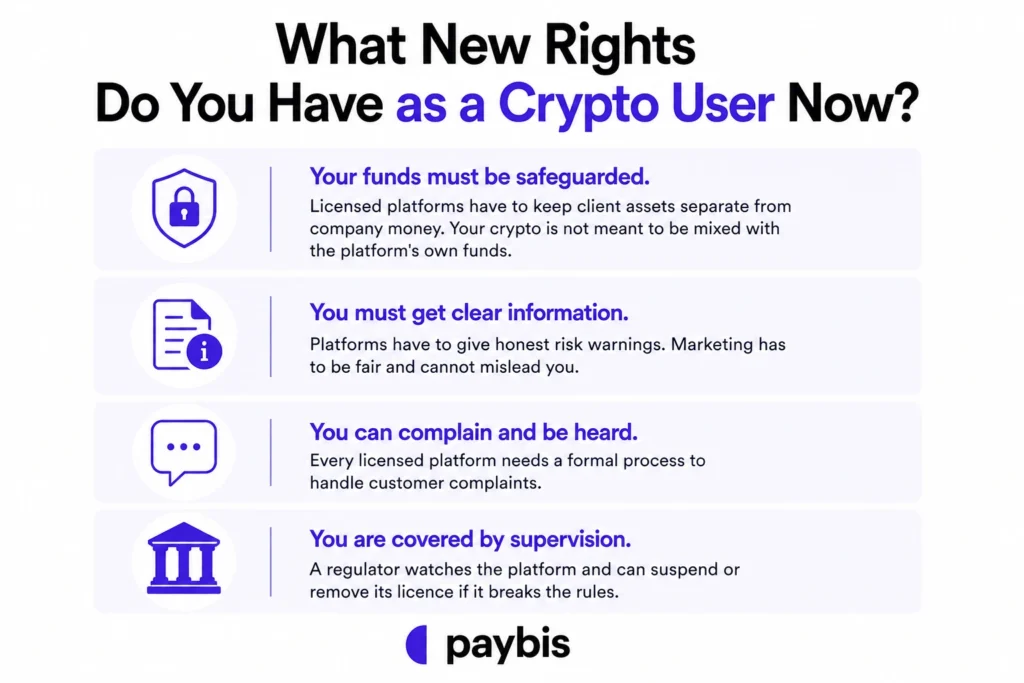
These protections apply to every platform that holds a CASP licence. That is a real change from the older system, where many platforms answered to no one.
What Happens to Your Crypto if Your Platform Is Not Licensed?
If your platform did not get a MiCA licence, it has to wind down its EU business in an orderly way. It must safeguard your assets during that process and tell you how to withdraw or move them.
ESMA expects unlicensed platforms to communicate clearly with customers. That means telling you the timeline and any deadline for moving your funds.
If you use a platform that is closing in the EU, do not ignore its messages. Withdraw your crypto or move it to a licensed platform before any deadline passes. Acting early is the safest choice.
How Do You Check if Your Platform Is Licensed?
You can check any platform on ESMA’s public CASP register. ESMA is the EU’s markets regulator. Its register lists every authorised platform, and the check takes under a minute.
Here is how to do it:
- Go to the ESMA website and open its register of CASPs.
- Search for your platform’s name.
- Confirm the entry shows full authorisation, not a pending or withdrawn status.
You can also look at the platform’s own website. A licensed platform names its regulator and licence clearly. Vague wording like “compliant” with no named regulator is a warning sign. For a wider view, see our full list of MiCA-licensed exchanges.
Do These Rights Apply Everywhere You Use Crypto in the EU?
Yes. A MiCA licence passports across all 27 EU member states and the wider EEA. The same protections follow you whether you buy crypto at home or in another EU country.
This is how MiCA is designed. A platform gets its licence in one country and can then serve clients across the Union. The rules stay the same wherever you are.
Paybis is authorised in Latvia and passports across all 27 EU member states. Your protections do not weaken when you cross a border.
Is Paybis a Licensed Platform Under the New Rules?
Yes. Paybis holds full MiCA CASP authorisation from the Bank of Latvia, granted in May 2026. It also holds a PSD2 Payment Institution licence from the same regulator. Both licences passport across all 27 EU member states.
Paybis has operated since 2014 and serves more than 7 million users across 180+ countries. The CASP licence means EU customers use a platform that a financial regulator has reviewed and approved.
Alongside its EU licences, Paybis is registered with FinCEN in the United States and FINTRAC in Canada. It also holds a VASP registration in Poland and is PCI DSS certified for card security.
For you, that means you can buy crypto on a licensed, supervised platform. You can also verify Paybis yourself on the ESMA register in under a minute.
Bottom Line
Your rights as a crypto user in the EU are stronger since 1 July 2026. Licensed platforms must protect your money and answer to a regulator.
The simplest step you can take is to check that your platform is licensed. Open the ESMA register and search its name. If it is authorised, it will be there.
Paybis holds MiCA CASP authorisation from the Bank of Latvia. You can buy crypto on a platform that meets the EU’s new rules.
FAQ
Did MiCA make crypto safer in the EU?
It added protections that were not there before, such as asset safeguarding and complaint rules. It does not remove market risk. Crypto prices still rise and fall on their own.
Can a platform outside the EU still serve me?
Only in narrow cases. A non-EU platform generally cannot market crypto services to EU users without an EU licence.
What should I do if my platform is closing in the EU?
Withdraw or transfer your assets to a licensed platform. Follow the wind-down instructions and any deadlines the platform gives you.
Is "MiCA compliant" the same as licensed?
No. The precise term is MiCA CASP authorisation. “MiCA compliant” is vague wording. Look for a named regulator and a confirmed licence.
Disclaimer: Don’t invest unless you’re prepared to lose all the money you invest. This is a high‑risk investment and you should not expect to be protected if something goes wrong. Take 2 mins to learn more at: https://go.payb.is/FCA-Info