

Bitcoin Price Prediction 2026
2026 has been a hard year for Bitcoin holders. The price opened January above $93,000. By the end of June it had dropped to a 21-month low near $60,000. It’s now trading in the mid-$60,000s, down about 48% from its all-time high of $126,000 set in October 2025.
Is this the start of a longer bear market? Or just a rough patch before the next leg up? We’ll look at the fundamentals, the technical picture, the macro backdrop, and what analysts are forecasting for the rest of the year.
Bitcoin has dropped more than 50% from a peak before. It happened after the 2021 top and after the 2017 top too. Each time it eventually climbed to new highs. Whether that happens again this cycle is the real question here.
Bitcoin Price in 2026: What Happened So Far
January 2026: BTC opens the year above $93,000, still carrying momentum from 2025.
October 2025, for context: Bitcoin had hit its all-time high of $126,000 the previous month.
February 2026: A sharp sell-off drags BTC down toward $60,000, followed by a partial bounce back to around $67,000.
June 2026: BTC closes the month near $60,000, a fresh 21-month low and down about 35% for the year.
July 2026: Price steadies and climbs back into the mid-$60,000s, trading around $64,000 to $66,000 by late July.
No single event caused the drop. There was no exchange collapse and no stablecoin losing its peg. It came from profit-taking after 2025’s rally, uncertainty around the new Fed chair and interest rates, and a general risk-off mood across markets.
In 2021 Bill Gates said this while giving an interview to the New York Times:
“Bitcoin uses more electricity than any country except the top 10. This can’t be sustainable. I think regulation will come that will make it a lot less attractive as an investment.”
Fast forward to 2024, Bitcoin miners are increasing using renewable resources to keep the network up and running and institutional adoption of Bitcoin has made it even more of an attractive asset while reducing volatility.
Note: The analysis in this article is purely for educational purposes and may deviate significantly from reality. Further, past performance does not guarantee future results. Consult a qualified financial expert/investment advisor before make decisions based on independent third-party opinions/analyses.
Fundamental Analysis
Let’s analyze the fundamental core values of Bitcoin and see what major problems it is solving.
If you are familiar with the history of Bitcoin, you probably know that Satoshi Nakamoto released a whitepaper with a viable solution to a long-standing problem, often referred to as the Byzantine’s General Problem: the ability to transfer value between two parties without any intermediary, such as a bank or government.
Never has it been possible to instantly transfer value over long distances in a completely trustless manner. And, with the creation of Bitcoin, there was finally a breakthrough.
As Satoshi put it, the “peer-to-peer” electronic cash system essentially stands for the network’s ability to transfer value directly from “person to person”, without any involvement from third parties.
Bitcoin As A Digital Asset
For new investors, Bitcoin also serves another function – that of a new asset class. New BTC can be mined, just like any other precious metal. In this case, miners use strong computing power instead of shovels and pickaxes. But here’s the interesting part.
What makes Bitcoin different and stronger than precious metals, is its predetermined inflation/deflation schedule. There are only 21,000,000 Bitcoins available for mining, around 19 million of which have already been mined.
Every four years, the amount of Bitcoin rewarded to miners is reduced in half (halved), and the production of new Bitcoins will end by the year 2140.
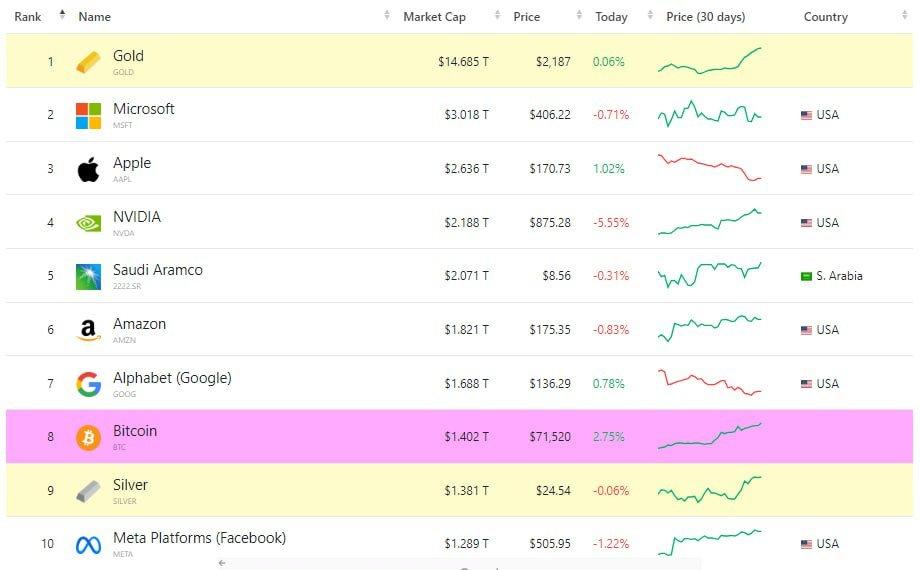
Since 2024, big asset managers like BlackRock and Fidelity have been buying Bitcoin through spot ETFs, and that continued through 2025. It helped push Bitcoin to a new all-time high of $126,000 in October 2025. At that point Bitcoin’s market cap put it ahead of silver among the world’s largest assets.
Since then, Bitcoin has given back a lot of that gain. Its market cap now sits around $1.33 trillion. That’s still far bigger than any other crypto asset (more than five times the size of Ethereum, the next largest), but it shows that institutional buying doesn’t make the volatility disappear.
Bitcoin overtaking Silver as a commodity set a media frenzy as the technology underlying Bitcoin is less than 2 decades old while Silver has been an actively traded commodity for centuries.
Technical Analysis
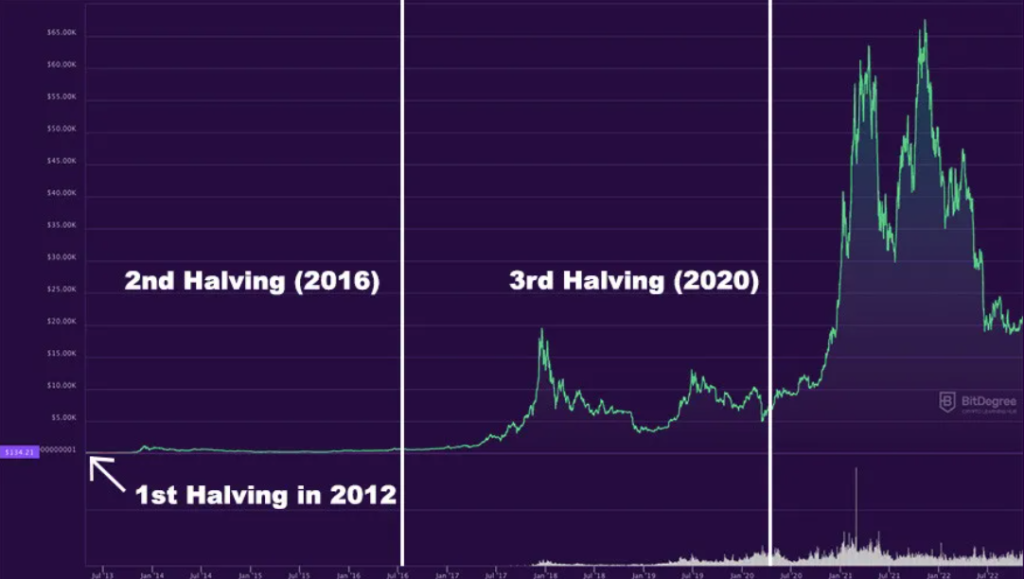
Past performance does not guarantee future results. But it can certainly help with making an educated guess. So, take this analysis with a grain of salt and do your research or consult a professional. Let’s begin by mapping BTC halving periods on the Bitcoin price chart.
Bitcoin halving is an inflation-easing mechanism when the reward for mining is cut in half. It follows the fundamental principle of supply and demand. Likewise, Bitcoin halving exists to alleviate demand-pull inflation. Baked into Bitcoin’s source code, it is scheduled to occur every 210,000 mined blocks, which takes about four years.
Looking at past halving cycles, Bitcoin has usually peaked 12 to 18 months after a halving. The April 2024 halving broke that pattern a bit. BTC hit an early high before the halving even happened, thanks to ETF approval. But the wider cycle still played out close to schedule. The real cycle top came in October 2025, about 18 months after the halving.
The next halving isn’t due until 2028. That means 2026 is happening in the back half of the current four-year cycle, which is usually the more volatile stretch. That lines up with the sharp drop we’ve seen this year.
To understand it better let’s first understand what is ETF and what role it plays in BTC’s price. ETFs are exchange-traded funds that track the value of a specific asset and trade on traditional market exchanges.
In the case of Bitcoin ETF’s approval, investors have the freedom to invest in Bitcoin without having to go through the hassle of using cryptocurrency exchange while providing leverage to its price. After the Bitcoin ETF’s approval billions of dollars have come into the market helping Bitcoin to reach its all-time high even before the halving.
According to the previous charts of halving it is expected for Bitcoin’s price to increase significantly in the peak of the Bull Run which usually starts after the halving.
Macroeconomic Events
Inflation and Interest Rates
Bitcoin’s correlation with traditional assets has increased in recent years. During the high inflation period of 2022, Bitcoin’s price did not demonstrate the inflation-hedge qualities its proponents often cite.
Interest rates are still a big factor for Bitcoin in 2026. The Fed also has new leadership this year. The Senate confirmed Kevin Warsh as the new Fed Chair, replacing Jerome Powell, in one of the closest votes in modern history. A new chair usually brings some uncertainty about where rates go next, and markets have been pricing that in. Higher rates still make safer assets more attractive and pull some money away from Bitcoin, which has added to this year’s drop.
Geopolitical Tensions
The ongoing Russia-Ukraine conflict has injected significant uncertainty into global markets. During periods of heightened geopolitical risk, investors often exhibit a “flight to safety” behavior, selling off riskier assets like Bitcoin in favor of assets like gold or US Treasuries.
Specific events within geopolitical conflicts can trigger sharp volatility spikes in the cryptocurrency market. News of sanctions, escalations, or potential resolutions can cause significant swings in Bitcoin’s price.
De-dollarization
There is a growing trend among some nations to reduce their reliance on the US dollar as the primary reserve currency. This de-dollarization effort could lead to a decrease in demand for the US dollar.
If the US dollar loses its dominance, some investors and nations may turn to alternative stores of value or mediums of exchange. Bitcoin, with its decentralized nature and limited supply, could potentially benefit from this shift, should the trend accelerate.
Institutional Investments Into Bitcoin
Increase In Institutional Adoption: We have already discussed that major financial institutes and corporations like BlackRock and Fidelity are investing heavily in Bitcoin which suggests a growing confidence in the overall cryptocurrency world. This could lead to a wider investor base and potentially higher prices.
For instance, Belarusbank, the largest bank in Belarus is considering setting up a cryptocurrency exchange. With more authorized adoptions like these, Bitcoin could soon become the new normal, glaring upon the fiat currencies.
If governments establish clear regulations for the cryptocurrency market, it could legitimize Bitcoin and attract more institutional investors leading to a positive impact on price.
In recent times we have an example of El Salvador, how this country is bullish on Bitcoin and is daily buying one Bitcoin. This initiative has pushed the nation’s Bitcoin holdings to a substantial total of 5,690 BTC worth around $400 million.
Spot Bitcoin ETFs have been around for a while now. They’re a normal, established way for institutions to hold Bitcoin. The bigger story in 2026 is corporate treasuries. Companies like Strategy keep building large Bitcoin reserves, some of it funded through stock sales, and they’ve kept buying through the price drop. That kind of steady buying is different from the speculative retail rushes of past cycles. It’s one reason a lot of analysts think this is a shakeout, not a multi-year bear market.
This ease of access through familiar investment vehicles like ETFs eliminates the need for institutions to grapple with the complexities of cryptocurrency exchanges and digital wallets.
The embrace of spot Bitcoin ETFs by institutions is likely to boost demand and potentially add stability to the notoriously volatile Bitcoin market. This institutional interest further legitimizes Bitcoin as an asset class, paving the way for greater mainstream acceptance.
Useful links
Analyst Price Targets for the Rest of 2026
Forecasts for where Bitcoin lands by the end of 2026 are pretty spread out. That spread is worth paying attention to on its own.
| Source | Year-end 2026 Target | Outlook |
|---|---|---|
| Standard Chartered | $100,000 | Expects a strong recovery in the second half |
| Polymarket (prediction market) | $70,000 to $75,000 | Expects a modest recovery from current levels |
| Short-term technical view | $70,000 (July target) | Recovery depends on reclaiming the 50-month EMA near $65,600 |
The gap between $70,000 and $100,000 shows genuine disagreement among professionals. Treat any single number in this table as one possible outcome, not a promise.
Bitcoin Price Prediction for the rest of 2026
2025 ended well for Bitcoin. The post-election rally carried it all the way to a new all-time high of $126,000 in October. 2026 has gone the other way. BTC opened the year above $93,000, fell to around $60,000 by the end of June, and has since settled into the $64,000 to $66,000 range through July.
Analysts don’t agree on what comes next. Standard Chartered has kept its $100,000 year-end target, which would mean a strong second half. More cautious forecasters point to prediction markets, where the going range for year-end sits closer to $70,000 to $75,000. The Fear & Greed Index has been sitting around 29, in fear territory. That level has marked past bottoms about as often as it’s signaled more downside, so it’s worth watching but not something to bet on by itself.
Bitcoin Price Prediction 2027-2030
Looking further out:
The next Bitcoin halving lands in 2028. In every past cycle, a halving has been followed by a major bull run within the next year or two. If that pattern holds again, momentum could start building into and after 2028.
Predictions past that point get harder to trust. They depend on how institutional adoption keeps growing, how regulation develops, and whether governments and companies keep treating Bitcoin as something worth holding long term rather than trading short term.
Treat any 2029 or 2030 number you see online as a rough guess. Even professional analysts don’t have a strong track record forecasting Bitcoin four years out.
Conclusion
2026 has been a reality check after last year’s excitement. Bitcoin is down almost half from its October 2025 peak, and institutional adoption alone hasn’t been enough to stop that. Still, the things that mattered before haven’t gone away. Supply is still capped. Institutions are still building infrastructure. The government’s reserve is still standing. Corporate treasuries are still buying through the dip.
Nobody knows yet whether $60,000 was the bottom or just a stop along the way down. That uncertainty is exactly why no single price target here should be treated as fact. Do your own research, only risk what you can afford to lose, and talk to a financial advisor before acting on any prediction, including the ones in this article.
The Paybis blog will continue to provide useful education surrounding Bitcoin, cryptocurrencies, and blockchain.
FAQ
Will Bitcoin go back up in 2026?
Nobody knows for sure. Bitcoin has recovered from steep drops in every past cycle, and current year-end targets range from around $70,000 to $100,000, both above today’s price. But there’s no guarantee that pattern repeats, and a lot depends on the Fed’s rate decisions and whether institutions keep buying through the dip.
What is Bitcoin's all-time high?
$126,000, set in October 2025. As of late July 2026, BTC is trading around 48% below that, in the mid-$60,000s.
Why did Bitcoin crash in 2026?
No single cause. It came from profit-taking after 2025’s rally, uncertainty tied to the new Fed chair and interest rate policy, and a broader pullback across markets. There was no exchange failure or stablecoin collapse behind it.
What is the U.S. Strategic Bitcoin Reserve?
A Bitcoin reserve held by the U.S. government, set up after calls to treat Bitcoin as a strategic asset like gold. It’s still in place as of mid-2026, and the government hasn’t sold during the current downturn.
When is the next Bitcoin halving?
The last halving was in April 2024. The next one is due in 2028.
What do analysts predict for Bitcoin by the end of 2026?
Estimates vary a lot. Standard Chartered has kept a $100,000 target. Prediction markets are pricing closer to $70,000 to $75,000. That gap tells you there’s no real consensus right now.
Is now a good time to buy Bitcoin?
That depends on your own risk tolerance, timeline, and finances, and no article can answer it for you. Bitcoin has moved more than 40% in a single year in both directions before. Talk to a financial advisor and only invest what you can afford to lose.
Disclaimer: Don’t invest unless you’re prepared to lose all the money you invest. This is a high‑risk investment and you should not expect to be protected if something goes wrong. Take 2 mins to learn more at: https://go.payb.is/FCA-Info



I think this is among the most significant info for me. And i am glad reading your article. But should remark on some general things, The site style is ideal, the articles is really nice : D. Good job, cheers
“Im thankful for the blog.Much thanks again. Really Great.”
Well that is true every financial expert or not expert in financial they predict their own analysis and opinion about bitcoin price reach in the future. For me my own prediction and view of bitcoin for the year 2020 for the reality 30,000$, 100,000$ is so very obvious is too expensive mor etear to wait before they can reach. And according from the article came from the op share I also agree bitcoin is the solution of worldwide problem.
Годнота спасибо
Интересный пост
Verrygood
I’ve found it a little difficult to find computer parts without having to buy whole computers and tearing them apart myself. . I want to start my own business using the computer parts, but where can I get the computer parts (the small parts)? I have tried my local recycle center and no success.. I’m on the verge of contacting an established computer craftsperson and cosigning to their business. . . Anyone with ideas or advice?.