Cloud Mining vs Home Mining in 2026: What’s the Difference and Which Makes Sense?
- Home mining means running your own ASIC hardware at home. It is loud, expensive to set up, and only profitable in 2026 if your electricity costs less than $0.10/kWh.
- Cloud mining means renting hash power from a remote data center. You avoid the hardware but take on contract risk and lower returns.
- Bitcoin’s network hashrate surpassed 800 EH/s in early 2026. Mining difficulty has followed. The window for casual home mining has largely closed.
- Cloud mining has a well-documented scam problem. Unexpected fees, shrinking returns, and contract modifications are common complaints even with legitimate providers.
- For most people, buying Bitcoin directly is simpler and more cost-effective than either mining approach.
- Industrial-scale operations with power rates under $0.05/kWh and top-tier ASICs are where profitable mining actually happens in 2026.
At 2am, the sound is impossible to ignore. A home ASIC miner does not hum like a laptop. It roars like a compact vacuum cleaner that never switches off. For some people, that sound still represents opportunity. For most, it is a good reason to look at the alternatives.
Mining Bitcoin in 2026 is a very different proposition from what it was five years ago. The April 2024 halving cut the block reward to 3.125 BTC. The network hashrate has hit new all-time highs above 800 EH/s. The math has become less forgiving at every step. This article breaks down what home mining and cloud mining each actually involve in 2026, what they cost, and how to think about whether either one makes sense for your situation.
What Is Home Mining and How Does It Work in 2026?
Home mining means running your own hardware to validate Bitcoin transactions and earn block rewards. In practice, this means buying one or more ASIC miners, connecting them to a mining pool, and running them continuously in your home or a rented space.
The hardware does one thing: it performs trillions of hash calculations per second in competition with every other miner on the network. When your pool collectively solves a block, you receive a share of the 3.125 BTC reward proportional to the hash power you contributed.
Solo mining is effectively off the table for home users in 2026. The probability of a single home ASIC solving a block independently is vanishingly small given current network difficulty. Pool mining is the standard approach, where miners combine their computing power and split rewards.
The machines that matter in 2026 are top-tier ASICs. The Bitmain Antminer S21 XP at 13.5 joules per terahash and the Whatsminer M60 series are the workhorses of profitable operations right now. Older hardware is less competitive and consumes more energy per unit of hash power, which quickly turns the electricity bill into the whole story.
To understand more about how Bitcoin transactions and mining actually work at a technical level, the Paybis guide to how Bitcoin works covers it in plain English.
What Is Cloud Mining and How Does It Work in 2026?
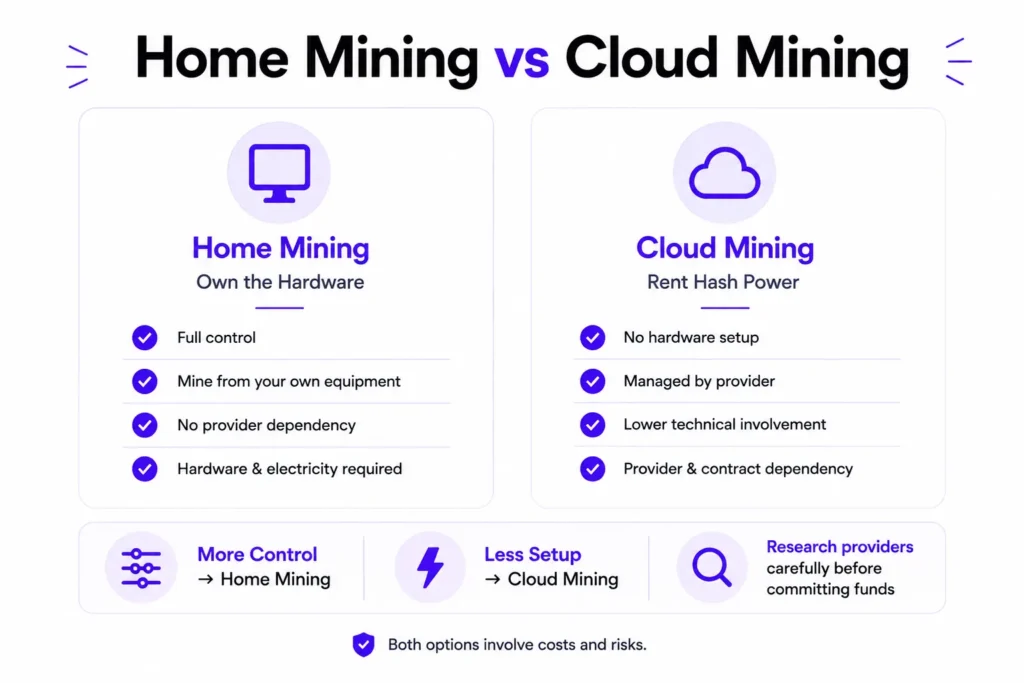
Cloud mining means renting computing power from a remote data center rather than owning and running hardware yourself. You sign a contract for a specific amount of hash power over a defined period, pay upfront or by subscription, and receive your proportional share of mining rewards while the provider handles everything else.
The appeal is obvious. You don’t need hardware; there is no noise, no heat, and no setup. You pay a fee and receive earnings.
The reality is more complicated. Service fees eat into returns, and cloud mining providers typically charge rates that leave customers with lower net earnings than the raw hash power would generate independently. Contracts often include clauses that allow the provider to modify terms if profitability drops, which means the deal you signed may not reflect what you actually receive.
Cloud mining also carries significant counterparty risk. The provider holds your capital and controls the hardware. If the business closes or was fraudulent from the start, recovering that capital is extremely difficult. This matters because the cloud mining sector has a well-documented history of scams. Regulators have flagged “guaranteed returns” style pitches repeatedly. Not every cloud mining operation is fraudulent, but the proportion of bad actors is high enough that due diligence before committing any money is essential.
Which One Is More Profitable in 2026?
The honest answer depends almost entirely on your electricity rate.
Home mining with top-tier hardware at $0.05 to $0.08/kWh is genuinely profitable in 2026. Industrial operators and hosted mining services accessing cheap power in that range continue to generate consistent returns. At $0.10/kWh, margins are narrow but positive when Bitcoin is at current price levels. Above $0.12/kWh, which covers most residential electricity rates in the US and European averages well above that, most home setups run at a loss.
In Europe, the average residential electricity rate runs around €0.28/kWh. At that rate, running even a top-tier Antminer S21 XP produces a net loss after power costs. The hardware might earn €8 to €15 per day in gross revenue, but the electricity bill wipes it out.
Cloud mining profitability is harder to assess because the fees are not always fully disclosed upfront. In most cases, published comparisons show that cloud mining returns trail what the same capital would have generated by simply buying Bitcoin and holding it. The service fees, combined with the margin the provider takes, tend to compress returns below what the underlying hash power produces.
What Does Home Mining Actually Cost in 2026?
The upfront hardware cost is the starting point. A current-generation top-tier ASIC costs between $3,000 and $8,000 depending on the model and efficiency rating. That purchase needs to be recovered through mining earnings before any profit is possible.
Electricity is the ongoing cost that determines whether the math works. A modern 4,000-watt ASIC running continuously consumes roughly 2,900 kWh per month. At $0.10/kWh that is $290 per month. At $0.28/kWh it is over $800 per month. The hardware earns the same amount regardless of what you pay for the power.
Beyond hardware and electricity, home mining involves cooling costs. ASICs generate significant heat, particularly in summer. Running them in a poorly ventilated space accelerates hardware wear and can create fire risk. Noise mitigation is also a real consideration. Some miners install units in garages or outbuildings specifically because the sound level inside a home becomes unbearable.
The payback period on hardware at current difficulty, even under good conditions, typically runs 12 to 18 months. That calculation assumes Bitcoin’s price and mining difficulty both stay roughly constant, which they do not. If difficulty rises, the payback period extends. If Bitcoin’s price falls, the payback period extends further.
What Are the Risks of Cloud Mining?
Cloud mining carries risks that home mining does not, and they are harder to assess before committing money.
The biggest risk is counterparty fraud. The cloud mining sector has produced a large number of operations that collected upfront payments and either delivered nothing or operated legitimate-looking services that quietly disappeared. Regulators in multiple countries have issued warnings specifically about cloud mining platforms. Before signing any contract, verifying that a provider has a demonstrable track record, audited financials, and clear terms around contract modifications is essential.
Contract risk is real even with legitimate providers. Many cloud mining agreements include clauses that allow the operator to reduce payouts, suspend contracts, or cancel early if profitability drops below a threshold. This means the deal you sign and the deal you actually receive can diverge significantly if market conditions change.
Transparency on fees is also a known problem. Providers may advertise a maintenance fee that sounds modest, then apply additional charges for electricity, management, and early termination that significantly reduce net earnings. Reading the full contract before committing is not optional.
The result is that cloud mining is typically better suited to people who want exposure to mining economics without operational overhead, are willing to accept lower net returns in exchange for that simplicity, and have done thorough due diligence on the specific provider.
Is Mining Worth It for the Average Person in 2026?
For most people, the honest answer is no. The window for casual home mining producing meaningful returns has largely closed since the 2024 halving and the resulting rise in network difficulty.
The people mining profitably in 2026 are large-scale operators with negotiated electricity contracts below $0.05/kWh and fleets of the most efficient ASICs available. Running near-100% uptime at that scale requires industrial infrastructure. A home setup operates in a completely different economic environment.
For a typical person running one or two ASICs at home on residential electricity, the math does not close. Hardware depreciates. Difficulty increases. Electricity bills are fixed. The gap between what the hardware earns and what it costs to run is negative in most residential settings.
Cloud mining addresses some of these problems but introduces others. You avoid the hardware and electricity overhead, but you take on contract risk, fee opacity, and the counterparty risk described above. For most people, the result is lower net returns than the alternatives alongside risks that are harder to monitor and control.
If Mining Does Work Out, How Do You Actually Convert Earnings to Cash?
This is the question most mining guides never get to. You’ve spent months accumulating small amounts of Bitcoin through pool payouts. Now what?
Miners typically receive payouts directly to a wallet address. From there, converting to fiat requires either selling on an exchange or using a platform that handles the conversion directly. You can sell Bitcoin on Paybis and receive fiat back to your bank account, which is a cleaner route than sending to a trading exchange and navigating a separate withdrawal process.
The timing of when you sell matters for the same reason electricity costs matter: the price you receive relative to your cost of production determines whether the mining operation was profitable in real terms. Miners who accumulated through periods of low Bitcoin prices and sold at higher prices locked in strong returns. Miners who did the reverse did not. Having a straightforward off-ramp ready before you need it is worth thinking about as part of the setup, not an afterthought.
If you prefer bank transfers for larger amounts, you can withdraw Bitcoin to your bank account directly through Paybis, which is more practical than card-based cash-outs for significant mining payouts.
Is There a Middle Path Between Mining and Just Buying?
A lot of people researching cloud mining vs home mining are really asking a different question: is there a way to get Bitcoin without paying full market price, and without the complexity of running hardware?
The honest answer is that mining is the main mechanism for that, and the economics of it in 2026 make it work only in specific situations. But it’s worth being clear about what buying actually looks like as a comparison.
When you buy Bitcoin with a bank account via SEPA or ACH, the total cost at current rates on Paybis runs well under 1% in processing fees. That’s your break-even: if you can mine Bitcoin at an effective cost per coin below market price minus 1%, you’re ahead. At residential electricity rates in most countries, that’s very hard to achieve post-halving.
The calculation becomes even clearer when you factor in hardware depreciation. An ASIC bought today will be worth significantly less in 18 months as newer, more efficient models release. That depreciation is a real cost that reduces your effective return from mining, and it doesn’t exist when you buy directly.
Once you have Bitcoin regardless of how you got it, keeping it in a secure crypto wallet you control is better than leaving it in a mining pool account or on an exchange. Self-custody removes the counterparty risk that the article covers in the cloud mining section, and it applies equally to any Bitcoin you’ve earned through mining.
Is Buying Crypto a Better Alternative to Mining?
For most people who are interested in accumulating Bitcoin or Ethereum, buying directly is simpler, cheaper, and easier to manage than either of the mining approaches.
Mining is fundamentally a bet on your operational efficiency relative to the rest of the network. If your electricity is cheap enough and your hardware is efficient enough, you accumulate Bitcoin at a cost below its market price. If your costs are above that threshold, you are paying more for Bitcoin through mining than you would by buying it.
At residential electricity rates, buying Bitcoin directly on a licensed platform tends to result in more Bitcoin held per pound or euro spent, without the hardware depreciation, noise, heat, ongoing operational management, or counterparty risk of cloud mining.
This does not mean mining has no place. For people with access to very cheap electricity, it remains a legitimate path. For people who want to support network decentralization and understand the economics clearly, home mining is a deliberate choice. But for someone whose primary goal is accumulating crypto, the operational complexity of mining rarely justifies the overhead.
You can buy Bitcoin or buy Ethereum on Paybis with fees shown upfront before you confirm, on a platform that has been operating since 2014 and is licensed under MiCA in the EU.
Bottom Line
Home mining and cloud mining are very different propositions in 2026, and neither is a straightforward path to profit for most people. Home mining requires cheap electricity, expensive hardware, and a tolerance for noise and heat that most residential setups cannot accommodate economically. Cloud mining removes the operational overhead but introduces contract risk, fee opacity, and a sector with a well-documented scam problem. For people whose primary goal is accumulating Bitcoin or Ethereum, the numbers in most situations favour buying directly over either mining approach. For people with genuinely cheap electricity and the right hardware, mining remains a real business. The gap between those two situations is where most of the confusion about mining profitability lives.
FAQ
Is Bitcoin mining still profitable in 2026?
Bitcoin mining is profitable in 2026 for operations with the right setup. Industrial-scale miners with electricity rates below $0.05 to $0.08/kWh and top-tier ASIC hardware rated under 15 joules per terahash continue to generate consistent returns. Home miners on residential electricity at $0.12/kWh or above face a difficult environment after the 2024 halving. Profitability is not binary. It depends on your specific power rate, the efficiency of your hardware, and the relationship between Bitcoin’s price and current network difficulty. Using a mining profitability calculator with your actual electricity cost and the specific machine you are considering gives a more accurate picture than any general statement.
What is the minimum electricity rate needed for home mining to be profitable?
Based on 2026 network conditions and current Bitcoin prices, the general threshold for home mining profitability with top-tier hardware sits around $0.08 to $0.10/kWh. Below that, a current-generation ASIC like the Antminer S21 XP can generate positive returns. Above $0.10/kWh, margins become very narrow and the operation becomes loss-making as electricity rates rise toward residential averages. European residential electricity averages around €0.28/kWh, which makes home mining uneconomical for most European users at current conditions.
How do I avoid cloud mining scams?
The most reliable signal is a verified track record. Providers that have been operating for several years, have published audited financial information, and have verifiable user reviews over time are a safer starting point than new entrants making high-return promises. Guaranteed return offers are a specific warning sign flagged by multiple regulators. Read the full contract before committing any money, paying attention to maintenance fee structures, contract modification clauses, and termination terms. If the total fee picture is difficult to find or understand, that is itself a meaningful signal.
Can I mine Bitcoin with a regular computer or GPU in 2026?
Bitcoin mining with a GPU or consumer-grade CPU has been economically irrelevant for years. The network is dominated by ASICs that are orders of magnitude more efficient at the SHA-256 algorithm Bitcoin uses. A GPU would earn an immeasurably small fraction of a block reward while consuming significant electricity. For Bitcoin specifically, only ASIC hardware produces meaningful results at current network difficulty. GPU mining remains viable in 2026 for some alternative cryptocurrencies that use ASIC-resistant algorithms, such as Monero.
What happens to mining after future Bitcoin halvings?
Bitcoin halvings reduce the block subsidy by 50% approximately every four years. The next halving after April 2024 is expected around 2028, which would reduce the block reward from 3.125 BTC to 1.5625 BTC. Each halving increases the pressure on mining economics and tends to shake out less efficient operations. The long-term model for mining profitability shifts increasingly toward transaction fees as the block subsidy declines. Whether that transition sustains current mining economics at scale is one of the more actively debated questions in Bitcoin’s long-term design.
Disclaimer: Don’t invest unless you’re prepared to lose all the money you invest. This is a high‑risk investment and you should not expect to be protected if something goes wrong. Take 2 mins to learn more at: https://go.payb.is/FCA-Info