Crypto Swap Security: How To Avoid Scams, Hacks And Lost Funds
Key Takeaways: Safe crypto swaps require three habits: verify the URL before connecting a wallet, ignore unsolicited support messages, and use a regulated platform with transparent fees. Paybis processes swaps with 2-minute identity verification, fees shown upfront starting from 1.49%, and 24/7 human support with no surprises at checkout. Paybis holds FinCEN and FINTRAC registrations, carries PCI DSS Level 1 certification, and has recorded zero security breaches since 2014, serving 5M+ users across 180+ countries. You can fund your account using PayPal to buy Bitcoin, buy Bitcoin with ACH transfer, or with Revolut Pay.
Americans lost $9.3 billion to cryptocurrency fraud in 2024, a 66% increase from the prior year. Most of those losses had nothing to do with sophisticated blockchain exploits. They came from fake apps, phishing messages, hidden fees, and confusing interfaces that caused users to confirm the wrong transaction.
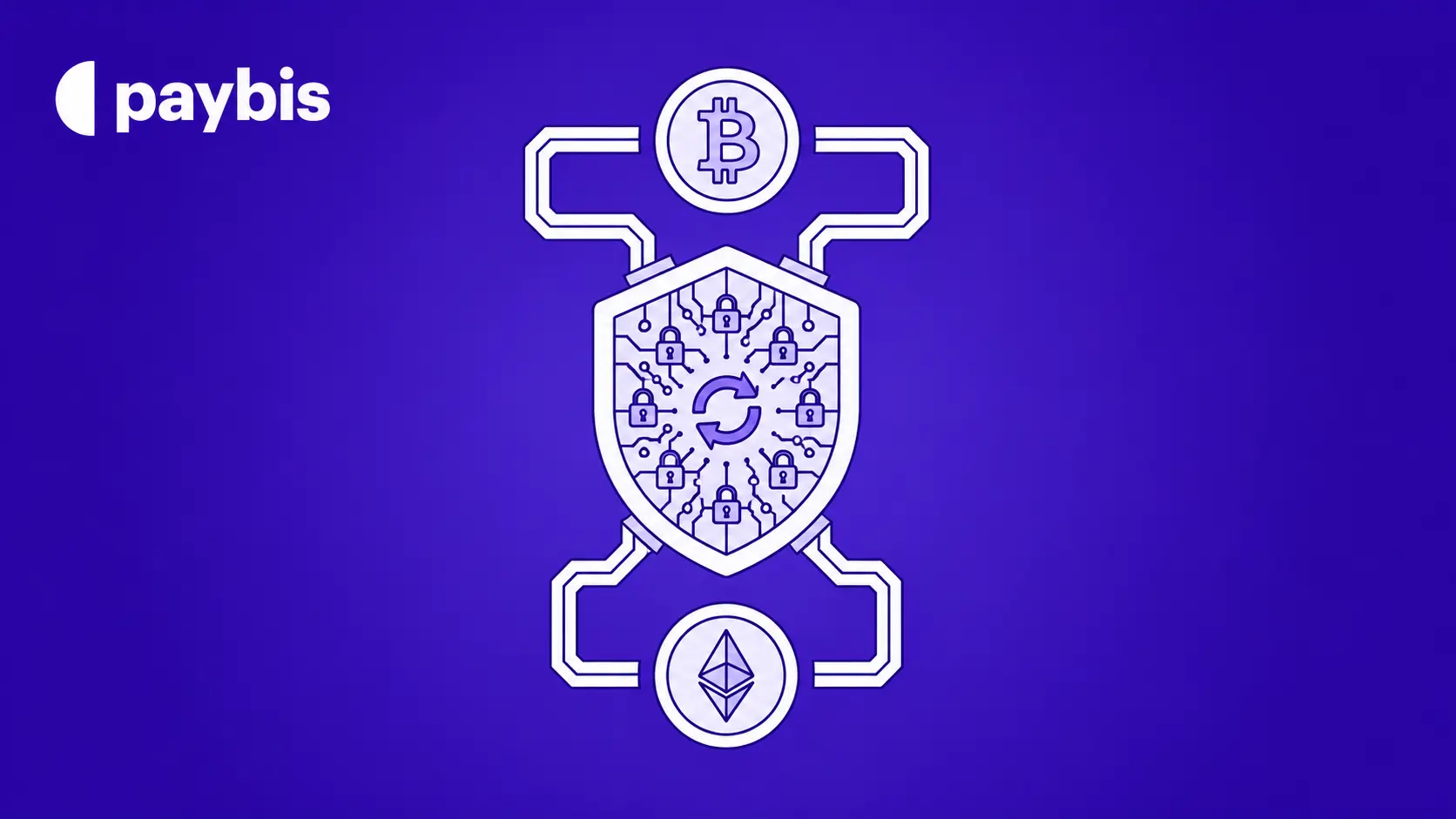
A crypto swap is exchanging one cryptocurrency for another directly, without converting to cash first. Swapping Bitcoin for Ethereum happens on-chain in a single step. The process is fast, but the risks are real if you do not know what to watch for. Whether you prefer to buy Bitcoin with PayPal, buy Bitcoin with ACH transfer, buy Litecoin with PayPal, or buy Bitcoin with Revolut Pay, the same security principles apply to every method. This guide breaks down every major vulnerability, the red flags to spot in real time, and the habits that keep funds safe from start to finish.
Key Vulnerabilities In Crypto Exchange Apps
Understanding where the risks live is the first step to avoiding them.
Decoding Smart Contract Flaws
A smart contract is automated code on a blockchain that executes transactions without a middleman. Nick Szabo, who popularized the concept, compared smart contracts to vending machines. Insert money, select a product, and the machine delivers it automatically based on pre-written rules. The problem is that poorly written code contains bugs, and attackers look for those bugs before anyone else does. Unaudited smart contracts, meaning code never reviewed by an independent security firm, carry the highest risk. Always check whether a platform’s contracts have been reviewed by reputable firms such as CertiK or Trail of Bits before using any decentralized protocol. For a deeper primer on how this technology works, the guide to what smart contracts are explains the mechanics and risks in plain language.
Spot Fake Crypto Swap Apps
Scammers clone legitimate apps down to the logo, color scheme, and interface layout. Before downloading any crypto app, check these four signals:
- Developer name: Look for an exact match with the official company website. Fraudulent apps use names that differ by one or two characters.
- Download count: Established platforms show millions of downloads. A recently published app with a disproportionately low download count relative to its claimed user base should raise concerns.
- Review quality: Fake apps often show generic praise with no specific detail, or reviews all posted on the same date.
- Permissions: Genuine wallet apps only request what is strictly necessary. Any app requesting microphone or contact access without a clear reason is a red flag.
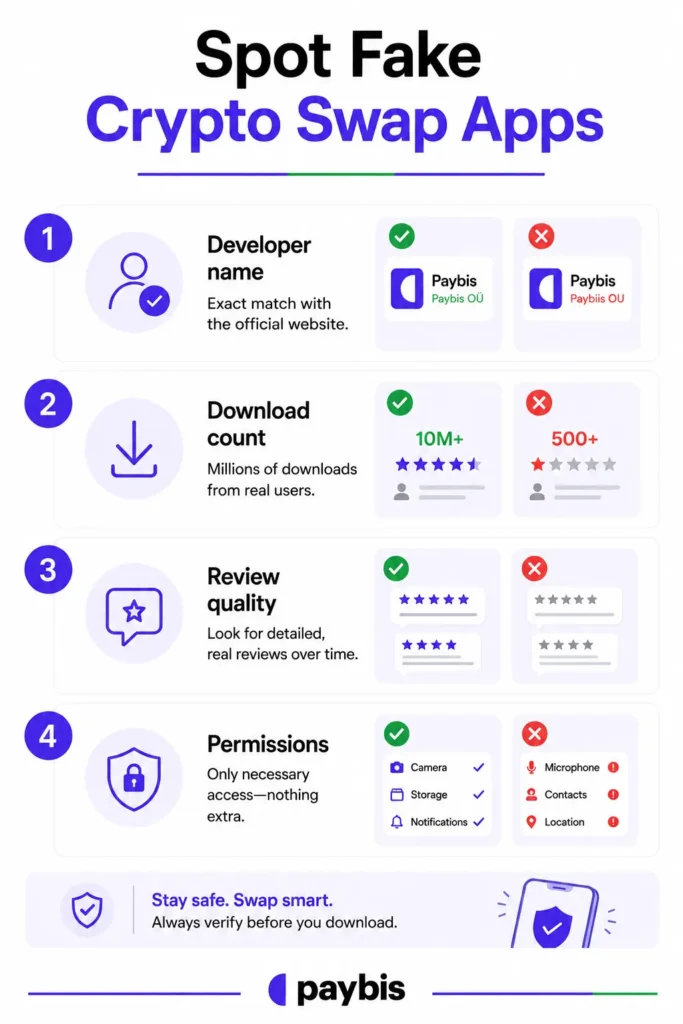
For safe access, go directly to the site or use the verified Paybis app on Google Play rather than searching app stores and trusting top results. If you are evaluating which app to trust, the best crypto mobile app guide walks through what to look for in a secure, well-reviewed option.
Spotting Fake Crypto Projects
Honeypot tokens are designed so buyers can purchase them but can never sell. The token appears to gain value, you buy in, and then find the smart contract blocks any sell order. Your funds are permanently trapped. Rug pulls work differently: developers launch a project, generate hype, attract buyers, and then withdraw all backing reserves in a single transaction. The token price collapses to near-zero instantly.
Exchange Account Compromises
Phishing and weak password attacks are by far the most common account takeover methods. Account compromises also happen through password reuse when other sites are breached, and through SIM swapping, where attackers convince a mobile carrier to transfer a phone number they control. The defense against all three is the same: switch from SMS-based two-factor authentication (2FA) to an authenticator app, which generates codes on your device without involving your phone carrier, and use a unique strong password for every platform. The Paybis wallet security guide covers the full setup checklist.
Avoid Losing Money To Slippage
Slippage is the difference between the price you see when you click “swap” and the price you actually receive when the transaction processes. Think of it like an airport exchange rate that shifts while you wait in line. You expect $5 per unit, but by the time you reach the counter the price has moved to $5.50, so you receive fewer than planned. On platforms that lock pricing before confirmation, this risk is eliminated for the duration of the lock. Paybis locks your price for 15 minutes at checkout.
How To Spot A Crypto Swap Scam Before You Lose Money
Knowing vulnerability categories is half the battle. Spotting specific scam mechanics in real time is the other half.
Spotting Fake Crypto Swap Sites
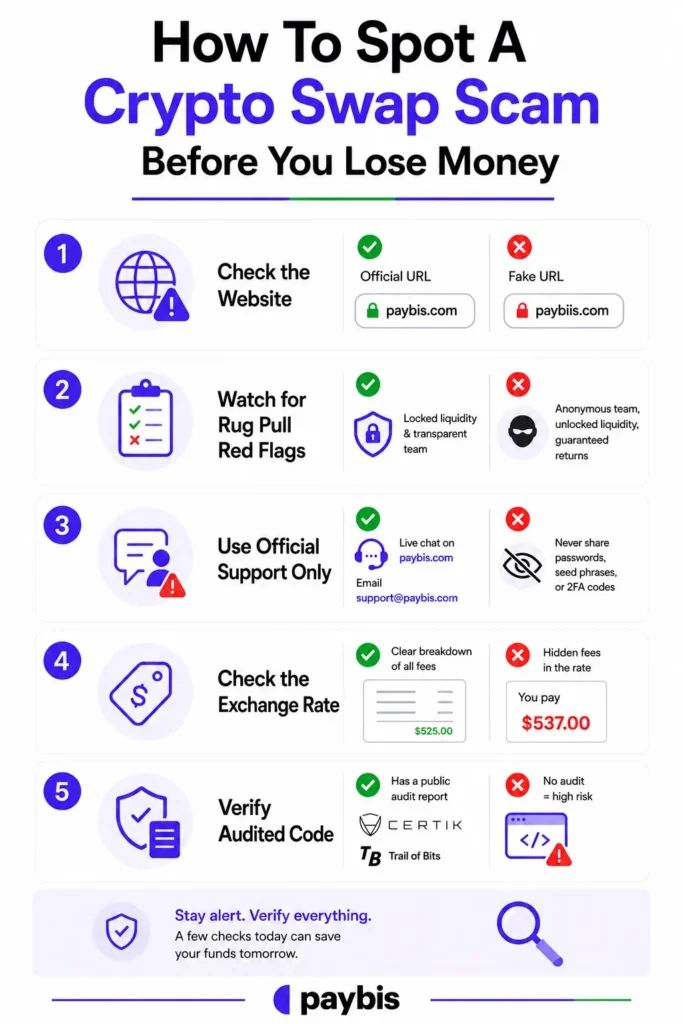
Front-end exploits target the website interface rather than the underlying blockchain. A fake site mimics a legitimate one pixel-for-pixel but routes transactions to an attacker’s wallet. URL spoofing is the primary delivery mechanism, changing one or two characters in a domain name to create a convincing fake. Always type the URL directly or use a saved bookmark. Never follow links from emails, social media DMs, or pop-up advertisements.
Warning Signs Of Rug Pull Projects
Before buying any new token, run through this checklist:Are the developers publicly identified with verifiable histories?Is the liquidity locked in a smart contract for a defined period?Does a small number of wallets hold the majority of supply?Is the project making promises of guaranteed high returns?
Anonymous teams, unlocked liquidity, concentrated holdings, and guaranteed returns are the four most consistent rug pull warning signs. Understanding what liquidity means in crypto markets is essential background for evaluating these risks. The Paybis guide to popular broker scams covers additional patterns that new users encounter frequently.
Phishing Via Fake Support Channels
Phishing attacks via fake Telegram groups, Twitter accounts, and Discord servers are among the most common contact vectors for crypto scams. Attackers pose as customer support representatives, request account credentials or seed phrases, and drain funds immediately.
Legitimate Paybis support is available through the embedded live chat on paybis.com and via email at support@paybis.com, as listed on the Paybis contact page. Paybis support agents never ask for a password, seed phrase, or 2FA code. Average response time is 1-2 minutes, 24/7, in 9+ languages.
Spotting Scam Exchange Rates
Hidden spreads are a fee layer that many platforms embed into the exchange rate itself rather than listing separately. A “$500 purchase” costs $537 because a spread was baked into the quoted price, with no line item showing the actual deduction. Paybis displays every fee component, including service fee, payment processing fee, and the network fee (the cost miners charge to process a transaction on the blockchain), before confirmation. The total shown at checkout is the total charged to your card. For a detailed breakdown of how decentralized exchange costs compare, see the DEX fees vs Paybis guide.
How to Spot Unaudited Code
For any decentralized platform, look for a publicly available security audit report from a named firm. If a platform cannot link to an audit report, treat it as unvetted. CertiK’s audit database and Trail of Bits’s published reports provide publicly accessible records of audited protocols. No report means no independent verification of the code your funds depend on.
Security Audit Status Of Major Swap Platforms
Not all security claims carry the same weight. Understanding what makes an audit legitimate lets you evaluate any platform in under five minutes.
Spotting A Secure Crypto Audit
A credible security audit typically meets four criteria: conducted by a qualified auditor, ideally an independent named firm such as CertiK, Sherlock, or OpenZeppelin (though audits from other qualified sources can still carry weight), ideally published as a full public report rather than a summary badge, since leading firms such as Least Authority publish the majority of their reports openly as a transparency standard, completed on the current version of the code since audits apply only to the specific version reviewed at the time, and covering both smart contract logic and custody model. Platforms that share full audit reports openly have nothing to hide.
Top Swap Platforms With Vetted Security
For centralized platforms, regulatory compliance and payment security certification perform the equivalent function of a smart contract audit. Here is how major platforms compare:
| Platform | Type | Security Verification | Compliance Status |
|---|---|---|---|
| Paybis | Centralized | FinCEN (US: 31000272911973), FINTRAC (CA), PCI DSS Level 1 | Current (2026) |
| Coinbase | Centralized | FinCEN registered, SOC 2 Type 2 | Current |
| Binance | Centralized | Multiple jurisdictions, ISO 27001 | Current |
| Kraken | Centralized | FinCEN registered, SOC 2 Type 2 | Current |
| Uniswap v3 | Decentralized | Trail of Bits, ABDK audits | Public reports available |
| 1inch | Decentralized | OpenZeppelin, Pessimistic | Public reports available |
Paybis holds FinCEN registration (US entity 31000272911973) and FINTRAC registration (Canada), carries PCI DSS Level 1 certification (the highest standard for payment processing security), and has recorded zero security breaches since launching in 2014 across $5B+ in total processed volume.
For context on what exchange security failures look like:
Warning: Unvetted Crypto Swap Sites
Using an unregistered exchange means zero consumer protection if something goes wrong. There is no regulator to contact, no fund insurance, and no legal recourse if the platform disappears. The custodial wallet risks guide explains exactly what questions to ask before trusting any platform with funds.
Your Guide To Checking Crypto Audits
Follow these four steps before using any swap platform:
- Search the platform name on FinCEN’s MSB registrant search to confirm US registration.
- Check CertiK or Trail of Bits for a published audit report linked directly from the platform’s website.
- Verify the official domain matches the address on the platform’s regulatory filing exactly.
- Check Trustpilot review volume and recency. Paybis has 30,780+ Trustpilot reviews with a 4.1 rating, reflecting sustained trust over years rather than manufactured spikes.
Secure Your Crypto Swap App From Phishing
Phishing causes the majority of personal crypto losses. These four habits eliminate most of the risk.
Save Trusted Crypto Swap Sites
Bookmark every legitimate crypto platform you use. This simple step eliminates the risk of a typo or a spoofed search result. Paid search ads can promote fraudulent sites that appear above legitimate results, so “top result” is never a reliable trust signal.
Verify URLs Before Connecting Your Wallet
Before connecting a wallet or entering payment details, check three things:
- The full URL is exactly correct with no character substitutions
- HTTPS is present (look for the padlock icon in the browser address bar, though note this confirms the connection is encrypted, not that the site is legitimate)
- No suspicious subdomains appear before the main domain (for example, avoid secure-paybis.com or paybis-swap.com)
The guide to swapping on an external wallet also covers safe wallet connection steps for each transaction type.
How To Identify Fake Support
Real support teams share one defining characteristic: they never ask for a seed phrase, password, or 2FA code. If a “support agent” requests any of these via chat, Telegram, Twitter DM, or email, that person is a scammer regardless of what logo appears in their profile. The Paybis PayPal scam article covers a related pattern where scammers fabricate disputes to extract sensitive credentials.
Legitimate Paybis support connects through the chat widget on paybis.com or via email at support@paybis.com, with human agents responding in 1-2 minutes around the clock.
Keep Your Seed Phrase Safe From Scams
A seed phrase is the master password for a crypto wallet: a string of 12 to 24 words that restores full access on any device. Anyone who has it controls every asset in that wallet, permanently. The single rule that prevents most seed phrase theft: never type it into any website, pop-up window, or app that has not been independently verified as legitimate. Write it on paper and store it physically. Never photograph it, email it, or save it in cloud notes or messaging apps. For guidance on choosing a secure place to store your assets in the first place, see the best Bitcoin wallets guide.
Protect Large Crypto With Hardware Wallets
For holdings above a few thousand dollars, cold storage (an offline device that stores private keys disconnected from the internet) provides meaningfully stronger protection than any online platform. These devices sign transactions offline, meaning even a fully compromised computer cannot access the keys. Purchase only from a manufacturer’s official website or authorized retailers, and verify the packaging is factory-sealed before first use. Counterfeit hardware devices with pre-loaded malicious firmware are a documented and active attack vector.
Understand Slippage: Avoid Costly Mistakes
Slippage causes losses even on legitimate platforms, often without the user realizing what happened until after the transaction confirms.
How Slippage Affects Your Crypto Swap
Picture the airport analogy: you check the rate board, walk to the counter, and by the time you reach the window, the rate has shifted against you. In crypto, other transactions process between the moment you click “swap” and the moment your transaction confirms on the blockchain. High-volume assets like Bitcoin and Ethereum move less. Low-liquidity tokens can shift dramatically between the quote and execution.
Set Your Safe Slippage Range
Most decentralized swap interfaces let you set a maximum slippage tolerance before confirming. Security best practices recommend keeping this between 0.1% and 5%, depending on the asset’s trading volume and current network fees. Setting it too high exposes transactions to automated bots that can exploit the gap.
High Slippage: Lost Funds Risk
Low-liquidity tokens are the most dangerous in this context. When a token has small backing reserves, even a moderately-sized swap can move the price by 20% or more during execution, delivering far less crypto than the quoted figure suggested. The guide to exchange token investments on Paybis explains how to evaluate token liquidity before committing any amount.
Prevent Front-Running Swap Scams
Front-running is an automated attack where bots detect a pending transaction, buy the same token before it executes to drive the price up, and then sell immediately after, leaving the original buyer with fewer tokens than expected. Keeping slippage tolerance low reduces the window these bots can exploit. Centralized platforms like Paybis use locked pricing at checkout and are not subject to this attack type.
Smart Practices For Secure Crypto Swaps
These habits reduce exposure to the most common attack vectors.
Test Small Crypto Swaps First
Before moving any significant amount, send a small test transaction to the destination wallet and confirm it arrives correctly. This prevents losses from copied wallet addresses, wrong network selection, and clipboard-hijacking malware. If the test transaction lands incorrectly, the guide on wrong-network sends explains recovery steps before the full amount is at risk.
Verify Recipient Wallet Address
Clipboard-hijacking malware silently replaces copied wallet addresses with an attacker’s address. After pasting a wallet address, verify multiple characters at both the beginning and end against the original source. Note that sophisticated malware can create near-identical lookalike addresses that pass a simple four-character check. Cross-referencing the full address or using an address verification tool adds an important extra layer. If a fraudulent address is encountered, report it to Paybis to protect other users.
Choose Proven Crypto Swap Apps
Track record is the most reliable security signal available. Paybis has served 5M+ retail users across 180+ countries with zero security breaches since 2014. The 31,000+ Trustpilot reviews with a 4.1 rating reflect a consistent user experience across years, not a recent spike.
One verified user summarizes the experience directly:
“Onboarding: Fast and transparent. Identity verification is well explained with clear progress indicators, reducing anxiety… fees are shown upfront, and transaction speeds were consistently good during my tests.” – Joon Huh on Trustpilot
“Paybis has an easy platform to purchase crypto. And the processing is extremely fast! I am using Paybis for my retail transactions.” – Sandra Jenkins on Trustpilot
How To Enable Crypto Safeguards
Four settings every crypto user should activate today:2FA via authenticator app: Switch from SMS codes to an app-generated code that requires physical device access.Strong unique password: 20+ characters, unique per platform, stored in a password manager.Login notifications: Enable email or app alerts for new device logins wherever the option is available.Withdrawal address restrictions: Where available, restrict withdrawals to pre-approved wallet addresses only.
Stay Safe: Update Your Crypto Tools
Outdated browsers, wallet apps, and operating systems contain known vulnerabilities that attackers actively exploit. Updates patch those vulnerabilities. Enable automatic updates for all financial apps and keep mobile operating systems current. This applies to the Paybis mobile app, where updates include security patches alongside new features, and to any browser used to access web-based platforms.
Verify Crypto Before You Swap
Before buying any token, find the official contract address on the project’s verified website or official social profile. Paste that address into the correct blockchain explorer for the relevant chain and confirm it matches exactly. Names, logos, and ticker symbols can all be cloned by scammers in minutes, but the contract address recorded on the blockchain is the only reliable identifier for any token. This habit is especially important when a token is trending and copycat versions proliferate rapidly. The cryptocurrency trading guide covers verification habits and broader due diligence practices that apply to every swap decision.
Lost Crypto? Your First Steps To Recovery
Speed matters if something goes wrong. Take these steps immediately.
Capture Transaction Details And Proof
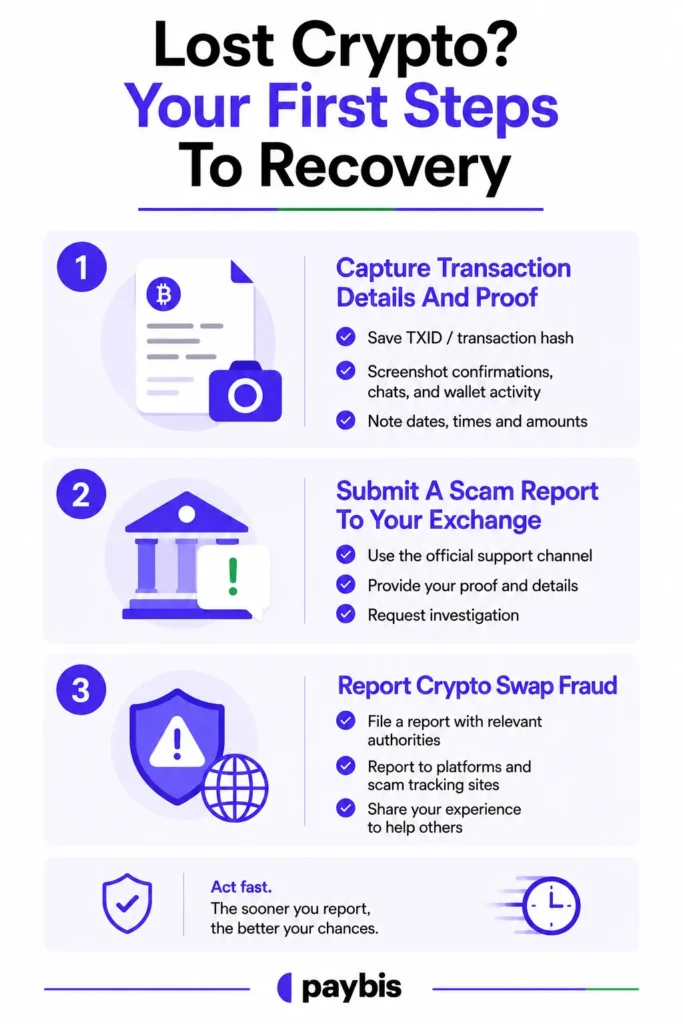
Before contacting anyone, document everything: screenshot the confirmation screen, save the transaction hash (TXID, the unique identifier assigned to every blockchain transaction), record the destination wallet address and exact amount, and note the time and date. This documentation is required for every formal report.
Submit A Scam Report To Your Exchange
Contact your platform’s official support immediately. For Paybis users, 24/7 live chat connects to a human agent in 1-2 minutes. Provide the TXID, destination address, and full transaction documentation. The Paybis wallet swap guide details what information the support team needs for any transaction inquiry.
Report Crypto Swap Fraud
File a complaint with the relevant authorities. In the United States, submit to IC3.gov, the FBI’s Internet Crime Complaint Center. Provide your name, contact details, the platform involved, and all transaction records. Filing contributes to investigations that have led to prosecutions and partial fund seizures in documented cases.
Why Crypto Transfers Are Final
Blockchain transactions are irreversible by design. Once a transaction confirms on the network, no platform, bank, or government can reverse it. This is the fundamental difference between crypto and a credit card payment. Be cautious of any offer promising to reverse a confirmed blockchain transaction in exchange for an upfront fee. Verify everything before clicking confirm.
Essential Security Tips For Safe Crypto Swaps
These final points reinforce the most important conclusions from this guide.
Getting Your Scammed Crypto Back
Recovery is possible in limited circumstances, primarily when funds arrive at a regulated exchange that can freeze the receiving account in response to a law enforcement order. It is rare and typically takes months or longer when possible.
Decentralized vs. Centralized Swap Security
Centralized exchanges (CEX) hold your funds during a swap, while decentralized exchanges (DEX) execute swaps through smart contracts without taking custody. Both carry specific risks.
| Feature | CEX Risk | DEX Risk | How to Mitigate |
|---|---|---|---|
| Custody | Exchange holds keys (IOU model) | User holds keys, risk is smart contract integrity | Use regulated CEXs with cold storage, audit DEX contracts before use |
| Primary attack type | Exchange hack or insolvency | Smart contract exploit or scam token | Verify regulatory status, check published audit reports |
| Scam vectors | Phishing, fake apps, support impersonation | Honeypot tokens, rug pulls, front-running | Verify URLs, check contract addresses, set low slippage tolerance |
| Consumer protection | Depends on regulatory registration status | None in most cases | Stick to audited, registered protocols |
Paybis operates as a regulated centralized gateway. The Paybis Kraken security comparison explores how this custody model compares against other centralized approaches in more detail.
Verify A Swap Platform’s Legitimacy
Before using any crypto platform, complete this four-point check:
- Regulatory registration: Search FinCEN’s MSB registrant database and FINTRAC’s registry for the platform name.
- Security certification: Look for PCI DSS Level 1 compliance, the standard Paybis holds.
- Security track record: Search news archives for breach reports. Paybis has zero since 2014.
- Human support access: Contact support before an emergency. Difficulty reaching a human is a meaningful risk signal.
Avoid Mistakes: Secure Beginner Crypto Swaps
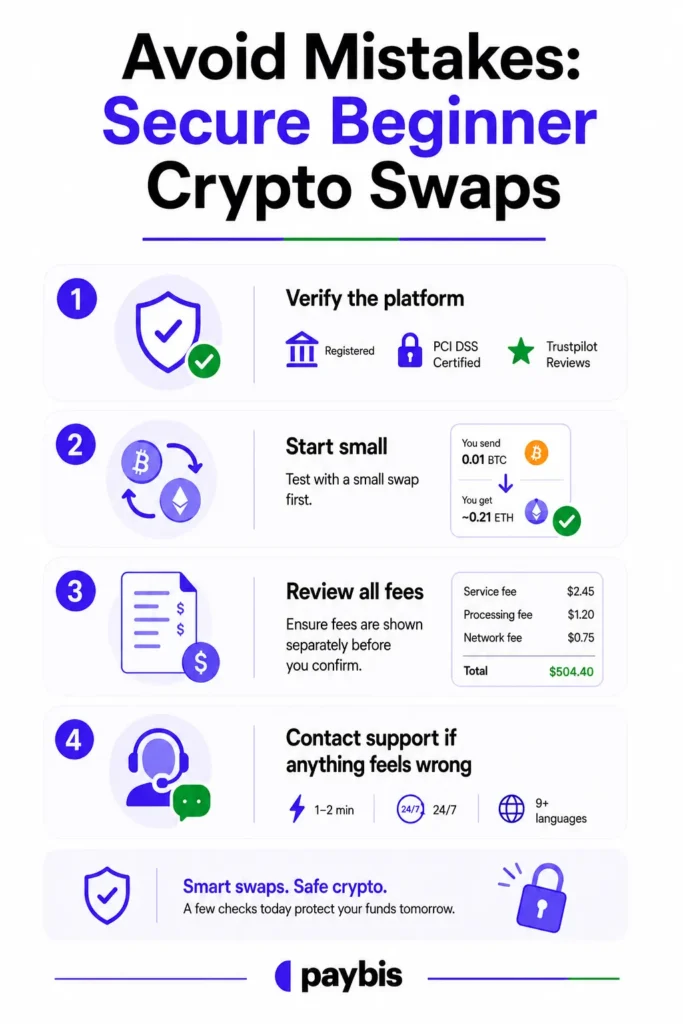
Here is the 4-step safe swap process:
- Verify the platform: Check registration status, PCI DSS certification, and Trustpilot reviews before creating an account.
- Start small: Run a small test swap to confirm the receiving wallet is correct and the platform performs as described.
- Review all fees: Confirm the service fee, processing fee, and network fee all appear as separate line items before confirming.
- Contact support if anything feels wrong: On Paybis, a human responds in 1-2 minutes, 24/7, in 9+ languages.
Do I Need A Security Audit To Swap Safely?
There is no need to conduct an audit personally, but rely on platforms that have already passed one. For centralized platforms, FinCEN registration, FINTRAC registration, and PCI DSS Level 1 certification provide the equivalent security baseline. For decentralized protocols, a recent public report from a named auditor is the minimum requirement before use.
Ready to swap crypto securely? Create a Paybis account, complete identity verification in 2 minutes, and swap with all fees shown upfront and 24/7 human support available throughout the process. Paybis supports 90+ cryptocurrencies across 180+ countries with 20+ payment methods.
Key Terminology
- Crypto swap: Exchanging one digital asset directly for another without converting to cash first. Bitcoin to Ethereum is a swap. Bitcoin to dollars is a sell.
- Slippage: The difference between the expected price of a swap and the actual execution price, caused by price movement between the moment a transaction is confirmed by the user and when it processes on the blockchain.
- Seed phrase: A master password of 12 to 24 words that restores full access to a crypto wallet on any device. Anyone who obtains it controls all assets in that wallet. Never share it under any circumstances.
- Smart contract: Automated code on a blockchain that executes transactions without a middleman. Unaudited code can contain bugs that attackers exploit to drain funds.
- Transaction hash (TXID): A unique identifier assigned to every blockchain transaction, used to track, verify, and investigate any transfer on the blockchain. Save this immediately after any transaction where something goes wrong.
- Cold storage: An offline device that stores private keys disconnected from the internet, providing significantly stronger protection for large holdings than any online wallet.
FAQ
Is Swapping Crypto Safe?
Yes, swapping crypto is safe when you use a regulated platform, verify the URL before connecting a wallet, and confirm all fees before completing the transaction. Most losses come from phishing, fake apps, and unvetted platforms rather than fundamental blockchain failures.
What Happens If My Swap Fails On Paybis?
If a transaction is rejected for security or compliance reasons, Paybis initiates a refund to your original payment method per its refund policy. Contact 24/7 live chat to confirm the status and get guidance on next steps.
How Much Are Swap Fees On Paybis?
Paybis service fees start from 1.49%, with 0% service fee on the first card transaction. Processing fees are 4.5-8.5% for card transactions over $50 (depending on currency), plus a network fee that varies with blockchain congestion. All three fee components appear as separate line items before confirming any transaction.
How Do I Know If A Crypto Platform Is Legitimate?
Check for FinCEN registration at the FinCEN MSB registrant search, FINTRAC registration, PCI DSS Level 1 certification, a breach-free track record, and verified Trustpilot reviews. Paybis meets all five criteria with 30,780+ Trustpilot reviews and a 4.1 rating.
What Should I Do If I Sent Crypto To The Wrong Address?
Document the transaction immediately with screenshots and the TXID (the unique identifier assigned to every blockchain transaction), then contact platform support. The wrong-network send guide covers specific recovery steps, including when intervention is possible and when a transaction is irreversible.
Disclaimer: Don’t invest unless you’re prepared to lose all the money you invest. This is a high‑risk investment and you should not expect to be protected if something goes wrong. Take 2 mins to learn more at: https://go.payb.is/FCA-Info