Crypto Swap Tax Implications: What You Need to Report in 2026
Key Takeaways:According to IRS guidance, swapping one cryptocurrency for another (Bitcoin for Ethereum, for example) is generally treated as a taxable event. The IRS treats cryptocurrency as property, so every swap typically counts as selling the first asset and buying a new one. Tax professionals generally calculate your gain by subtracting your original cost basis from the fair market value at the time of the swap. Standard practice is to report each swap on Form 8949 and summarize on Schedule D. Transferring crypto between wallets you own is generally NOT considered taxable. Ready to get started? You can buy Bitcoin with a bank account, with PayPal, store assets in a Paybis crypto wallet, or swap BTC to ETH base directly on Paybis.
A crypto swap is exchanging one digital asset directly for another without converting to dollars first. Here’s everything you need to know, in plain English, to file your 2026 return correctly.
What Crypto Swaps Are and Why the IRS Taxes Them
When you swap Bitcoin for Ethereum, you are technically selling Bitcoin and using the proceeds to buy Ethereum. The fact that no dollars touched your bank account doesn’t matter. You disposed of an asset, and that disposal creates a taxable event. If you want to make this kind of move yourself, you can swap BTC to ETH on Paybis in just a few steps.
According to IRS guidance, cryptocurrency is treated as property, not currency. This is the foundational rule that makes every swap taxable. When you swap Bitcoin for Ethereum, you are technically selling Bitcoin and using the proceeds to buy Ethereum. The fact that no dollars touched your bank account doesn’t matter. You disposed of an asset, and that disposal creates a taxable event.
One loophole that no longer exists: the like-kind exchange rule. Before 2018, some investors argued that swapping one crypto for another qualified for Section 1031 deferral. According to tax guidance, changes to tax law closed that permanently for all non-real estate assets. The IRS has confirmed that no crypto swap qualifies for like-kind exchange treatment.
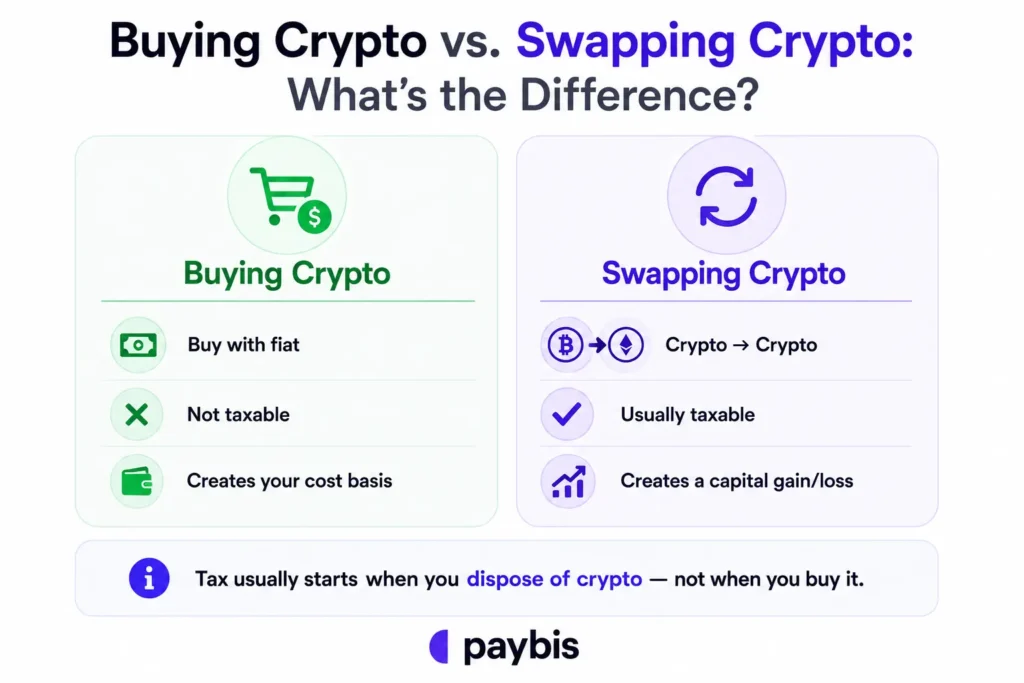
Buying Crypto vs. Swapping Crypto: The Key Difference
Buying crypto with dollars is not a taxable event on its own. You simply acquire an asset with a cost basis equal to what you paid, including fees. The tax only applies when you dispose of that asset, whether by selling it for fiat, spending it, or swapping it for a different coin. You build the tax liability on the way out, not on the way in.
According to standard tax treatment, buying crypto with dollars is not a taxable event on its own. You simply acquire an asset with a cost basis typically equal to what you paid, including fees. The tax only applies when you dispose of that asset, whether by selling it for fiat, spending it, or swapping it for a different coin. You build the tax liability on the way out, not on the way in.
Any exchange of one cryptocurrency for another is a taxable disposal. Common examples:
- Swapping Bitcoin (BTC) for Ethereum (ETH)
- Swapping Ethereum for a stablecoin like USDC (yes, stablecoin swaps are taxable, because stablecoins are still classified as property under tax law regardless of their dollar peg)
- Swapping any token for any other token on a centralized or decentralized exchange
One crucial exception: According to tax guidance, moving crypto between wallets you own is generally not a taxable event. No disposal has occurred, so no tax applies. Transferring Bitcoin from your Paybis wallet to an external hardware wallet you control typically doesn’t trigger a tax bill. For guidance on how Paybis records this kind of move, see the Paybis wallet withdrawal guide.
The formula for every swap is: Capital Gain (or Loss) = Fair Market Value at Swap – Cost Basis
If the swap produced a loss (you swapped for less than you originally paid), that loss can offset other capital gains, which reduces your total tax bill. Keep records of every losing swap, because those losses have real value at filing time.
Track Your Cost Basis from Day One
Your cost basis is the total amount you spent to acquire the cryptocurrency you’re swapping, including every fee paid at purchase. Per IRS Form 8949 instructions, the basis of a digital asset includes transaction fees, commissions, and other acquisition costs. Missing fees means you overstate your taxable gain and pay more tax than you legally owe. For a practical overview of how to execute swaps and track the associated data, see our guide on how to swap crypto instantly.
This is where Paybis’s fee structure makes a practical difference at tax time. We display Service Fee (starting from 1.49%), Processing Fee, and Network Fee on every transaction before you confirm. Your cost basis starts from an accurate, complete number, not an estimate. Platforms that embed hidden spreads make this calculation much harder to get right.
Fair market value (FMV) is the price your crypto would have sold for on the open market at the exact moment of the swap, expressed in US dollars. Two practical examples:You swap 1 BTC for 20 ETH. If Bitcoin is trading at $90,000 at that moment (a hypothetical figure for illustration), your FMV for the disposal is $90,000.You swap 500 USDC for 0.005 BTC on June 10, 2025. Bitcoin is priced at approximately $100,000, making 0.005 BTC worth $500. Your FMV for disposing of the USDC is $500.
Use the price on a reputable exchange at the exact time of the transaction and record both the price and the timestamp.
Short-Term vs. Long-Term Capital Gains
How long you held the crypto before swapping determines your tax rate. The IRS applies a one-year rule:
| Holding Period | Tax Treatment | 2025 Tax Year Rate (Most Individuals) |
|---|---|---|
| 1 year or less | Short-term capital gain | Taxed as ordinary income (up to 37%) |
| More than 1 year | Long-term capital gain | No higher than 15% for most filers |
Here is a full illustrative example using round numbers:
- January 2024: You buy 1 Bitcoin for $30,000. Your cost basis is $30,000.
- March 2025 (more than one year later): You swap that 1 Bitcoin for 20 ETH when Bitcoin’s market price is $40,000.
- Calculate your gain: $40,000 (FMV received) minus $30,000 (cost basis) = $10,000 taxable gain.
- Determine your rate: You held Bitcoin for more than one year, so this is a long-term capital gain taxed at no higher than 15% for most filers.
- Estimate tax owed: Approximately $1,500 at the 15% long-term rate.
Form 8949 and Schedule D
You report every individual crypto disposal, including swaps, on Form 8949. For each swap, enter the date acquired, date swapped, proceeds (FMV at swap), cost basis, and gain or loss. Schedule D then summarizes the totals from Form 8949, separating short-term and long-term gains.
Crypto tax software tools like Koinly and CoinTracker can import your transaction history directly from exchanges and generate a Form 8949-ready report automatically, which saves significant time if you made more than a handful of swaps. If you’re weighing which platform to use for your trades, our comparison of Paybis vs Binance for fast crypto purchases breaks down the key differences in fee transparency and record-keeping.
Form 1099-DA: The New 2026 Filing Requirement
Starting with the 2025 tax year, centralized exchanges registered in the US must issue Form 1099-DA reporting your gross proceeds from crypto sales and swaps. Brokers must furnish these to taxpayers by February 17, 2026, and file a copy directly with the IRS. For a full breakdown of how this affects your filing, CountDeFi’s Form 8949 and Schedule D guide covers the 1099-DA rollout in detail.
This is a significant shift. The IRS now receives a direct reporting feed from major exchanges, which means it can automatically match your return against exchange data. Accurate self-reporting matters more in 2026 than it ever has.
According to tax guidance, starting with the 2025 tax year, centralized exchanges registered in the US are expected to issue Form 1099-DA reporting your gross proceeds from crypto sales and swaps. Brokers are expected to furnish these to taxpayers by February 17, 2026, and file a copy directly with the IRS. For a full breakdown of how this affects your filing, CountDeFi’s Form 8949 and Schedule D guide covers the 1099-DA rollout in detail.
This is a significant shift. According to tax guidance, the IRS is expected to receive a direct reporting feed from major exchanges, which means it can potentially match your return against exchange data. Accurate self-reporting matters more in 2026 than it ever has.
Prepare Your Records Before You File
The core principle, that swapping one cryptocurrency for another is a taxable disposal applies in the UK, Canada, and Australia as well. According to tax guidance, HMRC applies Capital Gains Tax to crypto swaps in the UK (see the Blockpit HMRC guide for UK-specific rules). According to guidance, the CRA treats crypto as property in Canada, and the ATO applies Capital Gains Tax in Australia, including a 50% CGT discount for assets held over one year. If you’re filing outside the US, the concepts in this article apply directionally, but each jurisdiction uses different forms, rates, and calculation methods. Consult a local tax professional for jurisdiction-specific guidance.
Before you begin organizing records, it helps to understand how you came to hold your crypto in the first place. If you’re newer to crypto or considering your first purchase, our guide on how to choose which exchange to buy Bitcoin from explains what to look for in a platform, including fee transparency that directly affects your tax records. It’s also worth reading how to create and verify an account on Paybis so your identity is confirmed and your transaction history is properly attributed before you export records for tax filing.
Required Crypto Swap Tax Records
For each swap you make, keep the following:
- The cryptocurrency you disposed of and the quantity
- The date you originally acquired it
- The date of the swap
- Fair market value in USD at the exact time of the swap
- Your original cost basis, including all fees
- The cryptocurrency you received and its FMV at receipt
- Wallet addresses involved
Software for Accurate Swap Taxes
Crypto tax software automates the heavy lifting. Tools like Koinly and CoinTracker import transaction history directly from exchanges, calculate gains automatically, and generate Form 8949-ready reports. If fee-related discrepancies between platforms have ever caused you confusion at tax time, our breakdown of 5 hidden Coinbase fees and how to avoid them is worth reviewing before you import your data.
Get Your Transaction History from Paybis
Accurate taxes start with accurate data. You need a complete transaction history before any software or spreadsheet can produce reliable numbers.
How to Export Your History from Paybis
Follow these steps: Log into your account at paybis.com. Navigate to your transaction history or account dashboard. Select the date range covering your tax year. Export the data as a CSV file.
You can also review the Paybis swap guide and the external wallet swap instructions for additional context on how your swaps are recorded.
Because Paybis shows your Service Fee, Processing Fee, and Network Fee on every transaction before you confirm it, you know exactly what you paid at the time of purchase. This upfront transparency makes tax reporting simpler than platforms that hide fees in spreads or show only total amounts. With 5M+ retail users and $1.2B+ in annual transaction volume (last 12 months as of Oct 2025), Paybis’s records are complete and reliable.
“The interface is clear, transactions are fast, and support has been helpful whenever I had questions.” – Elizar S. on G2
Both Binance and Coinbase offer transaction history exports under account settings. On Coinbase, navigate to “Taxes” and download the transaction report. On Binance, use “Transaction History” under the Wallet section. Both platforms export data with dozens of columns that often need cleanup before they work cleanly with tax software, whereas Paybis’s fee structure is itemized and consistent on every transaction, which cuts the time spent organizing data.
Common Crypto Swap Tax Mistakes to Avoid
Small errors in crypto tax reporting can trigger IRS CP2000 notices and audits, but they’re easy to avoid once you know what to watch for.
Both Binance and Coinbase offer transaction history exports through their account settings. Check each platform’s documentation for specific export procedures. Paybis’s fee structure is displayed before each transaction, which can simplify the data organization process for tax reporting.
If you used decentralized exchanges (DEXs), there’s no central account to log into. According to tax guidance, you may need to pull your history from a blockchain explorer using your wallet address, or use crypto tax software that can import from your public wallet address. Swaps executed through a DeFi protocol are generally considered taxable events, even if they don’t appear in a standard exchange export.
Getting Your Cost Basis Wrong
Many filers calculate gains using only the purchase price and ignore the fees they paid. Per IRS Form 8949 instructions, acquisition fees increase your cost basis and directly reduce your taxable gain on disposal. Missing these deductions means paying more tax than you legally owe.
Why Accurate Swap Reporting Matters in 2026
As CryptoTaxCalculator notes, tax professionals generally advise reporting every swap, including small ones. Export your complete transaction history from every platform you used and cross-check the totals before filing. Use crypto tax software to catch anything you might have missed.
Because Paybis displays Service Fee (starting from 1.49%), Processing Fee, and Network Fee clearly before you confirm every transaction, there’s no guesswork when claiming these deductions. Your exported history gives you every fee figure you need. Independent reviews at Coin Bureau and 99Bitcoins confirm that fee clarity is a consistent Paybis platform feature, not a marketing claim. The platform has earned 30,780+ Trustpilot reviews with a rating of 4.1 or “Great,” reflecting that consistent experience across 5M+ users.
Ready to prepare your 2026 crypto taxes? Log into Paybis to export your complete transaction history and access every record, every fee, and every date you need to complete Form 8949 accurately. For personalized advice on your specific situation, consult a certified tax professional before finalizing your return.
Key Terminology
- Cost basis: The total amount you paid to acquire a cryptocurrency, including purchase price and all associated fees. This is the starting point for calculating your capital gain or loss when you dispose of the asset.
- Fair market value (FMV): The price your cryptocurrency would have sold for on the open market at a specific moment, expressed in US dollars. For crypto swaps, FMV is measured at the exact moment the swap executes. The IRS now receives direct reporting from major exchanges via Form 1099-DA and has expanded its data-matching capabilities. Unreported swaps can potentially result in CP2000 notices, penalties, and interest on underpaid tax. Accurate reporting is more important in 2026 than ever before.
- Capital loss: The loss realized when you dispose of an asset for less than its cost basis. Capital losses can offset capital gains, reducing your overall tax bill for the year.
- Form 8949: The IRS form where US taxpayers report every individual crypto disposal, including swaps, sales, and spending transactions. Every event that triggers a capital gain or loss gets a row on this form.
- Schedule D: The IRS summary form that totals all gains and losses from Form 8949, separated into short-term and long-term categories, and carries the net result to your main return.
- Form 1099-DA: A new IRS reporting form, effective for the 2025 tax year, that centralized crypto exchanges issue to taxpayers and the IRS to report gross proceeds from crypto disposals.
- Tax-loss harvesting: The strategy of intentionally realizing capital losses on losing positions to offset taxable gains elsewhere in your portfolio, reducing your total tax liability for the year.
FAQ
Is transferring crypto between my own wallets taxable?
No. Moving crypto between wallets you own is not a taxable event because no disposal has occurred. The tax event only triggers when you sell, swap, or otherwise dispose of the crypto.
Will I receive a tax form from my crypto exchange for 2026 filing?
Yes. Starting with the 2025 tax year, US centralized exchanges must send you Form 1099-DA by February 17, 2026, showing your gross proceeds from sales and swaps. Use it to verify your reported proceeds match what the IRS receives directly from the exchange.
Is swapping to a stablecoin like USDC taxable?
Yes. Swapping any cryptocurrency for a stablecoin is a taxable event, the same as any other swap. Stablecoins are classified as property under tax law regardless of their dollar peg. Your gain or loss is calculated the same way: fair market value received minus your original cost basis.
How do I calculate my cost basis for a crypto swap?
Your cost basis is the total amount you originally paid for the cryptocurrency you are swapping, including all fees. If you bought 1 ETH for $2,000 and paid $30 in fees, your cost basis is $2,030. Platforms that show fees upfront, like Paybis, make this straightforward from the moment of purchase.
Can I deduct crypto swap fees from my capital gains?
Yes. Fees paid when acquiring crypto increase your cost basis and reduce your taxable gain on disposal. Fees paid when swapping reduce your proceeds, achieving the same result. Keep records of every fee on every transaction.
Disclaimer: Don’t invest unless you’re prepared to lose all the money you invest. This is a high‑risk investment and you should not expect to be protected if something goes wrong. Take 2 mins to learn more at: https://go.payb.is/FCA-Info