Crypto Swap vs. Crypto Trade: What’s the Difference and Which Should You Use?
Key Takeaways: A crypto swap is a direct, token-to-token exchange that requires no order books, no market analysis, and as few as 3 steps to complete. Trading uses centralized order books and is designed for active market participants who want to profit from price movements. For beginners who want to acquire or exchange crypto today, swapping is faster and simpler. We let users swap Bitcoin to Ethereum, BTC to Uniswap, and swap crypto using an external wallet, supporting 90+ cryptocurrencies using local payment methods (including PIX) with fees shown upfront before confirming.
Most beginners lose time, not money, on the wrong type of transaction. They open a trading platform, see flashing charts, 600+ trading pairs, and terms like “limit orders” and “maker/taker fees,” and immediately close the tab. The good news is that for most everyday crypto goals, a swap gets the job done without any of that complexity. Whether you’re looking to swap crypto instantly or simply convert between assets, understanding the difference between swapping and trading will save you both time and fees.
What Is a Crypto Swap?
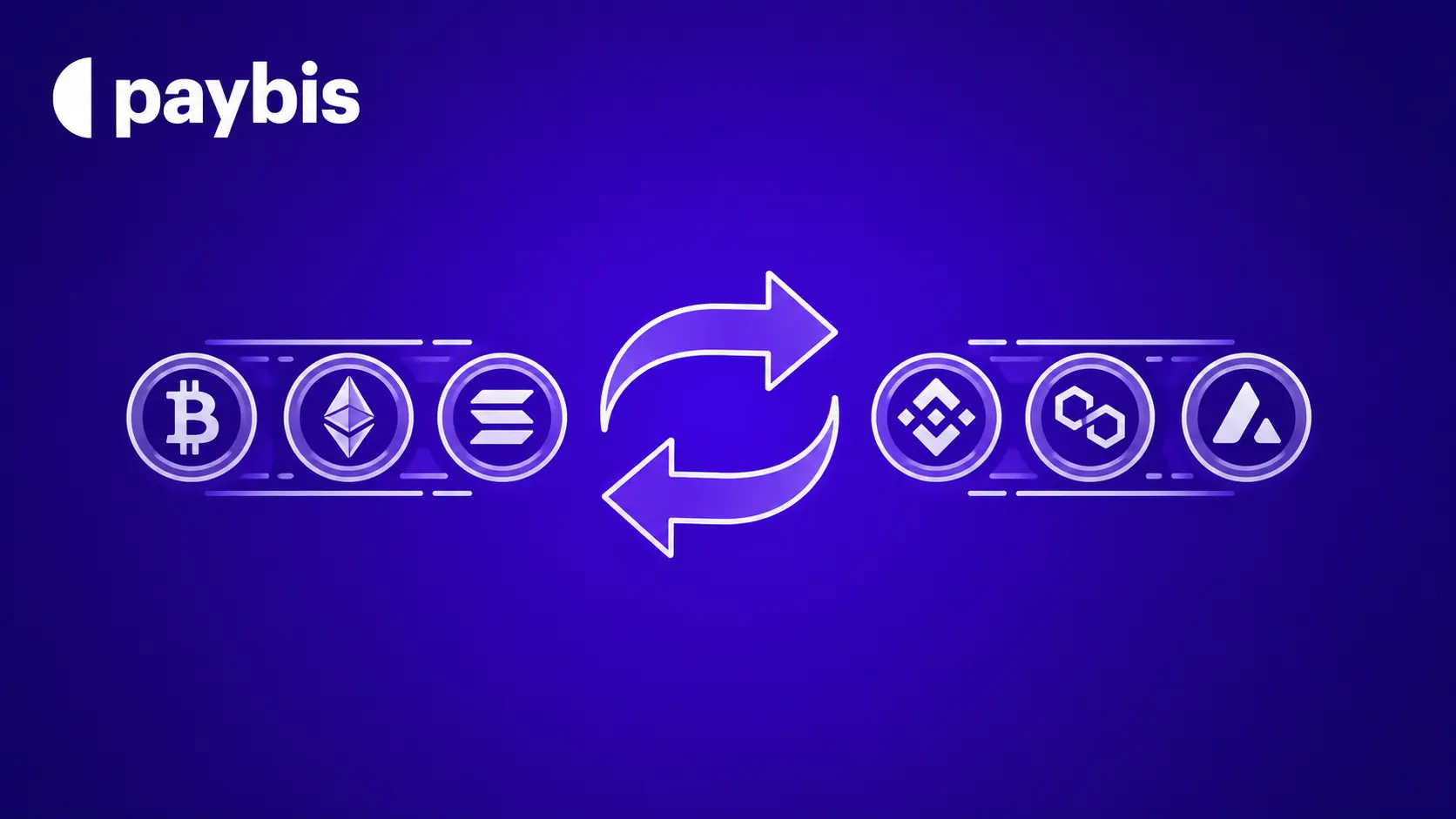
A crypto swap is a direct exchange of one cryptocurrency for another, without using fiat currency (like USD or EUR) as a middle step. You give one coin and receive another at an agreed rate. No order books. No waiting for a buyer to match your sell order. No trading charts required.
Industry surveys show that more than 30% of decentralized exchange users prefer crypto swapping for its speed and simplicity, and that preference reflects why swapping has become the default tool for everyday crypto users rather than active traders. The process looks like this: select the coin you have, select the coin you want, confirm the rate and fees, and receive your new tokens.
“I just pick how much crypto I want, pay with my card (or Apple/Google Pay), and in about 10-15 minutes the coins are already in my wallet.” – Christine K. on G2
How Smart Contracts and AMMs Power Swaps
Most decentralized swaps are powered by Automated Market Makers (AMMs). An AMM is the pricing engine behind most swap platforms and replaces the need for a human buyer and seller to agree on a price. Instead, it uses a liquidity pool: a shared reserve of two tokens locked inside a smart contract (self-executing code on the blockchain that requires no human to operate it).
When you swap Token A for Token B, you interact directly with that pool. The AMM automatically recalculates the price based on how much of each token remains. The more of Token B you take out, the more expensive it becomes. This happens in seconds, with no intermediary involved. Swapping via smart contracts leads to faster transactions because there are no intermediaries or complex order book systems slowing things down. For a visual walkthrough, this video shows the process.
What Is Crypto Trading?
Crypto trading means buying or selling cryptocurrencies on a centralized exchange using an order book: a live list of pending buy and sell orders where buyers list the price they’ll pay (bids) and sellers list the price they’ll accept (asks). When a bid meets an ask, the exchange’s matching engine executes the trade.
Trading requires you to understand order types (market, limit, stop-loss), read price charts, and time your entries and exits. Swapping requires none of that. If you’re new to the space, our cryptocurrency trading guide covers the fundamentals in detail before you commit to either approach.
Crypto Swap vs. Trade: 5 Key Differences
Here is a direct comparison before we break down each factor:
| Feature | Crypto Swap | Crypto Trade |
|---|---|---|
| Complexity | 3 steps, no charts needed | 7+ steps, requires market knowledge |
| Speed | Minutes, depending on the blockchain | Seconds for market orders, hours/days for limit orders |
| Fee Type | Network fee + protocol/service fee | Maker/taker fees + withdrawal fees |
| Custody | Non-custodial options available | Custodial (exchange holds funds) |
| Best For | Beginners, quick conversions | Active traders, profit-seeking strategies |
1. User Experience and Simplicity
Trading on a platform like Binance typically involves navigating to the trading interface, finding your pair among 600+ options, selecting an order type, entering a price and amount, and confirming. If your limit order doesn’t fill, you start over.
We built Paybis swaps to take 3 steps: select the token you have, enter the amount, and confirm. Our interface shows a simple calculator: “You send X → You get Y.” No charts, no order type selection, no waiting for a counterparty. This Paybis buy and sell guide demonstrates exactly how few steps are involved from start to finish.
“The interface is clear, transactions are fast, and support has been helpful whenever I had questions.” – Elizar S. on G2
2. Fee Structures: Maker/Taker vs. Network/Protocol
Trading fees are charged by the exchange on both sides of a transaction. Maker fees (charged when you add a limit order to the order book) typically run 0.01-0.10% on major exchanges. Taker fees run slightly higher. On top of that, you pay withdrawal fees to move funds off the platform.
Swap fees work differently. You pay a network fee (the cost the blockchain charges to process your transaction) and a protocol or service fee charged by the swap platform. On Paybis, we split fees clearly: our Service Fee starts from 1.49%, our Processing Fee runs 4.5-8.5% for card transactions over $50 (depending on currency), and the Network Fee varies by blockchain demand. We show all three before you confirm, as independently reviewed in Benzinga’s Paybis analysis and Coin Bureau’s full review. For a direct breakdown of how these costs compare with decentralized alternatives, see our DEX fees vs. Paybis comparison.
“Fees are shown upfront, and transaction speeds were consistently good during my tests.” – Joon Huh on Trustpilot
3. Transaction Speed and Settlement
Market orders on centralized exchanges typically execute in 1-5 seconds because the matching engine operates off-chain. But limit orders, where you set a specific price you’re willing to pay, can take hours or days to fill if the market never reaches that price.
Swap speed depends on the blockchain. Swaps on Ethereum typically take 1-15 minutes during congestion, while swaps on Layer 2 networks like Base or Polygon can settle in under 2 seconds. For Paybis card purchases, we process transactions quickly with near-to-instant blockchain settlement. When you need Bitcoin today and not after a limit order fails to fill, the speed difference is the deciding factor.
“The best platform for making crypto transfers, even buying directly to your preferred crypto wallet.” – HICHAM EL HORMI on Trustpilot
4. Privacy and Custody (Non-Custodial vs. Centralized)
Non-custodial means you hold the private keys to your crypto, not a third party. DEX swaps are typically non-custodial: your tokens move directly from your wallet to the smart contract and back, without ever sitting in an exchange’s account. If you’re evaluating wallet security options, it’s worth understanding what a hardware wallet is and whether one fits your setup.
Centralized trading platforms hold your funds in a custodial account. If the exchange locks your account or goes offline, you lose access to your assets. We balance security and accessibility: Paybis uses MPC wallets (multi-party computation wallets that split key control to prevent a single point of theft) for added security, while remaining a regulated platform registered with FinCEN (US entity 31000272911973) and FINTRAC (CA entity C100000646). Our regulatory registration means user protection, not just convenience. Both our Paybis wallet swap guide and external wallet swap guide document how either path works.
5. Slippage vs. Price Fluctuations
Slippage is the difference between the price you see when you initiate a swap and the price at which it actually executes. It happens because crypto prices move constantly, and a large swap can shift the balance of an AMM’s liquidity pool mid-transaction. Most exchanges set default slippage tolerance between 0.5% and 2% for standard assets. If the price slips beyond your chosen tolerance, the transaction fails and your funds return.
With a limit order in trading, you set the exact price at which your order fills, so slippage technically doesn’t occur. The trade-off: your order may never fill at all if the market moves against you. For a beginner executing a one-time conversion, knowing your maximum slippage upfront is simpler than waiting indefinitely for a limit order to match.
When to Swap vs. When to Trade
3 Scenarios Where Swapping Wins
Swapping saves time and reduces fees compared to selling for fiat and then buying a different coin, and it makes exploring different blockchain projects easier by letting you acquire various tokens in a single transaction. Here are three practical situations where swapping is the better call:
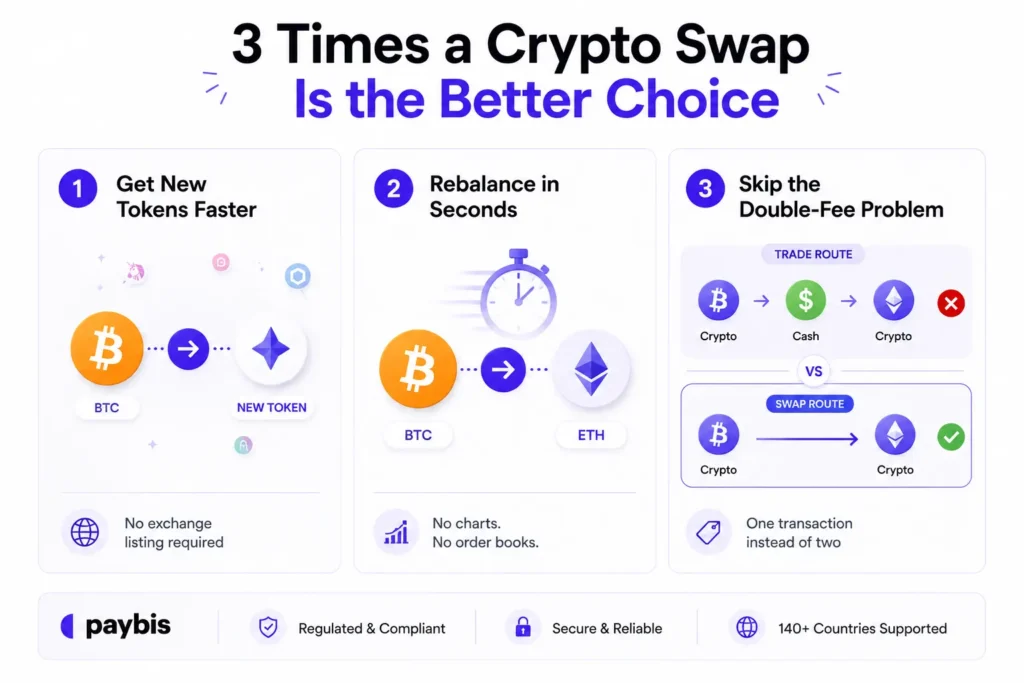
- Accessing a new token quickly: Centralized exchanges often don’t list newer or smaller-cap tokens. A swap platform connects directly to liquidity pools and supports a wider range of assets, including DeFi tokens unavailable on major exchanges.
- Diversifying without market analysis: You hold Bitcoin and want to add Ethereum to your portfolio without studying charts. A swap converts your BTC to ETH at the current market rate in minutes. No order type selection, no waiting for a fill.
- Avoiding the double-fee problem: Selling crypto for fiat and then buying a different coin costs two sets of fees (one exit, one entry) plus possible bank transfer delays. A direct swap cuts that to a single transaction.
“What stands out to me most about Paybis is the remarkable speed and smoothness of the crypto-buying process… the cryptocurrency is delivered straight to my wallet without any unnecessary steps.” – Egor N. on G2
The Role of Stablecoins in Swapping
Stablecoins (cryptocurrencies designed to maintain a fixed value, typically $1, by backing each token with reserved assets) act as a bridge in the crypto swap ecosystem. They allow you to lock in the value of a volatile asset without converting to fiat.
For example, if you hold Ethereum and the market looks uncertain, you can swap ETH for Uniswap to preserve value. Then swap back to ETH or into Bitcoin when conditions improve, all without triggering a full cash-out. We support a range of popular stablecoins, making this straightforward for any user.
How to Swap Crypto on Paybis (Step-By-Step)
We serve 5M+ retail users across 180+ countries and process $1.2B+ in annual transaction volume (last 12 months as of Oct 2025). We support 20+ payment methods including PIX. Here is the full workflow from acquiring your first crypto to executing a swap:
- Buy your first crypto using a local payment method. Visit paybis.com and use our calculator to select the crypto you want (Bitcoin, Ethereum, or any of 90+ supported coins). Choose your payment method: PIX (Brazil), Visa/Mastercard debit card, or any of our 20+ supported options. We display all fees (Service, Processing, and Network) before you confirm. We charge 0% Service Fee on your first card transaction.
- Complete identity verification. Upload a government-issued ID and take a selfie. Verification typically completes in under 2 minutes for most users, as a legal requirement under FinCEN and FINTRAC compliance rules.
- Navigate to the swap interface. Once we deliver your crypto to your Paybis wallet (near-to-instant, depends on the blockchain), open our swap tool. Select the token you hold and the token you want to receive. This step-by-step swap tutorial covers the full interface from login to receipt.
- Confirm the rate, fees, and total. Our calculator shows exactly what you’ll receive and what you’ll pay. Our Service Fee starts from 1.49%, and the Network Fee updates automatically based on real-time blockchain demand. Confirm only when you’re satisfied with the breakdown.
- Receive your new crypto. We complete your swap quickly, typically within minutes depending on the blockchain. Your new tokens arrive in your wallet. No waiting for order fills, no ambiguity about costs.
We offer 24/7 live chat support (average response time 1-2 minutes, available in 9+ languages) throughout the process. As one user described their experience after needing help mid-transaction:
“Not only did she handle my situation quickly concisely and solved it I am just so overwhelmingly happy that she was my agent… I love their customer service, it’s excellent!!” – Thadrah Bounds on Trustpilot
FXEmpire’s 2025 Paybis review and Finder’s exchange comparison both independently confirm the speed and simplicity of the onboarding and swap flow.
Ready to buy and swap crypto without the complexity? Create a Paybis account, complete identity verification in under 2 minutes, and use our simple swap calculator to convert between 90+ cryptocurrencies. We show all fees before you confirm, and our 24/7 human support team is one click away if you need it.
Key Terminology
- Liquidity pool: A reserve of two tokens locked inside a smart contract that powers AMM-based swaps. Users who deposit tokens into the pool earn fees from every swap that uses it.
- AMM (Automated Market Maker): A pricing algorithm that automatically sets the exchange rate between two tokens based on the ratio of assets in a liquidity pool, removing the need for a traditional buyer-seller order match.
- Slippage: The difference between the price you see when initiating a swap and the price at which it actually executes, caused by price movement between those two moments.
- Non-custodial wallet: A wallet where you hold the private keys to your crypto, meaning no third party can access, freeze, or move your funds without your authorization.
FAQ
Can I swap crypto for fiat?
No, a swap is specifically a token-to-token exchange and doesn’t involve fiat currency. To convert crypto to USD, EUR, or BRL, you sell your cryptocurrency through a platform like Paybis that supports selling crypto to your card. You can also withdraw Bitcoin to a bank account as an alternative route for cashing out.
What happens if the price changes during a swap?
The difference between the quoted price and the execution price is slippage. If the price shifts beyond your slippage tolerance (typically 0.5-2%), the transaction reverts and your funds return to your wallet.
Are crypto swaps taxable?
Yes, in most jurisdictions including the US. The IRS treats crypto swaps as disposals of one asset and acquisitions of another, making each swap a taxable event. Tax rules vary by country, so check local regulations for your specific situation.
How long does a swap take on Paybis?
We complete swaps quickly, typically within 10-15 minutes for most users, though final on-chain confirmation depends on the blockchain. Ethereum-based swaps typically confirm in 1-2 minutes, while faster chains settle in seconds.
Does swapping cost more than trading?
Not necessarily for small, occasional transactions. Trading platforms charge maker/taker fees plus withdrawal fees. Swaps charge a network fee and service fee in a single transaction, meaning infrequent conversions often cost less all-in than selling on an exchange and rebuying. Our Bitcoin Cash calculator can help you estimate costs before committing to a transaction.
Disclaimer: Don’t invest unless you’re prepared to lose all the money you invest. This is a high‑risk investment and you should not expect to be protected if something goes wrong. Take 2 mins to learn more at: https://go.payb.is/FCA-Info