Decentralized Exchange (DEX) Swaps Explained: Uniswap, SushiSwap, and Alternatives
Key Takeaways:DEX swaps let you trade one cryptocurrency for another without a middleman, but they carry real costs beginner guides rarely mention. You need a Web3 wallet, native crypto just to pay gas fees (the cost to process your transaction on the blockchain), and enough technical knowledge to avoid scam tokens, phishing sites, and irreversible wallet errors, all with zero support if something goes wrong. DEXs only accept cryptocurrency, there is no way to fund trades directly with a credit card, debit card, or bank transfer. On Paybis, you can buy 90+ cryptocurrencies using 20+ payment methods across 180+ countries, with all fees shown upfront and 24/7 human support averaging a 1-2 minute response time. You can buy Bitcoin with credit or debit card, with Skrill, Revolut Pay, PayPal, and use our Bitcoin cash calculator to estimate your purchase.
Most beginners land on a DEX looking for a simple way to buy crypto. They hit a wall: set up a Web3 wallet, own ETH just to pay fees, configure slippage tolerances, verify contract addresses. One wrong click and your funds disappear with nobody to call.
Decentralized exchanges (DEXs) like Uniswap are genuinely powerful tools for experienced DeFi (decentralized finance) traders. But for anyone who wants to convert $200 into Bitcoin today using a debit card or PIX, they are the wrong tool entirely. This guide explains exactly how DEX swaps work, walks through a complete Uniswap tutorial, and shows where a simpler path exists for those who need crypto now.
The Basics of Crypto Swapping on DEXs
A decentralized exchange is a peer-to-peer marketplace where transactions happen directly between crypto traders, run entirely by code rather than a company. Nobody holds your funds. Nobody approves your transaction. Code does everything automatically.
A crypto swap is the core action: select a token you own, select what you want, and code executes the trade at the current market rate minus fees. No order books. No human market makers. Just a smart contract (self-executing code that automates the trade) connecting buyers and sellers through shared liquidity.
How to Swap Crypto on a DEX
The core flow on any DEX follows four steps:
Connect a Web3 wallet (a self-custody crypto wallet like MetaMask) to the DEX platform.
Select the token you are selling and the token you want to receive.
Approve token access (required the first time you use a new token with a given DEX).
Confirm the swap and wait for blockchain confirmation.
That sounds simple. The complexity lives in every step surrounding those four actions.
Keep Your Crypto: Non-Custodial Swaps
DEXs are non-custodial, meaning you hold your own private keys (the unique code that controls access to your crypto) at all times. Every swap happens wallet-to-wallet through a smart contract, and the exchange never touches your funds.
This is empowering for experienced users who want full control. It is also total responsibility. Lose your private key, make a wallet error, or sign a malicious transaction, and there is no recovery path.
Key Parts of DEX Swaps: Pools and Contracts
Two concepts power every DEX transaction:
- Smart contract: Self-executing code that runs the swap automatically. Think of it like a vending machine: insert token A, the contract delivers token B at the current rate, with no human involvement.
- Liquidity pool: A pool of two or more tokens contributed by other users that the smart contract draws from to fill your trade instantly. Code governs the pool, so prices adjust automatically based on supply and demand within it.
Centralized vs. DEX: Fees and Control
The operational difference between a DEX and a centralized gateway comes down to who holds the assets, who sets the rules, and who you call when something breaks.
Who Holds Your Crypto Keys?
On a DEX, your assets never leave your wallet. The smart contract executes the trade, tokens move between wallets, and custody stays with you at every step.
On a centralized platform, we process your transaction, manage compliance, and offer both custodial options (we store your crypto securely) and the freedom to send to any external wallet. We support withdrawals to external wallets with zero restrictions on destination.
DEX Swaps: No ID Verification
DEXs (decentralized exchanges) require no account creation, no email address, and no KYC. KYC, or Know Your Customer, is the identity verification process that centralized platforms use to confirm who you are. You connect a wallet and trade immediately. This offers genuine privacy and permissionless access, which matters for users in regions where financial access is restricted.
The trade-off is that this same permissionless nature means anyone can list any token, including fraudulent ones designed to steal funds.
DEX vs. CEX: Complexity for Beginners
When you visit Paybis (a centralized platform), you see a calculator: “You send [amount] → You get [crypto].” Unlike DEXs that require no verification, Paybis verification takes under 2 minutes, and we show the full fee breakdown before you confirm payment. FXEmpire’s 2025 Paybis review notes our verification speed and straightforward interface as key advantages for users who tried other platforms first.
A first-time visitor to Uniswap sees a token selection interface with no guidance on which contract addresses are legitimate, no fiat payment options, and no instructions for setting up the wallet required just to access the platform.
How Fast Are DEX Crypto Swaps?
DEX speed depends entirely on blockchain congestion. The average Ethereum transaction time ranges from 13 seconds to 5 minutes under normal conditions and can stretch longer during peak periods. Gas fees spike during congestion, meaning both cost and speed become unpredictable at the same time.
We process card transactions in under 1 minute, with near-to-instant settlement depending on the blockchain. That difference matters when you need crypto today, not after waiting through an unpredictable network queue.
Direct Crypto Swaps: What You Gain
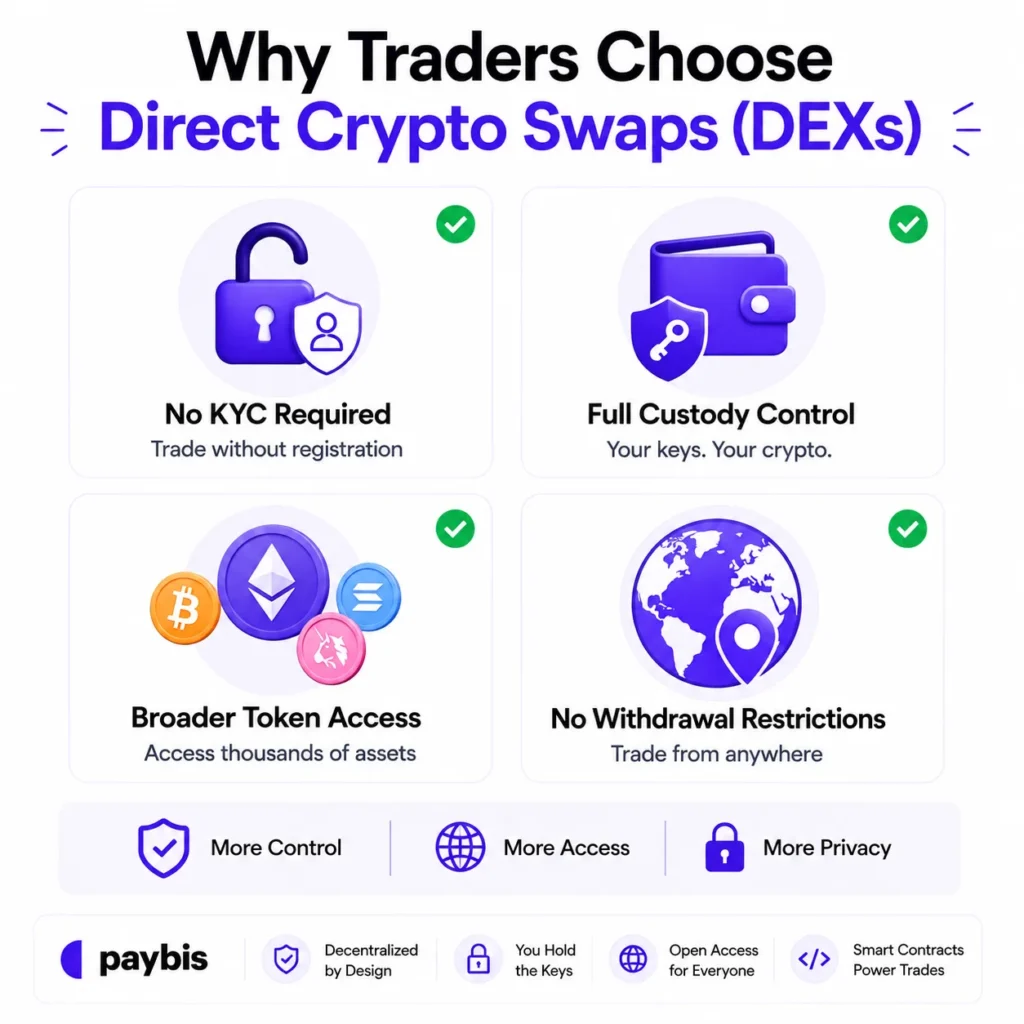
DEXs offer real advantages worth understanding honestly. These are the reasons experienced traders choose them:
- No KYC required: No registration means no data shared with a company or government. Permissionless access means no geographic gatekeepers can block your transaction based on where you live.
- Full custody control: Your funds never sit on an exchange. You trade directly from your wallet, and swapped tokens arrive back in that same wallet after confirmation.
- Broader token access: Any developer can deploy a token to a DEX liquidity pool, giving access to thousands of altcoins (smaller cryptocurrencies beyond Bitcoin and Ethereum) that centralized platforms haven’t listed yet.
- No withdrawal restrictions: DEXs impose no withdrawal holds, no transfer limits tied to verification tiers, and no geographic restrictions on where you send tokens after a swap.
Protecting Your Funds from DEX Swap Risks
For beginners, DEX risks are substantial and often not obvious until money is already at stake.
DEX Swap Fees: What You Pay
Three types of costs apply to every DEX swap:
- Protocol fee: A fixed percentage charged by the liquidity pool, typically 0.3% on Uniswap for standard pools (this goes to liquidity providers, not the protocol itself).
- Gas fee (network cost): A variable fee paid in ETH to blockchain validators. On Ethereum mainnet, gas costs for a Uniswap swap typically run from under $1 to over $50 depending on network congestion at the time. On PancakeSwap (BNB Chain), gas is often just cents.
- Slippage: The difference between the price you expect and the price you actually receive. Uniswap sets a default slippage tolerance between 0.1% and 5%, but during volatile markets actual slippage can exceed your tolerance and cause the transaction to fail entirely.
The gas fee is charged even when a transaction fails. No refunds. Our guide on finding the lowest fee crypto exchange breaks down how fee structures compare across different platforms if you want to minimise your trading costs.
Technical Hurdles for New DEX Users
Before you make a single swap, you must:
- Download and configure a Web3 wallet (MetaMask or similar).
- Purchase native crypto (ETH for Uniswap, BNB for PancakeSwap) specifically to pay gas fees.Transfer that crypto to the wallet correctly.
- Connect the wallet to the DEX interface.
- Verify token contract addresses to avoid fake tokens.
- Configure slippage tolerance before confirming.
Six technical steps before any actual trading begins. Each one carries risk of irreversible error. Our cryptocurrency trading guide covers the foundational knowledge you need before approaching any exchange, centralised or decentralised.
No Live Help for DEX Swap Errors
Most DEXs offer limited or no customer support. The decentralized nature of these platforms means there is no central team managing user issues, and most rely solely on community forums or self-service documentation. Regardless, no DEX team can reverse a failed transaction, recover funds sent to the wrong address, or undo a swap after blockchain confirmation.
As Coin Bureau’s 2025 Paybis review notes, we built support responsiveness as a defining differentiator for non-technical users. When your money is involved, “check the documentation” is not an acceptable answer.
“Paybis is a very good crypto exchange, and they have very good customer support and I am glad I can do business with them when I need to use crypto for certain business I need to take care of.” – Douglas Weaver on Trustpilot
DEX Code Flaws: Risking Your Funds
Smart contracts can contain exploitable bugs. Even thoroughly audited code can behave unexpectedly under rare conditions. Beyond code vulnerabilities, the permissionless nature of DEXs creates specific scam risks.
Because anyone can list a token, rug pulls are common. A rug pull occurs when a developer creates a token, builds apparent demand, and then drains the liquidity pool and disappears, leaving holders with worthless tokens. According to research cited in our crypto weekly digest, this type of fraud has created more than 300,000 scam tokens and defrauded over 2 million investors. Our deep dive into fake volumes in cryptocurrency markets explains how manipulation tactics like this work and what to watch for.Critical: Always navigate directly to the official DEX URL before connecting your wallet. Phishing sites clone Uniswap’s interface specifically to steal wallet credentials.
The True Cost of Your Swap
A $50 Uniswap swap on the Ethereum mainnet might include:
- Protocol fee (0.3%): $0.15
- Gas fee: $0.50 to $50+ depending on network congestion
- Slippage loss: variable, 0.1% to several percent
On a small transaction, gas fees alone can exceed the value of what you are trying to swap.
Uniswap Swaps: A Clear, Step-by-Step Guide
Uniswap is a well-established Ethereum-based DEX with a broad user base. Here is the complete process from zero crypto to completed swap.
1. Set Up a Web3 Wallet
Download MetaMask from metamask.io. Create a new wallet and write down your seed phrase (a 12-word backup that recovers your wallet if you lose device access). Store it offline in a secure location. Never share it with anyone. Our Bitcoin wallet basics guide covers the core principles of wallet security that apply equally to any Web3 wallet you use.
2. Deposit ETH to Your Wallet
You cannot use Uniswap without ETH. ETH pays the gas fee for every transaction, including failed ones. The fastest way to get ETH into MetaMask is to buy it directly on Paybis using your debit card, Skrill, or a local payment method like PIX. We support 20+ payment methods across 180+ countries. Once purchased, withdraw the ETH to your MetaMask wallet address.
“paybis helped me turn my paysafe balance I found into crypto and I was then able to turn that crypto into cash in about half an hour from start to finish …I was stoked as I really needed the money … I will definitely be using Paybis in the future and would recommend it to anyone” – jason halton on Trustpilot
Our guide on sending and withdrawing crypto covers the exact withdrawal steps to an external wallet.
3. Connect Your Wallet to Uniswap
Navigate directly to the official Uniswap application and bookmark it immediately.Critical security note: Never click links to Uniswap from emails, DMs, or social media. Phishing sites clone the interface to steal your wallet credentials.
Click “Connect” in the top right, select MetaMask, and approve the connection request in your wallet popup.
4. Select Crypto on Uniswap
The top field shows the token you are selling. The bottom field shows the token you want to receive. For any token found through social media or community recommendations, verify the contract address on CoinMarketCap or CoinGecko before proceeding. Fake tokens with identical names are common on DEXs.
For beginners, a market swap (immediate execution at current price) is simpler than a limit order.
5. Your Total Cost: Review and Approve
Before clicking Swap, review the details screen: expected output amount, slippage tolerance, and estimated gas fee. If this is your first time using a specific token, MetaMask will prompt you to approve Uniswap’s access to that token before executing, which costs a separate gas fee. After approval, click Swap, review the final confirmation, and confirm in MetaMask.
6. Wait for Blockchain Confirmation
After you approve in MetaMask, your transaction enters the Ethereum mempool (the queue where pending transactions wait to be picked up by validators). Once confirmed by the network, the average time on Ethereum runs 13-15 seconds under normal conditions but can extend several minutes during congestion. Track it in real time on Etherscan using your transaction hash (a unique identifier shown in MetaMask after you approve).
Once confirmed, popular tokens appear in MetaMask automatically. Less common tokens may require manual addition using the token’s contract address. Our guide on depositing crypto from external wallets explains how to move assets back to a custodial wallet after a DEX swap.
Popular DEX Alternatives to Uniswap
Not every DEX runs on Ethereum. Here are three alternatives with different trade-offs:
- SushiSwap: A fork (copy) of Uniswap’s code that developed its own ecosystem. Its SUSHI governance token distributes protocol fees to holders and grants voting rights. SushiSwap operates across Ethereum, Polygon, and Arbitrum.
- PancakeSwap: Runs on the BNB Chain rather than Ethereum. PancakeSwap’s standard swap fee is 0.25%, with gas costs often just cents per swap. The trade-off: smaller token selection and a more centralized blockchain.
- Curve Finance: Specializes in stablecoin swaps (cryptocurrencies designed to hold a fixed value). Its pricing formula minimizes slippage when swapping between assets that should trade at near-identical values.
DEX aggregators (platforms like 1inch that scan multiple DEXs simultaneously) can reduce costs on larger trades by routing your swap through the most efficient path across available liquidity.
Easy Crypto vs. Advanced Swaps: Which to Pick?
The comparison between a DEX and a centralized fiat gateway comes down to what you are actually trying to accomplish.
| Feature | DEX (e.g., Uniswap) | Centralized Gateway (Paybis) |
|---|---|---|
| Fiat payment methods | None (crypto only) | 20+ including PIX, Visa, Skrill, M-Pesa |
| Human customer support | None | 24/7, 9+ languages, avg. 1–2 min response |
| Fee transparency | Variable, estimated before confirmation | Service + Processing + Network shown before confirmation |
| ID verification | No | Yes, approximately 2 minutes |
| Token selection | Thousands (including unvetted tokens) | 90+ vetted cryptocurrencies |
| Fiat withdrawal | Not possible | Yes, to bank, card, or local methods |
| Geographic access | Platform-dependent (some block EU IPs, use wallet blacklists) | 180+ countries |
When to Use a Centralized Platform
If you want to convert local currency to crypto using a payment method you already have, we are the right starting point. Our supported countries page covers which markets and payment methods work in your region, including PIX in Brazil, M-Pesa in Kenya, and Webpay in Chile. Our overview of top payment methods to buy crypto explains the trade-offs between cards, bank transfers, and local options so you can choose the fastest route for your country.
Our guide on swapping crypto with external wallets shows how to move between centralized and decentralized options once you own your first crypto.
“Paybis offers transactions in a quick and easy format with thorough security measures. I’ve been using their app for quite some time and have had no issues.” – Amanda Stringfellow on Trustpilot
DEX vs. Paybis: Exact Swap Fees
On a DEX, your total cost includes a protocol fee (0.3% on Uniswap standard pools going to liquidity providers), a gas fee ranging from under $1 to $50+ on Ethereum mainnet depending on congestion, and slippage of 0.1% to several percent depending on liquidity. These costs are estimates, not guarantees, and the gas fee is charged even if the transaction fails.
We fix our fee structure and show it in full before you confirm. A card purchase includes a Service Fee starting from 1.49%, a Processing Fee of 4.5-8.5% depending on currency (for transactions over $50), and a Network Fee that adjusts automatically based on current blockchain demand. Your first card transaction carries a 0% Service Fee. Zero surprises at checkout.
The Benzinga Paybis review highlights our fee transparency as a key differentiator for first-time buyers. Our 30,900+ Trustpilot reviews rating of 4.1 (“Great”) consistently cite knowing the full cost before confirming as a reason for trusting us.
“The Paybis app it’s the easiest I’ve ever used it was the easiest I got to get verified it was the easiest to just complete the account setup and then I did use it one time and it was the easiest” – Tammy on Trustpilot
How Fast Are DEX Crypto Swaps?
Ethereum mainnet swaps take 13 seconds to several minutes under normal load and can fail during congestion with no refund of the gas fee. Layer 2 networks (Arbitrum, Base, Optimism) cut both cost and wait time significantly but add another setup layer.
We process card transactions in under 1 minute. Settlement is near-to-instant depending on the blockchain. You own crypto before a Uniswap user finishes configuring MetaMask slippage settings, as the Coin Bureau December 2024 Paybis review confirms with verified user timelines.
DEX vs. Paybis: Getting Human Support
Paybis 24/7 live chat interface showing real-time support access
DEX support does not exist. If a transaction fails on Uniswap, you lose the gas fee and investigate the cause yourself on Etherscan. If you approved a malicious contract, your wallet is drained with no escalation path.
We operate 24/7 live chat in 9+ languages with an average response time of 1-2 minutes, as G2 Paybis reviews document. If we reject a transaction for security reasons, we don’t charge you and your funds return immediately. Our support team explains what happened and guides you through next steps.
“Paybis is one of the leading Crypto networks you can for sure trust your transactions will always be swift and safe . Tap in Guys!” – Lostboy on Trustpilot
The video guide on how to verify KYC at Paybis walks through the full verification process for users who want to see the experience before signing up.
If you want a simpler route to owning crypto, we give you that path. Start with the Paybis exchange and Paybis Wallet for fiat-to-crypto conversion with full fee transparency and human support at every step.
Key Terminology
- Smart Contract: Self-executing code deployed on a blockchain that automatically carries out predefined actions (like swapping tokens) when conditions are met, without requiring any human to approve or manage the transaction.
- Gas Fee: A variable fee paid in a blockchain’s native token (ETH on Ethereum, BNB on BNB Chain) to compensate network validators for processing your transaction. Gas fees fluctuate based on how many transactions the network is handling at any given time.
- Slippage: The difference between the price you expected when you initiated a swap and the price you actually received when the transaction confirmed. High slippage occurs when a liquidity pool has limited funds or when prices move sharply while your transaction is pending.
- Liquidity Pool: A collection of tokens locked in a smart contract that powers trading on a DEX. Instead of matching individual buyers and sellers, the DEX draws from this shared pool to fill your order automatically.
- Non-Custodial: A system where you hold and control your own private keys. Non-custodial means no company can freeze or access your funds, but it also means no company can help you recover them if you make an error.
- Seed Phrase: A sequence of 12-24 words generated when you create a Web3 wallet that acts as the master backup for your private keys. Anyone with your seed phrase has complete control of your wallet and all funds inside it.
FAQ
Do I Need an Account to Use a DEX?
No. DEXs require only a self-custody Web3 wallet like MetaMask connected to the platform. You trade directly without providing an email address, password, or identity documents.
How Are DEX Swap Fees Calculated?
Every DEX swap includes a protocol fee (typically 0.3% on Uniswap, paid to liquidity providers) plus a variable blockchain gas fee ranging from under $1 to $50+ on Ethereum mainnet, depending on network congestion at the time of your transaction.
Can I Use a Debit Card to Swap Crypto on a DEX?
No. DEXs only accept cryptocurrency and have no fiat on-ramp. To use a debit card or local payment method like PIX, you need a centralized gateway. We support 20+ payment methods across 180+ countries.
How Do I Avoid Security Risks When Using a DEX?
Always navigate directly to the official DEX URL (bookmark it immediately), never share your wallet seed phrase with anyone, and verify token contract addresses on CoinMarketCap or CoinGecko before executing any swap involving an unfamiliar token.
Is Swapping Crypto Taxable?
In most jurisdictions, swapping one cryptocurrency for another is treated as a taxable disposal of an asset, so yes. Tax rules vary by country, and this applies equally to DEX swaps and centralized platform swaps.
What Happens When a DEX Swap Fails?
If your swap fails due to high slippage or insufficient gas, the transaction does not execute and your tokens remain in your wallet. The network still charges the gas fee for the failed attempt, meaning you pay for the transaction even though nothing was exchanged.
Disclaimer: Don’t invest unless you’re prepared to lose all the money you invest. This is a high‑risk investment and you should not expect to be protected if something goes wrong. Take 2 mins to learn more at: https://go.payb.is/FCA-Info