How Crypto Swaps Work: The Technical Mechanics Behind Token Exchanges
Crypto swaps exchange one digital asset for another instantly, without a middleman or traditional order book. Instead of matching you with a specific buyer or seller, swaps use automated programs called Automated Market Makers (AMMs) and pooled funds called liquidity pools to guarantee your trade executes immediately. Smart contracts automate every step, so no third party can hold, freeze, or interfere with your funds. We bring this technology to everyday buyers with a simple calculator interface, 2-minute verification, processing within minutes, and all fees shown upfront before you confirm. Fees start from 1.49% with processing fees at 4.5-8.5%. You can buy Bitcoin, swap BTC to ETH, BTC to Chainlink, or explore Bitcoin dominance to understand broader market context before your first swap.
Most people avoid swapping crypto because the technology sounds like a foreign language. But understanding how your tokens actually move does not require a computer science degree. You just need to know three things: what a liquidity pool is, how an AMM prices your trade, and why a smart contract ensures no third party can freeze, redirect, or interfere with your funds.
What Is a Crypto Swap?
A crypto swap is the direct exchange of one cryptocurrency for another without converting to fiat currency (like dollars or reais) in between. You put in Bitcoin, you get Ethereum. The exchange happens instantly through automated code, not a human broker.
This differs from traditional crypto trading, which typically involves selling one asset for fiat and then using that fiat to buy another, often across multiple steps and days of waiting. As GraphLinq Academy explains, swaps allow for instant and direct exchanges between different tokens, skipping the intermediate fiat step entirely. If you’re new to how Bitcoin works at a fundamental level, that’s a useful foundation before diving into swaps.
Swapping also covers converting fiat to crypto and back, which is exactly what we handle for everyday buyers: you send dollars or reais, and you receive Bitcoin or USDT in your wallet.
Token Swaps vs. Centralized Crypto Exchanges
The core difference between a swap and a centralized exchange trade comes down to who holds your money and how the price gets set. Here is how the two models compare:
| Feature | Crypto Swap | Centralized Exchange |
|---|---|---|
| Custody | Non-custodial: you keep control | Custodial: exchange holds assets |
| Price mechanism | AMM algorithm based on pool ratios | Order book matching buyers/sellers |
| Asset access | Wide range, including newer tokens | Curated, vetted list |
| Speed | Near-instant execution | Fast internally; bank transfers 3–5 days |
| Intermediaries | None: smart contracts execute automatically | Platform acts as intermediary |
As Britannica’s crypto comparison notes, centralized exchanges offer user-friendly interfaces but require you to deposit funds, giving the platform custody of your assets. Decentralized swaps let you trade directly from your own wallet without forfeiting control at any point.
The Core Mechanics of Crypto Swaps Explained
Three components make a crypto swap work: Automated Market Makers (AMMs), Liquidity Pools, and Smart Contracts. Each plays a specific role, and together they replace the traditional buyer-seller matching system entirely.
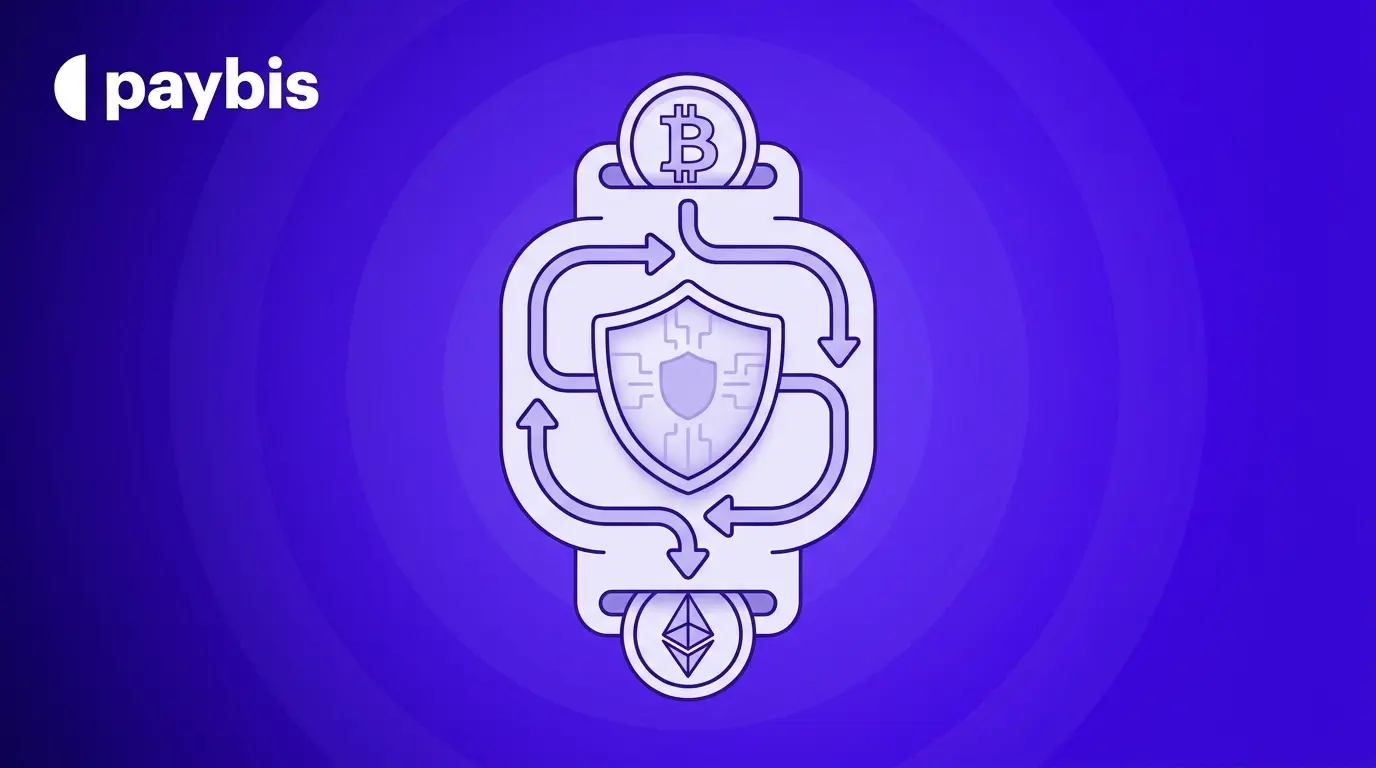
The diagram below shows the path your transaction takes from wallet to final token delivery:
How Automated Market Makers (AMMs) Set Prices
An Automated Market Maker is the algorithm that determines how much of one token you receive in exchange for another. It does not require a willing seller on the other side of your trade.
Instead, AMMs set prices based on the ratio of tokens in a pool. If a pool holds 1 ETH and 3,000 USDT, the implied ETH price is $3,000. When you buy ETH from that pool, you add USDT and remove ETH. The pool now has more USDT and less ETH, so the price of ETH rises for the next buyer.
Think of it like a balance scale: when you take tokens from one side, that side gets scarcer and more expensive. The side you add to becomes more abundant and cheaper. No chart-reading required.
CoinGecko’s AMM explainer confirms that larger trades cause more price movement relative to pool size. For a deeper look at how this model was pioneered, Uniswap’s AMM blog post is the original technical reference.
The Role of Liquidity Pools in Token Swaps
A liquidity pool is a crowdsourced reserve of cryptocurrencies locked in a smart contract that provides the funds needed to execute swaps. Without a pool, there is no source of tokens for the AMM to draw from.
Anyone can deposit tokens into a liquidity pool and become a liquidity provider (LP). In return, LPs earn a portion of trading fees from every swap that uses their pool. These fees are typically small percentages per transaction but accumulate significantly with high volume.
The main risk for LPs is impermanent loss, which occurs when the price of deposited tokens shifts while locked in the pool. For everyday buyers executing swaps, this is a liquidity provider concern, not yours. You select your tokens, confirm the rate, and execute. Understanding how often you can buy and sell on exchanges can also help you manage timing around pool liquidity.
Why Smart Contracts Keep Your Swap Secure
A smart contract is a program that lives on a blockchain and executes automatically when specific conditions are met. Smart contracts reduce the need for trusted intermediaries and automate the execution of agreements based on pre-written code.
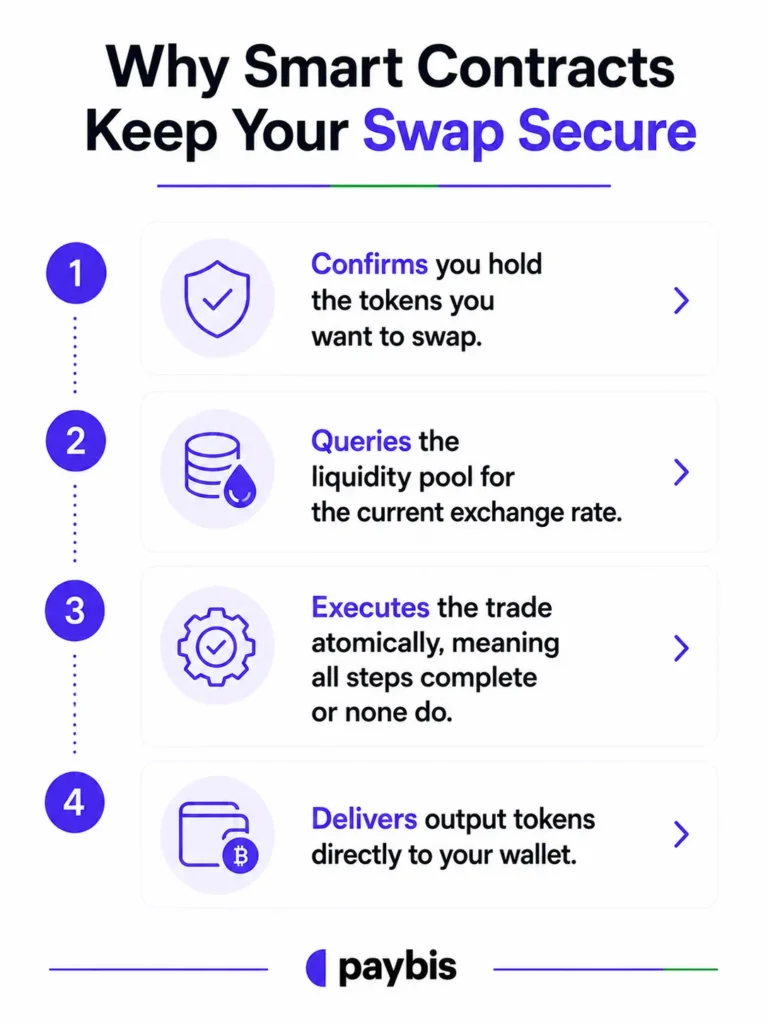
When you initiate a swap, the smart contract:
- Confirms you hold the tokens you want to swap.
- Queries the liquidity pool for the current exchange rate.
- Executes the trade atomically, meaning all steps complete or none do.
- Delivers output tokens directly to your wallet.
The critical security feature is immutability. Once a smart contract is deployed on a blockchain, it cannot be altered or secretly modified to redirect your funds. The code is publicly visible, so anyone can verify what it does before trusting it.
Think of it like a vending machine: insert your crypto, press execute, receive the output. No cashier, no waiting room, and the machine cannot change the terms mid-transaction. It’s also worth knowing how to spot and avoid crypto scams when interacting with smart contracts you haven’t verified.
Key Concepts to Know Before You Swap
Two variables affect the final amount you receive: slippage and fees. Understanding both prevents unpleasant surprises at checkout. Most platforms show these clearly, but knowing what to look for helps you compare options.
Understanding Slippage and Price Impact
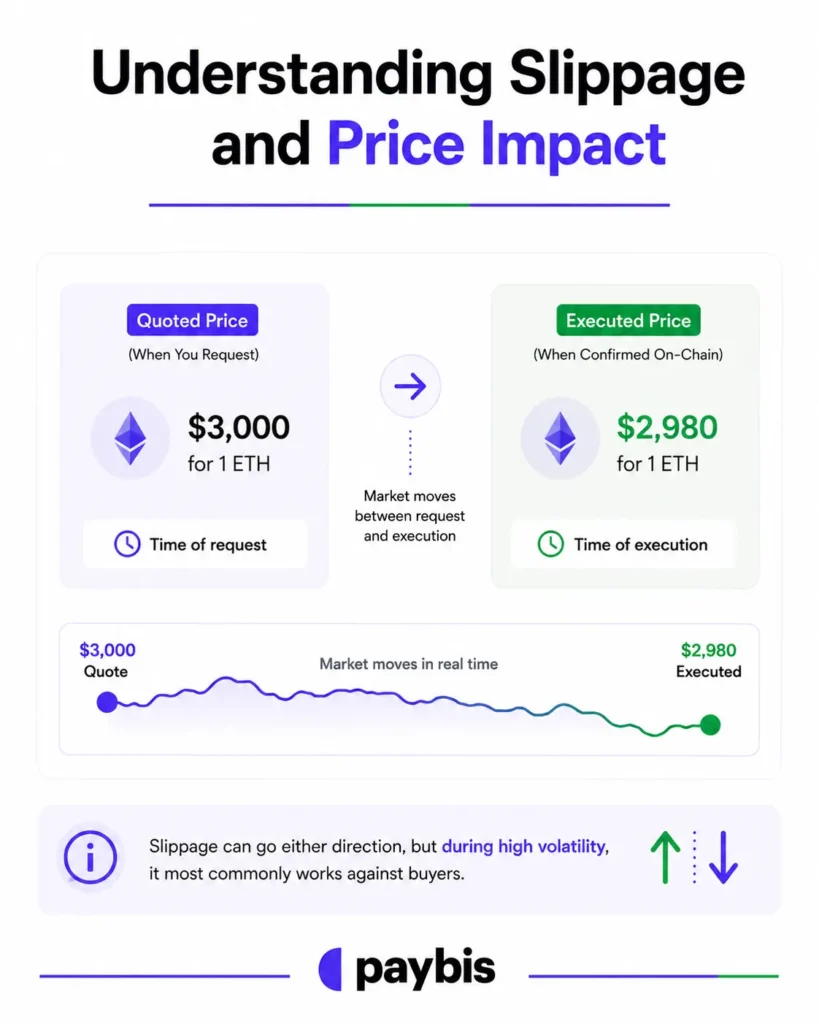
Slippage is what separates quoted from executed price. It happens because the market moves between the moment you request a price and the moment the transaction is confirmed on-chain.
A practical example: you place an order to buy 1 ETH at $3,000. By the time the blockchain processes it, ETH has shifted to $2,980, so you actually paid less. Slippage can go either direction, but during high volatility, it most commonly works against buyers.
CoW Protocol’s slippage guide recommends setting a slippage tolerance of 0.5% to 2% for most standard tokens. This is the maximum price difference you will accept before the transaction is canceled automatically. Most platforms set this by default. To minimize slippage, swap during low-congestion periods and use platforms with deep liquidity.
Network Fees vs. Platform Fees
Every crypto swap involves two types of fees. Knowing the difference prevents the “fee ambush” where the final charge is far higher than expected.
Network fees (also called gas fees) go directly to blockchain validators who process your transaction. These are set by the network, not the platform, and fluctuate based on demand. As Uniswap’s gas fee explainer shows, Ethereum gas fees vary based on network congestion and are unavoidable on any platform.
Platform fees are charged by the service facilitating your swap. On Paybis, we charge two components:
- Service Fee: Starts from 1.49%. Your first card transaction carries a 0% Paybis service fee.
- Processing Fee: 4.5-8.5% for card transactions over $50, depending on the currency used.
We display all three fees (Service, Processing, Network) before you confirm any transaction. What you see is exactly what you pay. For a broader look at how Paybis compares across top payment methods to buy crypto, our overview covers everything from cards to local bank transfers.
How to Swap Crypto: A Step-by-Step Guide
Here is how a swap executes on Paybis from start to finish:
- Choose the platform and access the swap tool. Go to paybis.com or open the Paybis app. You’ll see a simple calculator: “You send [amount] → You get [crypto].” No charts, no order books.
- Select your input and output tokens. Choose the currency you’re sending (e.g., BRL via PIX or USD via Visa card) and the crypto you want to receive from 90+ available cryptocurrencies. Enter your amount.
- Review the full fee breakdown before confirming. The screen shows Service Fee, Processing Fee, and Network Fee as separate line items. The total charged to your card appears before you click anything. For step-by-step guidance on swapping from your Paybis wallet, see the Paybis wallet swap guide. For external wallets, the external wallet swap guide covers the full flow.
- Complete identity verification (first-time users). Upload a government ID and take a selfie. Verification takes about 2 minutes for most users. You can follow our account creation and verification guide for a full walkthrough. For eligible smaller transactions, we offer a no-KYC purchase option.
- Confirm and execute. Click confirm, complete the 3DS security check on your phone (a text or app notification), and the transaction processes instantly (<1 minute). Settlement is near-to-instant, depending on the blockchain.
Why Use Crypto Swaps?
Speed for cross-border payments. Traditional international transfers take 3-5 business days and can cost as much as $45 per transaction. Swapping to USDT and sending it abroad takes minutes and costs a fraction of that. For anyone sending remittances or managing cross-border expenses, this difference is material.
Access to more assets. Decentralized swaps give users access to tokens not listed on major centralized exchanges. This matters for anyone holding stablecoins like USDT or USDC as a hedge against local currency devaluation, alongside major assets like Bitcoin and Ethereum. Explore stablecoin options on Paybis for a practical starting point. If you’re weighing how much exposure makes sense, our guide on how much Bitcoin you should own walks through the key considerations.
Control through non-custodial options. When you swap using your own wallet, you maintain full custody throughout. The smart contract delivers tokens directly to your address. You can learn more about how crypto wallets work and why custody matters in our help center.
How Paybis Simplifies the Swap Process
The mechanics described above run every time you use Paybis, but you never interact with them directly. We manage the technical process from start to finish. Your interface is a single calculator.
We’re FinCEN-registered (MSB in the US) and FINTRAC-registered (MSB in Canada), and have operated since 2014 without a security breach. We’ve processed $1.2B+ in annual transaction volume (last 12 months as of Oct 2025) and serve 5M+ retail users across 180+ countries with 20+ payment methods, including PIX in Brazil, Webpay in Chile, and FPS in the UK.
When something goes wrong, a human is available. We provide 24/7 live chat in 9 languages, with an average response time of 1-2 minutes, as verified in Coin Bureau’s Paybis review. We have 30,180+ Trustpilot reviews with a rating of 4 or “Great.”
“I’ve been using Paybis for a while now – and it’s really nailed the ‘easy and dependable’ part for me… Paybis makes buying crypto almost as easy as online shopping – quick, straightforward, and with peace of mind.” – Christine K. on G2
“I like how easy it is to buy crypto with my card and send it directly to my wallet. The interface is clear, transactions are fast, and support has been helpful whenever I had questions.” – Elizar S on G2
Ready to own Bitcoin in the next 10 minutes? Use the Paybis fee calculator to preview exactly what you’ll pay before you sign up. Create your account, complete the 2-minute verification, and your first card transaction carries a 0% Paybis service fee. Fees start from 1.49%.
Key Terminology
- Automated Market Maker (AMM): An algorithm that sets token prices based on the ratio of assets in a liquidity pool, eliminating the need for a traditional buyer-seller order book. It executes your trade automatically at the current pool-determined price.
- Liquidity pool: A reserve of two or more cryptocurrencies locked in a smart contract that provides the funds enabling swaps. Anyone can deposit into a pool and earn a portion of trading fees in return.
- Smart contract: A self-executing program deployed on a blockchain that automatically carries out the terms of a transaction when predefined conditions are met. It cannot be altered after deployment, meaning no party can change the rules mid-transaction.
- Slippage: The difference between the price quoted for a swap and the price at which it actually executes, caused by price movement during the transaction. Most platforms let you set a tolerance (typically 0.5-2%) beyond which the transaction cancels automatically.
- Network fee (gas fee): A fee paid to blockchain validators for processing your transaction, set by the network itself based on congestion, not by the platform. It is separate from any service or processing fee charged by the exchange.
- Decentralized Finance (DeFi): A category of financial services built on blockchain technology that operate through smart contracts rather than banks or brokers. Crypto swaps via liquidity pools are one of the core DeFi use cases.
- Non-custodial wallet: A crypto wallet where you hold the private keys, meaning you alone control access to your funds. Swapping through a non-custodial wallet means no platform can freeze or restrict your assets.
- On-chain transaction: A transaction recorded directly on the blockchain, visible to anyone and irreversible once confirmed. Every swap that uses a smart contract is an on-chain transaction.
FAQ
What happens if a crypto swap fails?
If an on-chain swap fails, the smart contract automatically reverses the transaction and returns your tokens to your wallet. Gas fees paid to network validators are not recoverable, but your crypto is returned.
How do I know the swap rate is fair?
We lock the price at the time you confirm and show the rate and fee breakdown before you click pay. The rate is based on live market data, and what you see at checkout is what executes.
Are crypto swaps taxable events?
In the US, the IRS swap tax guidance treats crypto swaps the same as crypto sales: you calculate the fair market value at the time of the swap and compare it to your original cost. Swapping at a loss is also a reportable event. Tax rules vary by jurisdiction, so consult a qualified tax professional for guidance specific to your country.
Disclaimer: Don’t invest unless you’re prepared to lose all the money you invest. This is a high‑risk investment and you should not expect to be protected if something goes wrong. Take 2 mins to learn more at: https://go.payb.is/FCA-Info