How to Buy Crypto in Canada: A Step-by-Step Guide
- Buying crypto in Canada is fully legal, and exchanges operating here must be registered with FINTRAC
- You can buy crypto in Canada using Interac e-Transfer, credit card, debit card, and bank transfer
- Canada taxes crypto as a commodity. Capital gains apply when you sell, trade, or spend it
- You do not need a wallet to get started; most Canadians buy directly to an exchange first
- On Paybis, the entire process from signup to first purchase takes under 10 minutes
Canada is one of the most crypto-friendly countries in the world. It approved the first Bitcoin ETF in North America back in February 2021, and its regulatory framework is among the clearest in the G7.
But if you’re doing it for the first time, the options can feel like a lot. Credit card or Interac? Exchange or peer-to-peer? Self-custody or keep it on the platform?
This guide walks through every step. By the end, you’ll know exactly what to do and how to make your first purchase without second-guessing yourself.
Before we dive in, if you’re ready to buy now, Paybis lets you buy Bitcoin with a credit card or debit card in minutes.
Is it legal to buy crypto in Canada?
Yes, buying, holding, and selling cryptocurrency is completely legal in Canada. The government treats crypto as a commodity, and exchanges operating in Canada must be registered with FINTRAC (the Financial Transactions and Reports Analysis Centre of Canada).
Canada has been ahead of most countries on crypto regulation. FINTRAC registration has been mandatory for crypto businesses since 2020, which means any platform operating legally here has passed anti-money laundering checks and follows strict KYC rules.
The Canadian Securities Administrators (CSA) also oversees crypto trading platforms at the provincial level. If a platform serves Canadian users without being registered, that’s a red flag worth acting on.
For you as a buyer, this regulatory structure is actually useful. It means there’s a layer of accountability that doesn’t exist in unregulated markets.
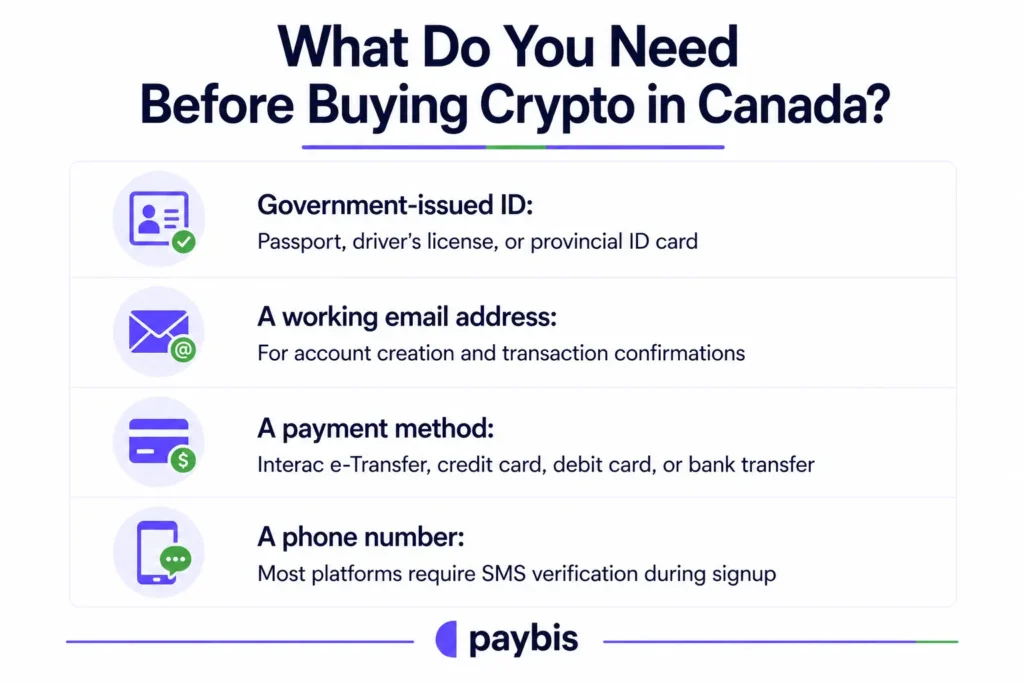
What do you need before buying crypto in Canada?
To buy crypto in Canada, you need a government-issued ID, a payment method, and an email address. Most platforms complete KYC verification in under 10 minutes.
Here’s the full checklist:
- Government-issued ID: Passport, driver’s license, or provincial ID card
- A working email address: For account creation and transaction confirmations
- A payment method: Interac e-Transfer, credit card, debit card, or bank transfer
- A phone number: Most platforms require SMS verification during signup
You don’t need a crypto wallet before your first purchase. Most beginners buy directly on a platform and store their crypto there initially. Wallets become relevant once you’re moving larger amounts or want full self-custody.
How do you buy crypto in Canada step by step?
The process has four main steps: choose a platform, create and verify an account, fund it with CAD, and place your first purchase.
Here’s exactly what that looks like in practice.
Step 1: Choose a platform
Pick a platform that is FINTRAC-registered and supports CAD deposits. Paybis supports credit and debit card purchases in Canada, which means you can go from sign-up to first purchase in under 10 minutes.
Step 2: Create and verify your account
Sign up with your email, set a strong password, and complete KYC verification. This involves uploading a photo of your ID and, in most cases, a selfie. Verification typically takes 5 to 10 minutes, though some platforms take longer during peak periods.
Step 3: Choose your crypto and amount
Decide what you want to buy and how much you want to spend. You don’t need to buy a whole Bitcoin. Every major cryptocurrency is divisible, so you can start with $50 CAD if that’s where you’re comfortable.
Step 4: Select your payment method and confirm
Select your payment method (credit or debit card on Paybis) and review the fees before confirming. Once the transaction processes, the crypto either lands in your platform account or gets sent to a wallet address you specify.
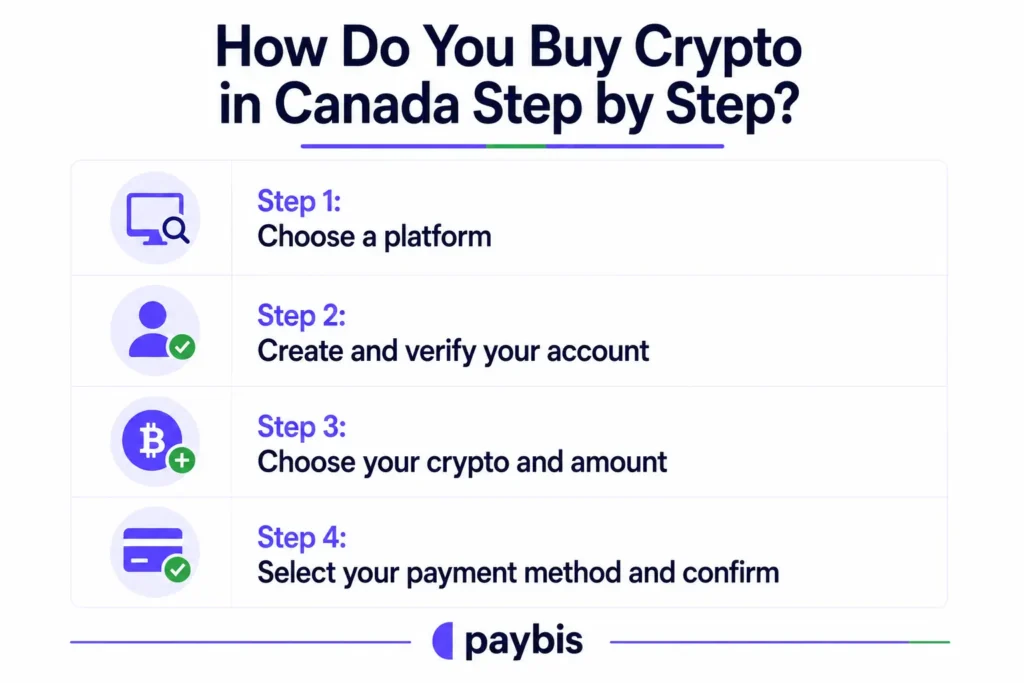
That’s the full process. The first purchase takes the longest because of verification. Every purchase after that moves much faster.
What payment methods can you use in Canada?
Canadian buyers have four main options: Interac e-Transfer, credit card, debit card, and bank wire. Interac is the most popular because transfers clear in minutes and fees typically stay under 2%.
Here’s how each one compares:
- Interac e-Transfer: The default choice for most Canadians. Almost every Canadian bank account supports it, transfers clear in minutes, and it’s the same system you’d use to send rent to a friend. If you’ve done that, you already know how it works.
- Credit card: The fastest option. Your purchase goes through instantly, which is useful when prices are moving. Credit card fees are higher (typically 3 to 5%), and some Canadian banks block crypto purchases on credit cards. Worth checking with your bank before you try.
- Debit card: Similar to a credit card in speed, with slightly lower fees on some platforms. Not every platform accepts Canadian debit cards, so check availability before signing up.
- Bank wire (EFT): The slowest option, but typically the cheapest for large amounts. Transfers can take 1 to 3 business days. Better suited to purchases above $5,000 CAD where the fee savings start to add up. See our full breakdown of payment methods for buying crypto to compare all options side by side.
What cryptocurrencies can you buy in Canada?
Canadians can buy over 90 cryptocurrencies on most regulated platforms, including Bitcoin, Ethereum, Solana, XRP, Litecoin, and USDT.
Bitcoin and Ethereum make up the vast majority of purchases in Canada by volume. The market has grown well beyond those two, and most regulated platforms now support a wide range of altcoins.
The most commonly bought cryptocurrencies in Canada:
- Bitcoin (BTC): The largest by market cap and the most widely accepted
- Ethereum (ETH): Powers most of the decentralized application ecosystem
- USDT (Tether): A stablecoin pegged to the US dollar, useful for holding value without converting back to CAD
- Solana (SOL): One of the fastest blockchains with growing adoption
- XRP: Frequently used for cross-border payments, popular for remittances
- Litecoin (LTC): An older alternative to Bitcoin with faster transaction times
If you’re buying for the first time, Bitcoin and Ethereum are where most people start. They have the deepest liquidity and the widest acceptance if you want to keep building from there.
Do you pay taxes on crypto in Canada?
Yes. The Canada Revenue Agency (CRA) treats cryptocurrency as a commodity, not a currency. That means capital gains tax applies when you sell, trade, or spend it.
The CRA’s position is clear: every time you dispose of crypto, it’s a taxable event. That includes selling for CAD, swapping one crypto for another, and spending it on goods or services.
Here’s how the tax calculation works:
- Capital gain = Proceeds minus your adjusted cost base (ACB)
- 50% of the capital gain is added to your taxable income for that year
- If you trade frequently, the CRA may classify your activity as business income, where 100% of profits are taxable
Receiving crypto as payment for work is also taxable as income at the fair market value on the day you received it.
The thing most new buyers miss: you don’t owe tax when you buy. The event happens when you sell or spend it. Holding doesn’t trigger anything.
Keep records of every transaction: the date, the CAD amount, and the price at the time. Tracking it from day one is much easier than reconstructing it two years later.
How do you store crypto safely in Canada?
You have two options: keep it on the platform where you bought it (custodial), or move it to a private wallet you control (self-custody). Both work. Which one makes sense depends on how much you’re holding.
Custodial storage (on-platform)
The platform holds your private keys on your behalf. This is how most beginners start. It’s convenient, you don’t need technical knowledge, and account recovery exists if you lose access.
The risk is real, though. If the platform has security issues or goes insolvent, your funds could be affected. The QuadrigaCX collapse in 2019, where Canadian users lost access to $190 million CAD in funds, is the clearest example of what that looks like in practice.
Self-custody (your own wallet)
You hold the private keys yourself. A software wallet like MetaMask works fine for smaller amounts. For larger holdings, a hardware wallet keeps your keys offline entirely.
The rule most experienced holders follow: not your keys, not your coins. The bigger your position, the more that rule matters.
Starting with custodial storage is fine. Moving to self-custody as your holdings grow is how most people do it.
What fees should you expect when buying crypto in Canada?
Fees vary by platform and payment method, but most Canadian buyers pay between 1.5% and 5% per transaction. The payment method you choose is the biggest variable.
Here’s a rough breakdown of what to expect:
| Payment Method | Typical Fee Range |
|---|---|
| Interac e-Transfer | 1.5% to 2.5% |
| Credit card | 3% to 5% |
| Debit card | 2% to 4% |
| Bank wire | 0.5% to 1.5% |
Beyond the platform fee, check for:
- Spread: The difference between the buy and sell price. Some platforms advertise zero fees but widen the spread instead.
- Network fee: Paid to the blockchain when you move crypto to a wallet. Varies by blockchain and congestion.
- Withdrawal fee: Some platforms charge to send crypto to an external wallet.
The easiest way to compare: check the total amount of crypto you receive for a fixed CAD amount across platforms, not just the stated fee percentage. Our guide on hidden crypto fees breaks down every charge to watch for.
Bottom Line
Canada is one of the easiest countries to buy crypto in. FINTRAC keeps platforms accountable. Interac makes deposits fast. The CRA has spelled out exactly how taxes work. There’s very little guesswork on the things that trip people up in other markets.
The process is four steps. Pick a FINTRAC-registered platform, verify your identity, fund your account, and place your first order. The first time takes the longest because of KYC. After that it takes minutes.
If you’re ready to go, Paybis supports credit and debit card purchases in Canada across 90+ cryptocurrencies. Signing up to first purchase takes under 10 minutes.
Buy crypto in Canada today. Paybis is available across Canada with credit and debit card support. Start here.
FAQ
Can I buy crypto in Canada without ID?
No. Every FINTRAC-registered platform in Canada requires identity verification before you can buy. This typically means uploading a government-issued ID and completing a selfie check. The process takes 5 to 10 minutes on most platforms, including Paybis. Platforms that skip KYC entirely are not operating legally in Canada.
What is the minimum amount of crypto I can buy in Canada?
Most platforms, including Paybis, set minimums around $20 to $50 CAD. You don’t need to buy a whole Bitcoin or a whole unit of any coin. Every major cryptocurrency is divisible, so you can start with whatever amount you’re comfortable with and scale from there.
Is Paybis available in Canada?
Yes. Paybis accepts Canadian users and supports credit and debit card purchases in CAD. The signup and verification process takes under 10 minutes, and purchases go through instantly once your account is verified.
Do I need a Canadian bank account to buy crypto in Canada?
Not necessarily. On Paybis, you can buy using a credit or debit card without a bank transfer. If you want to use Interac e-Transfer or EFT, you’ll need a Canadian bank account, but card-based purchases work without one.
What is the safest way to buy crypto in Canada?
Use a FINTRAC-registered platform, pay with a method you can reverse if something goes wrong (credit card offers more purchase protection than bank wire), and move larger holdings to a self-custody wallet once you’re comfortable.
Disclaimer: Don’t invest unless you’re prepared to lose all the money you invest. This is a high‑risk investment and you should not expect to be protected if something goes wrong. Take 2 mins to learn more at: https://go.payb.is/FCA-Info