How to Mine Ethereum Classic (ETC) in 2026: A Complete Setup Guide
- Ethereum Classic uses the Etchash algorithm and remains mineable with both GPU and ASIC hardware in 2026.
- ASICs now dominate the ETC network. GPU mining is still possible but requires hardware with more than 5GB of VRAM and competitive electricity costs.
- The network hashrate sits at 192.63 TH/s. Block reward is 2.56 ETC per block.
- At $0.10/kWh with top-tier hardware, net daily profit runs around $0.70. Electricity cost is the primary variable.
- Most miners use pools. Solo mining at home has near-zero practical probability of finding a block given current network difficulty.
- Popular mining software includes GMiner, NBMiner, lolMiner, and T-Rex. All support Etchash.
On the night of September 15, 2022, Ethereum switched off its proof-of-work mining forever. The Merge, as it was called, moved Ethereum to proof-of-stake and made GPU mining on the world’s second-largest blockchain obsolete overnight. Thousands of mining rigs, worth billions of dollars collectively, suddenly needed somewhere else to point their hashrate.
Most of them pointed it at Ethereum Classic.
ETC shares Ethereum’s original mining algorithm, Etchash. It was the obvious destination: same hardware, same software, familiar economics. The transition made ETC’s network significantly stronger and kept the chain running. In 2026, Ethereum Classic has moved past hype and price moonshots. It is a blockchain that survived, kept proof-of-work alive in Ethereum’s ecosystem, and continues to attract a steady community of miners who believe in it.
This guide covers everything you need to start mining ETC in 2026.
What Is Ethereum Classic and Why Is It Still Mineable?
Ethereum Classic is the original Ethereum blockchain. When Ethereum’s DAO was hacked in 2016 and the community voted to reverse the transactions, a group of developers refused. They kept the original chain running and called it Ethereum Classic. The idea was simple: a blockchain should be immutable. Code is law. What happened happened.
That philosophical difference has kept ETC alive ever since, even as the main Ethereum chain attracted most of the developer activity, capital, and attention. ETC has a smaller ecosystem and a lower price, but it has something Ethereum no longer has: proof-of-work mining.
When Ethereum moved to proof-of-stake in 2022, ETC became the primary home for Etchash miners. The network hashrate jumped significantly as former ETH miners arrived with their hardware. In 2026, ETC runs on a network of both GPU rigs and increasingly powerful ASIC miners. It remains one of the few major blockchains where GPU mining is still economically viable under the right conditions.
The ETC supply schedule also matters. Like Bitcoin, Ethereum Classic has a capped supply of 210 million coins and a block reward that reduces over time. The current block reward is 2.56 ETC. That scarcity model is part of why its community has stayed committed to it.
For a deeper look at how ETC compares to Ethereum across other dimensions, the Paybis Ethereum vs Ethereum Classic guide covers the differences in detail.
What Algorithm Does ETC Use and What Hardware Do You Need?
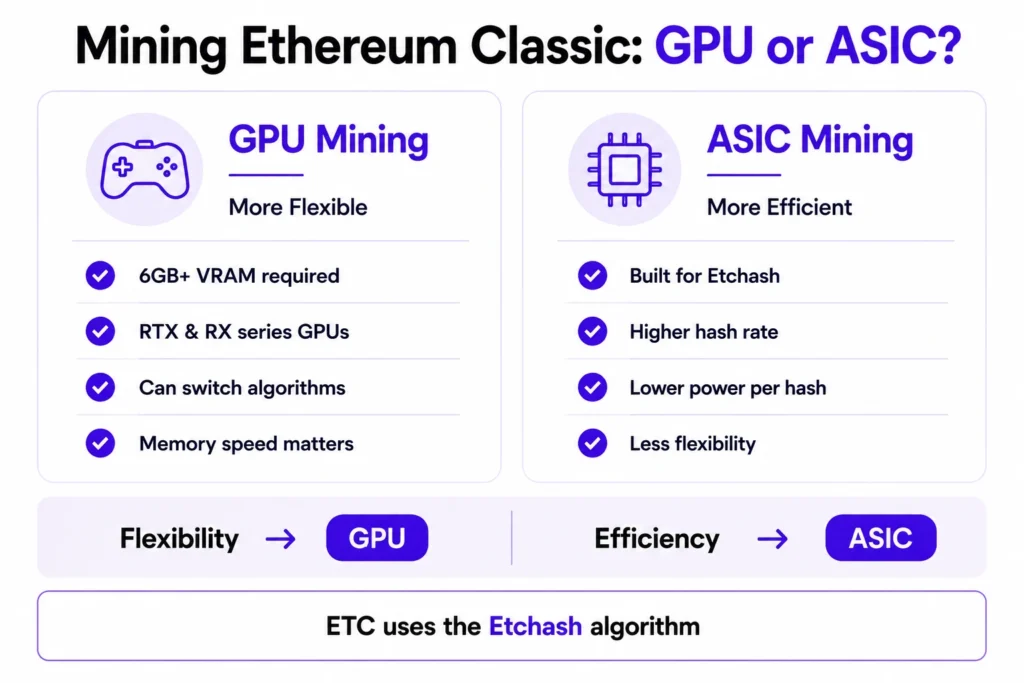
ETC uses Etchash, a modified version of the Ethash algorithm that Ethereum used before the Merge. Etchash was specifically designed to remain GPU-friendly while adding ASIC resistance features. In practice, ASICs have arrived anyway, but GPU mining has not been eliminated the way it was on Bitcoin.
For GPU miners:
You need a graphics card with more than 5GB of VRAM. The Etchash algorithm requires loading a DAG (Directed Acyclic Graph) file into GPU memory, and that file is now 4.202 GB. Any card with 5GB or less cannot mine ETC. Cards with 6GB will hit the limit in 2032. Cards with 8GB or more have a comfortable runway.
Nvidia RTX-series cards and AMD RX-series cards both work well. The sweet spot for efficiency is typically the RTX 3070 or 3080 range for Nvidia, and the RX 6800 XT range for AMD. Memory speed matters more than core clock for Etchash, so memory overclocking and core undervolting is a common optimization.
For ASIC miners:
ASICs now dominate ETC’s network hashrate. The iPollo V2H delivers 3,600 MH/s at 475W, making it one of the more efficient options for home setups. Jasminer and Bombax also produce competitive Etchash ASICs. The advantage is clear: far more hashes per watt than any GPU. The trade-off is less flexibility. An Etchash ASIC mines ETC and not much else.
For miners choosing between GPU and ASIC, the question is whether flexibility or raw efficiency matters more to them. A GPU rig can switch algorithms if ETC’s economics change. An ASIC cannot.
What Do the Current Mining Numbers Look Like?
The honest answer is that ETC mining in 2026 rewards patience and punishes short timelines.
Current network stats (as of May 2026):
- Network hashrate: 192.63 TH/s
- Block reward: 2.56 ETC
- ETC price: ~$8.50
- Time to mine 1 ETC: approximately 1.6 days at 5,800 MH/s
- Net daily profit at $0.10/kWh with top-tier ASIC: approximately $0.70
That $0.70 per day figure deserves context. It assumes the most efficient hardware available and electricity at $0.10/kWh. At $0.15/kWh, which is closer to the US residential average, that margin compresses significantly. At European residential rates around €0.28/kWh, most GPU setups run at a loss.
The miners who run profitably in 2026 share two characteristics. They have electricity costs well below $0.10/kWh through negotiated industrial contracts, solar setups, or geographic advantage. And they have either paid off their hardware already or acquired it at a deep discount.
ETC mining works on years, not months. The miners who approached it as a quick-return operation have largely moved on. The ones who remain are running hardware that was paid off long ago, or running in locations where power is cheap enough that the math stays positive even at thin margins.
You can track the live ETC price and use the Paybis ETC calculator to convert your mining output into your local currency.
How Do You Set Up ETC Mining Step by Step?
Setting up ETC mining takes less time than most people expect. The process is the same whether you are using a GPU or an ASIC, though the steps differ slightly.
- Step 1: Get a wallet. You need an Ethereum Classic wallet address to receive your mining rewards. Any wallet that supports ETC works. MetaMask supports ETC when configured for the ETC network. Hardware wallets like Ledger and Trezor also support it.
- Step 2: Choose a mining pool. For almost everyone starting out, a pool is the right choice. 2Miners, Ethermine (ETC), and F2Pool are among the largest. Each shows the current hashrate and expected payout frequency on their site. Pick one with a payout threshold you can reach reasonably within a few days of mining.
- Step 3: Download mining software. For GPUs, download GMiner, NBMiner, lolMiner, or T-Rex. All support Etchash. The miner you choose does not significantly affect your revenue, so pick based on stability and your GPU brand. For ASICs, the firmware is typically preloaded or available from the manufacturer.
- Step 4: Configure the miner. Create a config file or batch file with your pool address, your wallet address, and your rig name. A typical command for GMiner looks like this:
miner.exe --algo etchash --server etc.2miners.com:1010 --user YOUR_WALLET_ADDRESS.RIG_ID
Replace YOUR_WALLET_ADDRESS with your ETC wallet address and RIG_ID with whatever name you want for your rig.
- Step 5: Start mining and monitoring. Launch the miner and check that shares are being accepted by the pool. Most pools have a dashboard where you can track your hashrate and pending balance. Check it within the first hour to confirm everything is running correctly.
- Step 6: Optimize. Once running, most GPU miners undervolt their cards (reducing power consumption without hurting hashrate) and overclock memory speeds. This typically reduces power draw by 20 to 30% while maintaining 95%+ of hashrate. The exact settings vary by GPU model.
What Is the Difference Between Pool Mining and Solo Mining ETC?
Pool mining and solo mining produce the same reward per ETC block, but they distribute risk very differently.
In a pool, hundreds or thousands of miners combine their hashrate. When the pool finds a block, the reward is split proportionally based on each miner’s contribution. The result is small, regular payouts that scale with your hashrate. Variance is smoothed out. A miner contributing 1% of the pool’s hashrate can expect roughly 1% of the pool’s earnings, distributed frequently.
Solo mining means competing against the entire network on your own. At the current ETC network hashrate of 192 TH/s, a single GPU rig contributing 200 MH/s has a probability of finding a block roughly once every several years. On average. Sometimes longer. The reward when it happens is the full 2.56 ETC, but the timeline is unpredictable enough to make it impractical for anyone without significant dedicated hashrate.
For home miners and most small operations, pool mining is the realistic path. Solo mining is occasionally discussed by miners with large ASIC farms where the scale changes the probability calculation meaningfully.
Which Mining Software You Can Use for ETC in 2026?
Several miners handle Etchash well. The differences between them are small in terms of hashrate and efficiency, so stability and active development matter more than marginal performance differences.
- GMiner is widely used and actively maintained. It handles Etchash cleanly, supports both Nvidia and AMD cards, and has good pool compatibility. Developers update it regularly when algorithm or pool protocol changes occur.
- NBMiner is another solid choice with a long track record. It supports Etchash on both GPU brands and has a reputation for stability across long mining sessions.
- lolMiner is particularly well-regarded for AMD cards and has strong Etchash support. If your setup is AMD-heavy, it is worth benchmarking against GMiner.
- T-Rex is Nvidia-focused and performs well on RTX-series cards with Etchash. It has a built-in overclocking interface and monitoring dashboard.
All four are free to use with a small dev fee (typically 0.65 to 1%) built into the mining output. This means the miner keeps a small percentage of your shares as compensation for the software. It is standard practice in the industry.
What Do You Do With the ETC You Mine?
Once your pool balance reaches the payout threshold, ETC is sent to your wallet. From there, you have several options.
Hold it. Some miners accumulate ETC as a long-term position, treating the mined coins as an investment rather than immediate income.
Sell it. ETC is listed on major exchanges. Paybis supports ETC trading with 22 payment methods. You can check the current ETC to USD rate before deciding when to convert your earnings.
Swap it. You can swap ETC for Bitcoin, Ethereum, or another asset directly through an exchange without converting to fiat first.
If you want to buy ETC directly rather than mine it, Paybis supports purchasing Ethereum Classic with credit card, debit card, PayPal, Apple Pay, and other payment methods with fees shown upfront before you confirm.
Bottom Line
Ethereum Classic mining in 2026 is alive and running, but the economics require honest assessment. ASICs dominate the network. GPU mining remains possible with the right hardware and electricity cost. Payback periods are long at residential power rates, and daily returns are measured in cents to single dollars depending on setup size. The miners making it work in 2026 have cheap electricity, paid-off hardware, and a multi-year view. For those who mine ETC and want to convert their rewards, the ETC to USD converter and ETC calculator on Paybis let you track your output in real time.
This article is for informational purposes only. Mining profitability depends on electricity costs, hardware, market conditions, and other factors that change constantly. This is not financial advice.
FAQ
Can you still mine Ethereum Classic in 2026?
Yes. Ethereum Classic uses the Etchash proof-of-work algorithm and remains actively mineable in 2026 with both GPU and ASIC hardware. The network has been running continuously since the Ethereum Merge redirected former ETH miners toward ETC. GPU mining requires a card with more than 5GB of VRAM due to the current DAG size of 4.202 GB. ASIC miners from brands like iPollo, Jasminer, and Bombax offer higher efficiency but less flexibility.
What is the Etchash algorithm?
Etchash is a modified version of Ethash, the algorithm Ethereum used before moving to proof-of-stake. It was specifically adapted for Ethereum Classic to remain GPU-accessible while adding some ASIC resistance. In practice, ASICs have arrived on the ETC network, but the algorithm still supports GPU mining. It is memory-intensive by design, which is why GPU VRAM size matters for ETC mining in a way it does not for other algorithms.
How much ETC can you mine per day?
It depends on your hashrate and the current network difficulty. At the current network conditions in May 2026, a 5,800 MH/s setup takes approximately 1.6 days to mine 1 ETC on average. That translates to roughly 0.6 ETC per day at that hashrate before electricity costs. A single high-end GPU producing around 60 to 80 MH/s would generate a proportionally smaller share. Pool payouts vary depending on the pool’s payout schedule and your contribution to the pool’s total hashrate.
Is GPU mining ETC still viable in 2026?
GPU mining is still viable under the right conditions. Cards with 8GB or more of VRAM can mine ETC, and the Etchash algorithm has not completely locked out GPUs the way Bitcoin’s SHA-256 locked out everything except ASICs. The economics depend almost entirely on electricity cost. At rates below $0.08/kWh and with hardware already paid off, GPU mining can generate positive returns. At residential electricity rates in the US or Europe, most setups produce thin or negative margins. The Coincub 2026 mining guide describes ETC as rewarding patience and punishing short timelines.
What pools are available for ETC mining?
The main pools for ETC mining in 2026 include 2Miners, F2Pool, and Ethermine ETC. Each has a pool dashboard showing current hashrate and payout statistics. Most use the PPLNS (Pay Per Last N Shares) payout model, which rewards consistent contributors. Minimum payout thresholds vary by pool, typically starting around 0.1 ETC. Larger pools offer more frequent payouts due to higher probability of finding blocks, while smaller pools offer slightly better per-share rewards when blocks are found.
Disclaimer: Don’t invest unless you’re prepared to lose all the money you invest. This is a high‑risk investment and you should not expect to be protected if something goes wrong. Take 2 mins to learn more at: https://go.payb.is/FCA-Info