
Switching Crypto Exchanges? Most Europeans Don’t Even Know They Need To

- The deadline for crypto firms to get licensed under MiCA passed on 1 July 2026. Old national licences no longer count in any of the 27 EU countries
- Out of more than 1,200 firms that used to hold a national licence, only about 17 to 20% got the new MiCA licence in time
- Fees and pricing matter most to people choosing a new exchange (31.8%). Reviews, personal recommendations, and sign-up offers all matter less
- 68.6% of people don’t know if their current exchange has a MiCA licence
- Paybis holds a full MiCA CASP licence from the Bank of Latvia. This licence covers all 27 EU countries
Millions of Europeans are being pushed to switch crypto exchanges right now, whether they realise it or not. The reason is a new EU rule called MiCA. Most people have heard the name but don’t know what it actually means for them. Paybis asked crypto users across Europe two things: what they look for in a new exchange, and whether they know their current exchange’s legal status. The answers show a gap between what people want and what they actually know.
This article explains what changed under MiCA. It covers what people said matters most when picking a new platform. And it looks at why so many users don’t know where they stand.
Why Are Millions of Europeans Suddenly Switching Crypto Exchanges?
The deadline for crypto firms to get a MiCA licence passed on 1 July 2026. Any exchange serving EU customers without one is now breaking the law. MiCA has covered the whole EU since 30 December 2024. But firms with older national licences had until 1 July 2026 to switch over. That extra time is now gone.
Out of more than 1,200 firms that used to hold a national licence, only about 17 to 20% got the new MiCA licence in time. The rest had three choices. Get licensed. Leave the EU market. Or keep running without a licence, which is illegal. Users on those platforms feel the effects directly.
What Happens to Users on an Unlicensed Exchange?
Exchanges without a MiCA licence are already restricting accounts, often with little or no warning. Some are letting people withdraw funds but not deposit new money. Others have paused deposits altogether. Some have stopped trading completely. If you log in expecting things to work as normal, this can feel like being locked out of your own money.
This is why Paybis asked crypto users two simple questions. What matters most when picking a new exchange? And do they know if their current one is still allowed to operate?
What Do Europeans Actually Look for When Forced to Switch Exchanges?
Fees and pricing came out on top. 31.8% of people said this matters most. Reviews, personal recommendations, and sign-up offers all scored lower.
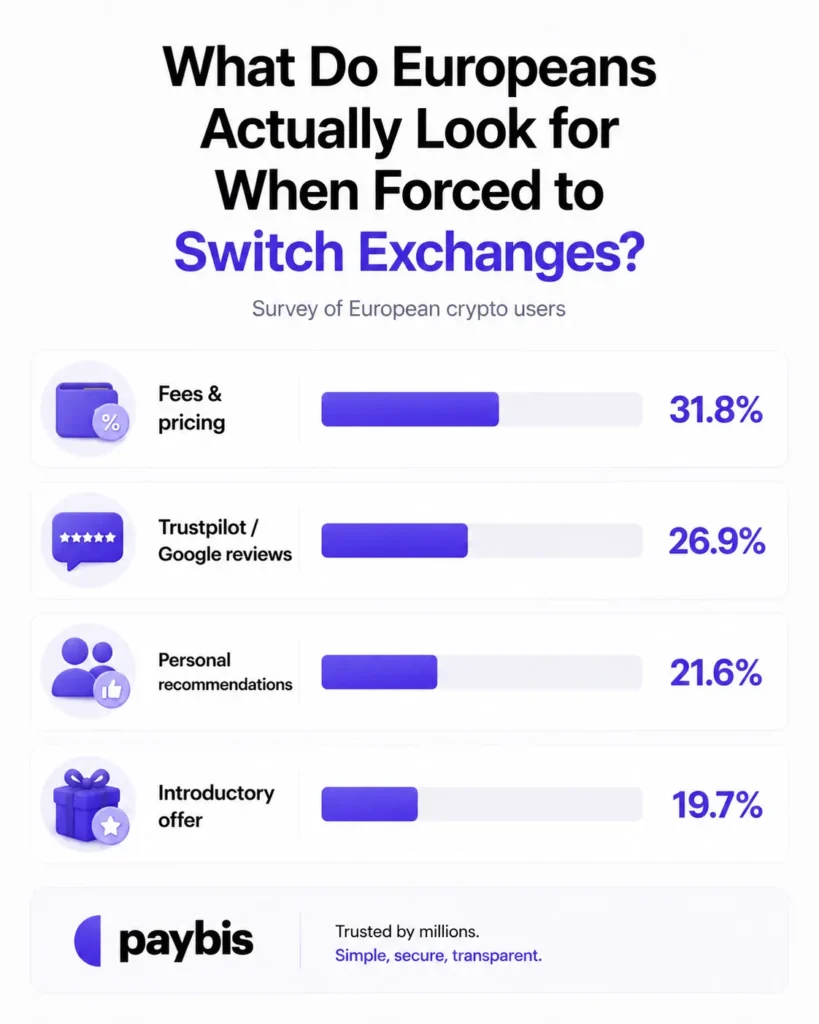
A few things stand out here.
- Price comes first when the switch isn’t your choice. Almost a third of people ranked fees above everything else. If you’re already being forced off a platform you liked, you don’t want to pay more on the next one.
- Reviews beat word of mouth. Trustpilot and Google reviews (26.9%) scored higher than personal recommendations (21.6%). When money is on the line, people trust a large number of public reviews more than one friend’s opinion.
- Sign-up bonuses matter least. Introductory offers ranked lowest at 19.7%. A one-off bonus doesn’t make up for the need for a platform that will still be around next year.
Do Most People Know If Their Current Exchange Is Still Licensed?
No. More than two-thirds of people, 68.6%, don’t know if their current exchange holds a MiCA licence.
That’s a big number given what’s at stake. Most previously licensed platforms failed to get the new licence in time. Several have already started blocking withdrawals or trading for accounts that don’t meet the new rules. Yet almost 7 in 10 users haven’t checked, or don’t know, where their own exchange stands.
This means many people will only find out there’s a problem after it happens. Deposits get switched off. Trades get frozen. An account quietly moves to withdrawal-only. By then, there’s no time to plan ahead.
Why Does This Awareness Gap Matter?
Because knowing what to look for and knowing you need to look are two different things. People already know what they want in a new exchange. Price first. Then reputation. Then advice from people they trust. Bonuses last. That part is clear.
What’s missing is simpler than that. Most people just don’t know their current exchange’s legal status. Nobody told them, and they haven’t checked.
How Can You Check If Your Exchange Holds a Real MiCA Licence?
Look for the exact licence type and the regulator that issued it. A general claim of being “compliant” isn’t enough. A real MiCA licence, called a CASP authorisation, is issued by a named regulator in an EU country. Legitimate exchanges list this clearly on their website, usually in the footer or a legal page.
Check for these three things:
- The regulator’s name and a licence or registration number
- Whether the licence is the new MiCA licence, not an old national one that no longer applies
- Whether the exchange also holds a PSD2 licence, which covers how it handles your money in euros or other currencies
If a website only says “MiCA compliant” without naming a regulator or a licence number, don’t take that at face value. Look further.
Paybis holds a full MiCA CASP licence from the Bank of Latvia. This licence covers all 27 EU countries. Paybis also holds a PSD2 licence from the same regulator. You can check how Paybis structures its fees before deciding where to move your crypto.
What Should You Look For When Switching Exchanges?
Follow the same order most people already use: fees first, reputation second, then confirm the licence is real. A low headline fee isn’t always the full story. Some platforms add costs elsewhere. Reviews help too, but recent ones tell you more than old ones. Checking the licence only takes a few minutes, and it protects you from landing on another exchange that isn’t allowed to operate either.
Bottom Line
This isn’t just a story about exchanges losing their licences. It’s a story about users who know what they want from a new platform, but don’t know they need to look for one yet. Fees and reputation will keep deciding where people move their crypto. But with close to 70% of users unaware of their exchange’s status, checking that status matters just as much as price.
If you’re ready to move to a platform with a clear, checkable licence, Paybis is fully licensed under MiCA and PSD2. Fees are transparent and support is available around the clock.
About Paybis
Paybis is a licensed cryptocurrency exchange that has operated since 2014. It serves users in more than 180 countries with over 90 cryptocurrencies and 22 payment methods. Paybis holds a 4.1 out of 5 rating on Trustpilot from more than 31,900 reviews.
Paybis’s licences and registrations:
- MiCA CASP licence, issued by the Bank of Latvia, covering all 27 EU countries
- PSD2 Payment Institution licence, issued by the Bank of Latvia
- FinCEN registration in the United States (#31000272911973, and #31000277275964 for a related entity)
- FINTRAC registration in Canada (entity C100000646) and Poland (entity C100000816, registration M22061209)
- VASP registration in Poland (RDWW-805, Tax Administration Chamber in Katowice)
Paybis charges a 2.49% service fee, with 0% on a user’s first card purchase per cryptocurrency. Support is available 24/7 via live chat, with response times of 1 to 2 minutes.
FAQ
What is MiCA and why does it matter for crypto users in Europe?
MiCA is the EU’s new rulebook for crypto companies. It stands for Markets in Crypto-Assets Regulation. It replaces the old system where each country had its own separate rules. Under MiCA, one licence covers a company’s operations across all 27 EU countries. For users, this matters because a platform’s licence now decides whether it can legally offer deposits, withdrawals, and trading. Platforms that missed the deadline are already limiting what users can do, and more restrictions are likely. Checking your exchange’s licence is now a practical step to protect your access to your own money.
What happened when the MiCA transition window closed?
Crypto firms that held older national licences had until 1 July 2026 to switch to a full MiCA licence. That date has now passed. Any firm serving EU customers without a MiCA licence is breaking the law, no matter what it was allowed to do before. Only around 17 to 20% of previously licensed firms made the switch in time. The rest had to get licensed, leave the EU, or keep operating illegally. Users on platforms in that last group are the ones most likely to see sudden restrictions on their accounts.
How do I know if my exchange has MiCA authorisation?
Look on the exchange’s website for a clear mention of a MiCA licence, along with the name of the regulator and a licence number. This is usually in the footer or on a legal page. A vague claim like “we are compliant” without naming a regulator is a reason to look closer. You can also check the public register kept by the relevant EU regulator, since licensed firms are listed there. If you search and still can’t find clear licensing details, treat that as a warning sign.
What should I prioritise when choosing a new exchange?
Based on what users told Paybis, fees come first. Public reviews come next, then personal recommendations, then sign-up offers. A low fee shown on the homepage isn’t always the full cost, so check the fee structure in detail. Recent reviews tell you more than old ones, since a platform’s service can change over time. Alongside all of this, check the licence. A great fee on an unlicensed exchange still carries the same risk described above.
Is Paybis licensed under MiCA?
Yes. Paybis holds a full MiCA CASP licence issued by the Bank of Latvia. This licence covers Paybis’s operations across all 27 EU countries. Paybis also holds a PSD2 licence from the same regulator, which covers how it handles currency transactions. Outside the EU, Paybis is registered with FinCEN in the United States and FINTRAC in Canada, and holds a VASP registration in Poland. Paybis has operated since 2014 and serves users in more than 180 countries.
Disclaimer: Don’t invest unless you’re prepared to lose all the money you invest. This is a high‑risk investment and you should not expect to be protected if something goes wrong. Take 2 mins to learn more at: https://go.payb.is/FCA-Info