Kraken Staking vs Alternatives: Rates, Risks & Fees (2026)
Key Takeaways:Kraken offers custodial staking for ETH, SOL, and ADA but takes 15–30% on Bonded Staking or a flat 30% on Flexible Staking. Coinbase charges 25–35% in commissions. Binance’s cut ranges from 9.95% to 39.95% depending on the asset. The safest alternative: buy crypto instantly on Paybis and stake directly from your own personal wallet, where no platform can freeze your funds, take a commission, or go bankrupt with your assets inside. You can also buy Bitcoin with PayPal, buy Binance Coin, or buy Bitcoin Cash with Paysafe Card to diversify your staking strategy across assets.
Earning passive income on crypto sounds simple until you remember what happened to Celsius and BlockFi customers. They deposited coins to earn yield, the platforms froze withdrawals, and users waited over 18 months in bankruptcy proceedings to recover a portion of their funds. The central question is not “What APY can I earn?” but “Do I actually own the coins I’m staking?” This guide compares Kraken’s custodial staking against Coinbase and Binance, then shows you how to buy crypto instantly on Paybis and stake from your own wallet, so no platform can freeze your funds or take a commission.
Understanding Kraken Staking: Rates and Requirements
Kraken runs a custodial staking service, meaning you send your coins to Kraken, and they stake on your behalf using their own validators. You don’t hold the private keys. Kraken does.
Current APY Rates for Major Coins (ETH, SOL, ADA)
Network conditions change these rates constantly, so treat them as estimates at the time of writing. For a broader look at which networks currently offer the highest yields, see our highest APY staking platforms guide.
| Coin | Kraken Est. APR* | Coinbase Est. APY* | Commission on Rewards |
|---|---|---|---|
| ETH | Up to 2.83% | 3–5% | Kraken: 15–30% / Coinbase: 25–35% |
| SOL | Up to 6.68% | ~4.12% | Kraken: 15–20% / Coinbase: 25–35% |
| ADA | Up to 2.94% | Supported | Kraken: 15–30% / Coinbase: 25–35% |
- Note: APR (Annual Percentage Rate) does not include compounding effects, while APY (Annual Percentage Yield) includes compounding. Rates are not directly comparable.
Lock-up Periods and Unstaking Delays
When you stake through Kraken, bonding and unbonding periods determine how long you wait before accessing your coins:
- ETH: Bonding takes approximately 3 days. Unbonding (getting your coins back) takes approximately 5 days under normal conditions, to 11 days during network congestion. You cannot sell or move your ETH during that window, regardless of market conditions.
- SOL: Unstaking aligns with Solana’s reward cycle (called an epoch), which runs approximately 2-3 days. The blockchain itself imposes this minimum wait, meaning unstaking typically takes 2-3 days on Kraken.
- ADA: No bonding or unbonding period. Your ADA stays liquid and transferable at all times. Kraken credits rewards weekly, starting immediately when you stake, though Cardano’s native protocol requires approximately 15-20 days for first rewards when staking directly through wallets.
Our staking guide breaks down these trade-offs in plain English if you want more context before committing funds. If you’re also weighing how much of your portfolio to allocate, our guide on how much Bitcoin you should own offers a useful framework for thinking about crypto position sizing.
The Risks of Exchange Staking (What Kraken Doesn’t Tell You)
Custodial staking is convenient, but that convenience carries a specific type of risk most platforms don’t highlight on their product pages. Our support documentation on custodial wallets and their risks covers this in detail.
Lessons from Celsius and BlockFi: Custodial Risk Explained
In 2022, Celsius Network and BlockFi both halted withdrawals and filed for bankruptcy. A federal judge ruled that Celsius customers had transferred control of their assets to the company, which meant their coins became part of the bankruptcy estate, not their personal property. Users became unsecured creditors (meaning they had no guaranteed claim to their funds) rather than asset owners.
The BlockFi Chapter 11 plan became effective in October 2023. While Chapter 11 typically allows reorganization, BlockFi’s plan resulted in liquidation and wind-down of the business. Neither platform carried FDIC insurance. When a custodial platform fails, bankruptcy courts count your coins as company assets, not yours.
Approximately 28% of all staked ETH resides with custodial services like centralized exchanges, meaning more than one in four staked ETH is not under the control of its owners.Ready to avoid custodial risk entirely?Check the Paybis fee calculator to see exactly what a $500 ETH purchase costs before you commit, with all fees itemized upfront.
Kraken’s Regulatory Status and SEC Settlement
In February 2023, the SEC charged Kraken for failing to register its staking program as a securities product. Kraken paid $30 million in fines and returned profits, and immediately shut down US staking services. Non-US users still have access through a separate subsidiary, but the enforcement action established that regulators treat custodial staking as a financial product requiring registration, not just a standard exchange feature.
Top Kraken Alternatives Compared
Coinbase Earn: Lower Rates but Higher Usability?
Coinbase makes staking invisible. Hold an eligible asset and rewards accumulate automatically with no setup required. For a beginner who wants simplicity, that is genuinely useful, and Coinbase is one of the most regulated publicly traded exchanges. The Coinbase vs Kraken comparison from Software Scope covers the practical interface differences.
The trade-off is cost. Coinbase takes a 35% commission on staking rewards for most assets, with Coinbase One members paying a reduced commission. At a 3-5% ETH APY, a 35% commission reduces your effective yield to roughly 2-3.25%. Bank transfers on Coinbase also take 3-5 days to clear, meaning you could wait nearly a week before your staked position is even funded. For a full breakdown of what those fees actually cost you, see our guide on 5 hidden Coinbase fees and how to avoid them.
Binance Earn: Complexity vs. Yield
Binance charges a commission on staking rewards that starts at approximately 9.95% for some assets but rises to 39.95% depending on the cryptocurrency and product type. On paper, its lower commission floor makes it attractive for yield, but finding the right staking product inside Binance takes real navigation effort. The Binance vs Kraken comparison from 99Bitcoins illustrates how complex the interface becomes for users who just want a straightforward earning product. Binance also paid $4.3 billion in regulatory fines in 2023 and remains restricted in several jurisdictions.
Self-Custody Staking: The Safest Alternative
Non-custodial staking means you stake directly from your own personal wallet. Your funds never leave your control. No exchange holds your private keys, so no exchange bankruptcy can freeze your assets. You delegate to a validator (a computer that secures the blockchain network and earns rewards), and the blockchain pays you directly, commission-free. Our guide to the best non-custodial wallets can help you choose the right wallet before you start.
| Platform | Custodial? | Est. ETH APY | Commission on Rewards | Key Risk |
|---|---|---|---|---|
| Kraken | Yes | Up to 2.83% APR | 15–30% | Regulatory risk, custody risk |
| Coinbase | Yes | 3–5% | 25–35% | High commission, 3–5 day bank waits |
| Binance | Yes | Varies | 9.95–39.95% | Interface complexity, regulatory issues |
| Self-Custody | No | Full network rate | 0% | Your own security responsibility |
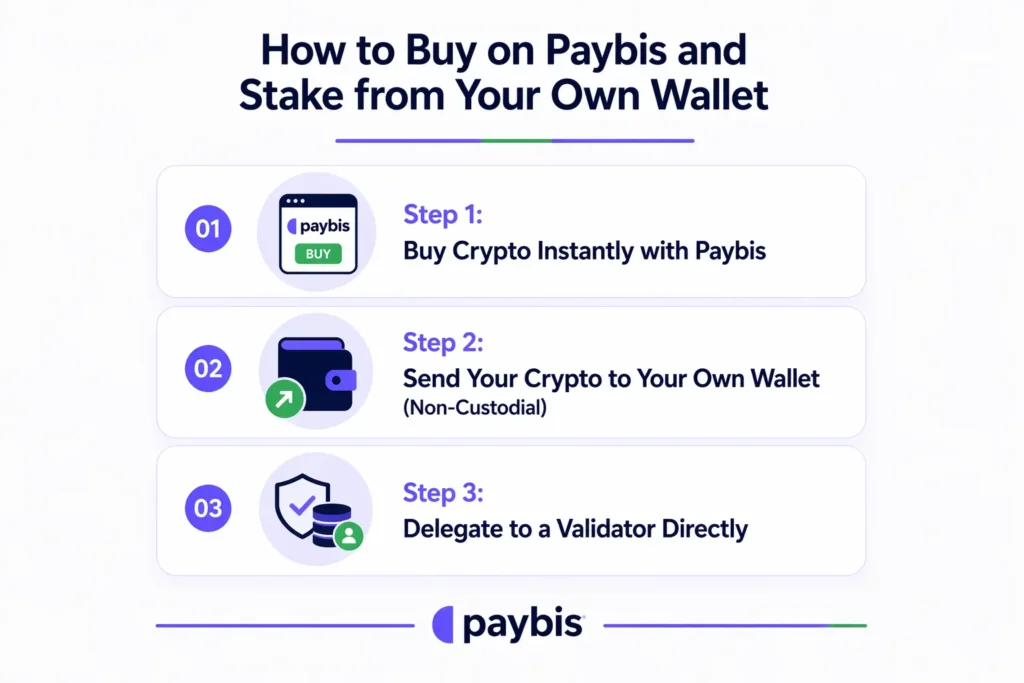
How to Buy on Paybis and Stake from Your Own Wallet
Paybis is a crypto purchase platform, not a staking pool. We verify your identity, process your card payment, and send your crypto to whatever wallet address you provide. We take 0% of your staking rewards because you stake entirely outside our platform.
Step 1: Buy Crypto Instantly with Paybis
Start at paybis.com and select the cryptocurrency you want to stake (ETH, SOL, and ADA are all supported among 90+ available cryptocurrencies). The calculator shows the exact amount you’ll receive, with all fees itemized before you confirm payment. If SOL is your target, the Solana calculator gives you a precise projection of staking returns based on current network rates. You can also buy Bitcoin with PayPal if that’s your preferred payment method.
Fees start from 1.49% as a service fee. Your first card transaction has a 0% service fee. Processing fees run 4.5-8.5% for card transactions over $50 depending on your currency. Network fees vary by blockchain demand. All three are visible before you click confirm.
Identity verification takes approximately 2 minutes (photo ID and a selfie). Once verified, transaction processing is instant at under 1 minute. Paybis has 30,700+ of Trustpilot reviews with a rating of 4.1 or “Great” (as of March 2026), and operates in 180+ countries with 20+ payment methods supported. The FXEmpire independent Paybis review and The DigiChick’s Paybis tutorial both confirm the speed of the verification and purchase flow.
“The Paybis app it’s the easiest I’ve ever used…it was the easiest to just complete the account setup and then I did use it one time and it was the easiest.” – Tammy on Trustpilot
“Paybis offers transactions in a quick and easy format with thorough security measures. I’ve been using their app for quite some time and have had no issues.” – Amanda Stringfellow on Trustpilot
Step 2: Send Your Crypto to Your Own Wallet (Non-Custodial)
After purchasing, withdraw crypto from Paybis to a personal wallet you control, whether that’s a software wallet on your phone or a hardware wallet device. The key point is that you hold the private keys, not a company.
Our Paybis wallet withdrawal guide covers the exact steps. You can also check Paybis withdrawal limits based on your account level before you start. For ETH specifically, our help page on Ethereum tokens on Paybis lists everything supported. If you’re new to choosing a wallet, our overview of what business wallets are explains the key differences between wallet types and custody models.
Step 3: Delegate to a Validator Directly
Once your crypto arrives in your personal wallet, staking is typically a single action inside the wallet’s interface. Choose a validator from a list, enter the amount you want to stake, and confirm. The blockchain does the rest.
Slashing is a built-in penalty where the network takes part of a validator’s staked tokens when they break rules or go offline repeatedly. Penalties typically range from 0.5% to 5% of a validator’s stake, depending on the network and severity of the violation. On Ethereum, for example, minor downtime results in small penalties (fractions of a percent), while coordinated attacks trigger larger slashes. You manage this risk by choosing established validators with strong track records rather than unknown operators. Most personal wallet interfaces display validator performance metrics, uptime percentages, and historical slashing events to help you decide.
For ADA holders, this process is especially straightforward because there’s no unbonding period. Your ADA stays liquid while earning rewards.
Paybis support is available 24/7 with an average response time of approximately 15 seconds if you have questions at any step.
“Support actually responds & is extremely courteous. Cheers guys.” – Kevin Ashley on Trustpilot
“Paybis is a very good crypto exchange, and they have very good customer support and I am glad I can do business with them when I need to use crypto for certain business I need to take care of.” – Douglas Weaver on Trustpilot
Which Staking Path Keeps You in Control?
Kraken offers a functional staking product, but convenience costs you in three measurable ways: the commission on rewards (15-30%), the lock-up periods that limit your access when markets move, and the custodial risk that means the platform holds your assets, and regulators can intervene. Coinbase costs even more in commissions. Binance costs less, but navigating its interface is a real barrier for anyone who just wants a simple earning product.
Self-custody staking removes all three problems. You keep 100% of your rewards, control your exit timing, and no platform failure can freeze your funds. The only added responsibility is securing your own wallet, which any personal wallet’s recovery phrase process handles. Our guide on how to choose which exchange to buy Bitcoin from is also worth reading if you’re still evaluating where to make your first purchase. Create a Paybis account, verify your identity in approximately 2 minutes, and see your exact fee total before you confirm. Fees start from 1.49%, and the first card transaction carries a 0% service fee.
Key Terminology
- Validator: A computer that secures a proof-of-stake blockchain by verifying and recording transactions. Validators stake tokens as collateral and earn rewards for honest participation.
- Custodial staking: When an exchange stakes crypto on your behalf and holds your private keys in the process. You give up direct control of your assets.
- Non-custodial staking: Staking directly from a personal wallet where you hold your own private keys. No third party can freeze or access your funds.
- APY (Annual Percentage Yield): How much you earn per year on your staked crypto, expressed as a percentage and including compounding. A 6% APY on $1,000 of SOL returns approximately $60 in SOL rewards over 12 months before any commission deductions.
- Unbonding period: The waiting time between requesting your crypto back and actually receiving it. Ethereum’s unbonding period varies from approximately 5 days under normal conditions to 11 days during network congestion. ADA has no unbonding period.
- Slashing: A penalty built into proof-of-stake blockchains. If a validator misbehaves or goes offline repeatedly, the network removes part of their staked tokens. Choosing established validators with strong track records reduces this risk.
- Private keys: The cryptographic proof that you own and control a crypto wallet. Whoever holds the private keys controls the funds. In custodial staking, the exchange holds them. In non-custodial staking, you do.
FAQ
Is Kraken staking safe in 2026?
Kraken is a regulated exchange with a long operating history, but the SEC forced it to pay $30 million in 2023 and end US staking services. Non-US users still have access, but the exchange holds your keys, which means custodial risk is built into the product.
Can I lose money staking on Kraken?
Your staked crypto stays denominated in that asset, so if the price falls, your fiat-equivalent balance falls with it. If Kraken halted withdrawals (as Celsius and BlockFi did), you would lose temporary or permanent access to your staked coins until any insolvency proceedings resolve.
What is the difference between custodial and non-custodial staking?
Custodial staking means an exchange stakes on your behalf and holds your private keys. Non-custodial staking means your coins stay in your own wallet and you delegate directly to a blockchain validator. You retain full access and control with non-custodial staking.
Does Paybis charge a fee for staking?
Paybis charges standard transaction fees when you buy crypto (starting from 1.49% service fee, shown upfront before you confirm). Paybis takes 0% of your staking rewards because you stake from your own personal wallet after withdrawing.
Disclaimer: Don’t invest unless you’re prepared to lose all the money you invest. This is a high‑risk investment and you should not expect to be protected if something goes wrong. Take 2 mins to learn more at: https://go.payb.is/FCA-Info