P2P Crypto Sales vs. Exchange Withdrawal: Which Gives You More Cash?
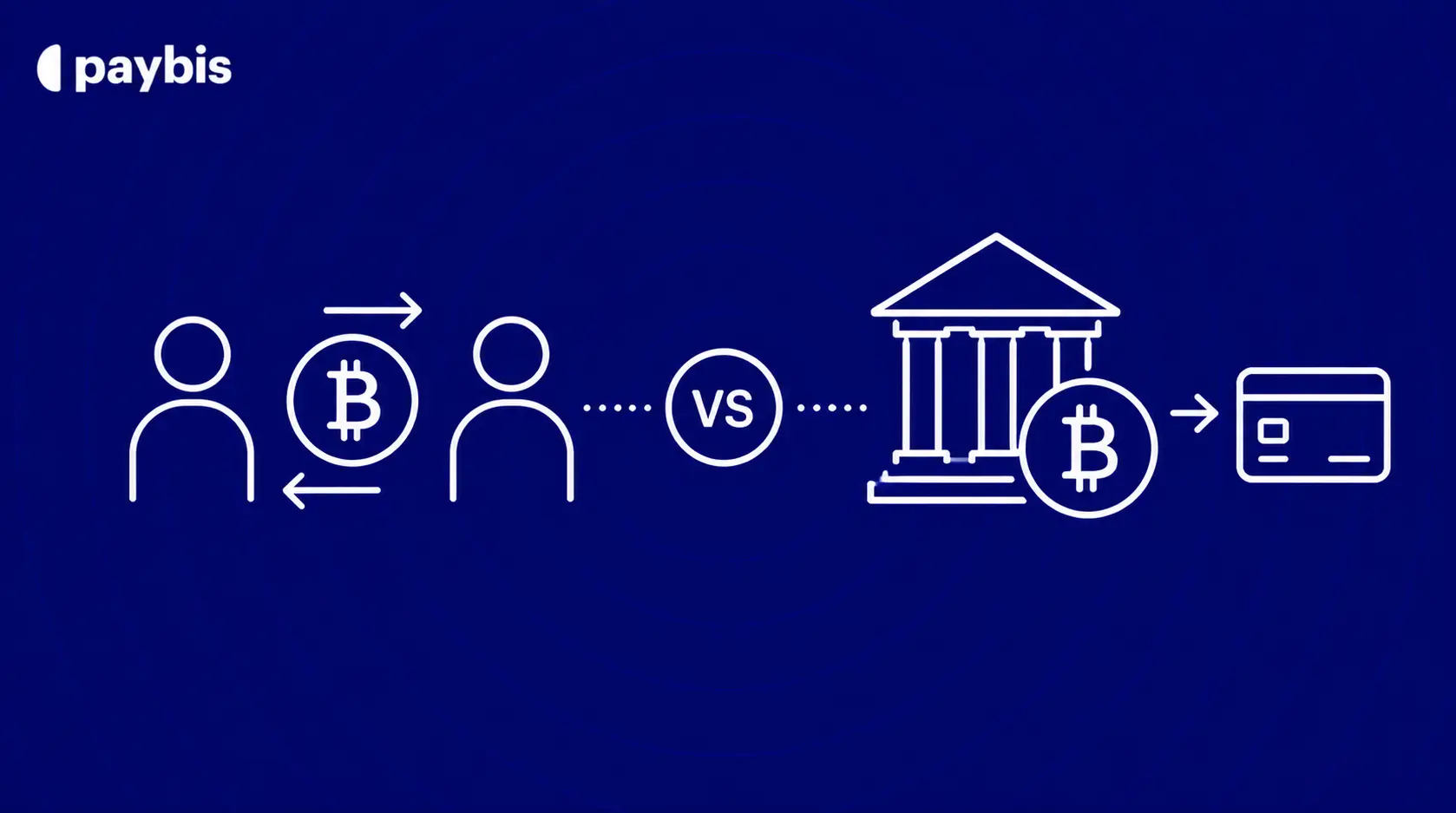
– P2P crypto sales often lose their price premium to platform and payment processor fees, which can total 4% to 5% on a $1,000 transaction.
– A Paybis SEPA bank withdrawal typically costs around 1% to 2% total, including service, processing, and network fees.
– Card withdrawals usually range from 3.5% to 5.5% or higher depending on currency and payment method.
– Paybis includes fraud protection measures such as 2FA, transaction monitoring, cold storage, and PCI DSS Level 1 compliance.
– All fees are shown before confirmation, with instant processing and 24/7 human support.
– Paybis is MiCA, CASP, FinCEN and FINTRAC registered.
– Looking to buy Bitcoin with PayPal or with ACH transfer? Paybis supports both methods with instant processing.
– Crypto assets can rise or fall in value.
Crypto assets can increase or decrease in value. Paybis is a payment gateway, not an investment service. This content is for informational purposes only and does not constitute financial advice.
You want to turn your Bitcoin into cash today. You are weighing P2P platforms that advertise premium prices against exchange withdrawals that promise speed and security. This guide breaks down exact fees, payout speeds, and scam risks for both methods. Here is which option actually puts the most cash in your account.
Your P2P Crypto Sale: Step-by-Step Guide
When you sell crypto P2P (peer-to-peer), you find another person who wants to buy and complete the transaction directly with them. No company acts as the buyer. The platform facilitates the handoff through an escrow system (a neutral holding arrangement where the platform locks your crypto until both sides confirm the trade is complete).
P2P Crypto Platforms Explained
When you agree to a P2P trade, the platform temporarily locks your crypto in escrow until the buyer confirms payment and you confirm receipt. Only then does escrow release the funds to the buyer.
The global P2P payment market is projected to reach USD 3.63 trillion in 2025, growing to USD 18.44 trillion by 2035 at a 17.65% annual growth rate, with cryptocurrency P2P transfers growing 23% in 2025 alone.
Where to Sell Crypto Peer-to-Peer
LocalBitcoins shut down in February 2023. The main active P2P platforms now are:
- NoOnes: Leading Paxful alternative with 900+ payment methods including bank transfer, mobile money, and gift cards. Global coverage.
- Bisq: Decentralized, open-source desktop software with no registration required. Deposits held in 2-of-2 multisig wallets for security.
- Binance P2P: Available within the Binance ecosystem. Takers pay zero trading fees and the platform supports 300+ payment methods, including bank transfer, PayPal, and M-Pesa.
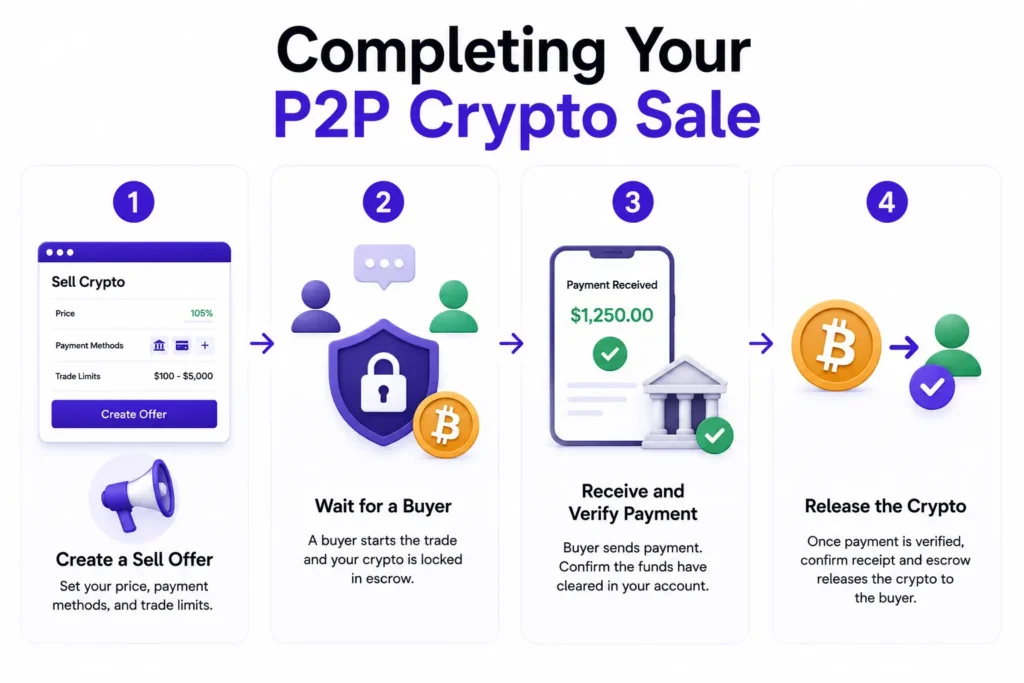
Completing Your P2P Crypto Sale
The P2P selling process on platforms involves four manual steps:
- Create a sell offer: Set your asking price (typically slightly above market), choose acceptable payment methods, and set trade limits.
- Wait for a buyer: A buyer initiates the trade, and the platform locks your crypto in escrow automatically.
- Receive and verify payment: The buyer sends payment. Confirm the funds have cleared in your account before releasing anything.
- Release the crypto: Once payment is verified, confirm receipt on the platform, and escrow releases the crypto to the buyer.
Critical safety rule: if a buyer asks you to move the conversation to WhatsApp or requests a direct bank transfer outside the platform, cancel the deal immediately. The Bitcoin Foundation’s P2P safety guide confirms that escrow is your only real protection during a P2P trade. For a broader look at how alternative payment methods compare to credit cards in crypto transactions, the Paybis blog breaks down the key trade-offs.
Exchange Withdrawals: What to Expect
When you use a centralized exchange (CEX), the platform acts as the intermediary between you and the buyer. The process is automated with no negotiation, no waiting for a counterparty to respond, and no manual payment verification required.
What Is an Exchange Withdrawal?
When you sell crypto on a CEX, the exchange’s matching engine pairs your sell order with a buyer, executes the trade, and updates your account balance automatically. You then withdraw the resulting fiat to a bank account or card.
The key difference from P2P: you don’t wait for a specific buyer to respond, check whether a payment screenshot is real, or manually release funds. The exchange handles all of that.
Best Exchanges To Sell Crypto
Not all exchanges offer the same experience for selling crypto and withdrawing cash:
- Binance: Large platform with complex interfaces. The P2P and spot markets operate separately, and the interface is built for experienced traders rather than straightforward cash-outs. See how Paybis compares to Binance for fast crypto purchases if you want a side-by-side breakdown.
- Coinbase: Standard ACH bank transfers carry no fees for most US users, but ACH transfers typically take 3 to 5 business days to complete, and weekend processing can extend this to 7 to 10 calendar days.
- Paybis: Designed for straightforward buying and selling without trading interfaces or order books.
Your Paybis Withdrawal Guide
Selling crypto and withdrawing cash on Paybis follows a process that varies by withdrawal type. The steps below cover selling crypto to a fiat payout method, for wallet-to-wallet withdrawals, refer to the full withdrawal guide:
- Select cryptocurrency: Choose the crypto to sell from 90+ supported assets.
- Enter amount: The calculator shows the exact fiat payout and all fees before confirmation.
- Choose payout method: Select bank transfer (SEPA for EU – Single Euro Payments Area), Skrill, Neteller, or card.
- Confirm and receive: Review the fee breakdown, confirm, and process funds instantly.
The sell from wallet guide covers selling directly from a Paybis wallet, and the external wallet selling guide explains how to sell from a third-party wallet.
P2P Premium vs. Exchange Fees: What You Actually Keep
The central appeal of P2P selling is the chance to sell above market rate. Whether that premium results in more cash depends entirely on what gets subtracted afterward.
Spotting P2P Premium Deals
P2P buyers sometimes pay above market rate for convenience, privacy, or because they are in a region where exchanges have limited availability. A seller listing Bitcoin at 2% above market may attract buyers who cannot access standard exchanges easily.
The catch: payment processor fees eat that premium. A 2% P2P price advantage disappears when PayPal charges you 2.99% + $0.49 to receive the payment. For a detailed comparison of PayPal vs. credit card for buying crypto, including how fees stack up across methods, the Paybis blog covers both options thoroughly.
Your Real Exchange Withdrawal Rate
Paybis shows the exact payout amount in a calculator before any transaction is confirmed. The service fee starts from 1.49%, with all processing and network fees itemized before the sell order is confirmed.
“Paybis is fast, accurate, exact to quote, offer promotions, offer paybis or external address, clean, simple interface and provide email processing updates.” – G Cham on Trustpilot.
A $1,000 Bitcoin Sale: Payout Options
Here is what a $1,000 Bitcoin sale looks like on each method using verified fee data:
P2P with PayPal as the payment method:
- Starting offer price (2% P2P premium): $1,020.00
- Platform escrow fee (1% of $1,020): -$10.20
- Sub-total before PayPal: $1,009.80
- PayPal seller fees (2.99% of $1,009.80 + $0.49): -$30.68
- Final payout: approximately $979
(calculated using the fee assumptions above; actual payout varies depending on your PayPal account type, platform, and applicable payment method fees)
Paybis bank transfer (SEPA):
- Market rate sale: $1,000.00
- Paybis service fee (0.99%): -$9.90
- Processing fee (0.05%, minimum €2): -$2.00
- Network fee (varies by blockchain congestion): -$2.00 to $5.00
- Final payout: approximately $983 to $986
Note: Service and processing fees are set by Paybis. Network fees are determined by Bitcoin miners and vary based on blockchain congestion. Paybis does not control these costs.
The P2P route requires multi-day manual verification, exposure to chargeback fraud, and no recourse if a fake payment receipt is used. The Paybis bank transfer route delivers funds on bank business days, with all fees shown before confirmation and full regulatory protection through FinCEN (Financial Crimes Enforcement Network) and FINTRAC (Financial Transactions and Reports Analysis Centre of Canada) registration.
Use the Paybis fee calculator to check the exact payout on your specific amount before committing to any method.
P2P vs. Exchange: Which Fees Cost You More?
Understanding P2P Selling Costs
P2P platform fee structures vary significantly, but regardless of whether a platform charges a direct trading fee, sellers commonly encounter additional costs that are easy to miss:
- Platform escrow fee: NoOnes charges sellers 1% on completed transactions for most payment methods.
- PayPal receiving fee: PayPal seller fees are 2.99% + $0.49 per transaction for most online sellers, meaning a $1,000 receipt costs roughly $30.49 in PayPal fees alone.
- Time cost: Manual negotiation, payment verification, and dispute handling add time that a standard exchange withdrawal significantly reduces, exchange withdrawals typically complete in minutes compared to the hours or days a P2P trade can require.
Minimize Exchange Withdrawal Costs
For card transactions, Paybis charges a service fee starting from 1.49% (with the first credit/debit card transaction at 0% service fee), a payment processing fee of 4.5% to 8.5% for transactions over $50 depending on currency, and a network fee that reflects actual blockchain costs at the time of the transaction.
For bank transfers (SEPA), the Paybis fee is 0.99% plus a 0.05% processing fee with a minimum of €2, making it the cost-efficient option for larger amounts. The BeInCrypto Paybis review confirms the platform displays its fee structure clearly before any transaction is executed. If you are also evaluating hidden costs on other platforms, this breakdown of 5 hidden Coinbase fees and how to avoid them is worth reading before committing to a provider.
Fees for Your Payment Method
| Method | Paybis Fee | Processing Fee | Example ($1,000) |
|---|---|---|---|
| Bank transfer (SEPA) | 0.99% | 0.05% (min €2) | ~$11 to $15 total |
| Skrill / Neteller | 1.49% | Varies by method | Contact support for quote |
For specific payment method walkthroughs, the AstroPay withdrawal guide and the Neteller, Skrill, and bank transfer guide cover each option in detail.
How Your Crypto Cost Adds Up
| Feature | P2P | Paybis |
|---|---|---|
| Fees ($1,000 sale) | ~4% to 5% combined | 1% to 10% (method-dependent) |
| Speed | 30 min to several days | Minutes to instant |
| Scam risk | High (chargebacks, fake proofs) | Low (FinCEN, FINTRAC registered) |
| Security | Escrow only | Cold storage, MPC, PCI DSS Level 1 |
| Fee transparency | Hidden until payment method chosen | All fees shown before confirmation |
| User experience | Manual negotiation, 4+ steps | Simple calculator, 4 steps |
| Support | Platform varies | 24/7 live chat, 1 to 2 min response |
“Paybis is so easy to use compared to many other companies in the same field. It is quick and you get your receipt and information right away.” – Tuula Rantanen on Trustpilot.
Your Funds, Fast: Comparing Withdrawal Times
How Quickly P2P Crypto Sells
P2P trades are only as fast as the buyer. After posting a sell offer, you wait for a buyer to initiate the trade, send payment, and then manually verify funds have arrived before releasing crypto from escrow. A typical P2P trade ranges from under an hour with an active buyer and fast payment method to several days for less common assets. Actual timelines vary widely by platform, buyer activity, and payment type.
For reversible payment methods like PayPal, confirming payment before treating it as final is essential since chargebacks can be filed days after the transfer appears to clear. Understanding why instant crypto buys can take days to settle helps explain the mechanics behind these delays across both P2P and exchange platforms.
Exchange Withdrawal Delays
The contrast with exchanges is significant. Coinbase ACH bank transfers typically take 3 to 5 business days, and weekend processing can extend this to 7 to 10 calendar days.
Paybis processes withdrawals differently. CryptoVantage’s review confirms Paybis emphasizes speed as a core differentiator. Card-based payouts process in under 1 minute on the platform side, with settlement near-to-instant depending on the blockchain. The step-by-step credit card sell guide shows the actual process from start to payout.
“I managed to sell my Bitcoin and withdraw funds to my card. Everything worked perfectly in the end.” – Mirjana Simpraga on Trustpilot
Card vs. Bank Transfer Speed
- Bank transfer SEPA (Paybis): Typically processed on bank business days.
- ACH transfer (Coinbase): 3 to 5 business days, up to 10 calendar days including weekends. For more on how ACH works for crypto purchases, the ACH solution for crypto purchases guide covers the mechanics and timing in detail.
- P2P manual process: Varies by buyer activity and payment method.
Are P2P Sales Safe? Avoid Fraud
P2P trading carries fraud risks that centralized exchange withdrawals do not.
Identifying P2P Crypto Scams
Three dominant fraud patterns target P2P sellers:
- Chargeback fraud: The buyer pays with a reversible method like PayPal. After you release the crypto, the buyer disputes the payment with their bank as unauthorized. Your account is debited, but the crypto is gone.
- Fake payment proof: The buyer sends a forged bank transfer screenshot or fabricated SMS confirmation. You release crypto from escrow before checking your actual account balance.
- Triangle scam: A fraudster uses stolen funds to pay you. When the real victim files a chargeback, you lose both the crypto and the payment.
According to CoinTelegraph’s coverage of P2P fraud risks, the FBI reported that Americans lost $9.32 billion to digital currency scams in 2024 alone. The video “Beware of Scammers on Paxful” documents a real case of a user losing all assets to fraud on a P2P platform.
How Exchanges Protect Your Funds
Centralized exchanges replace the trust problem with technical and regulatory infrastructure. Paybis specifically provides:
- Cold storage: The majority of customer crypto is secured offline, limiting exposure to online attacks.
- MPC technology: Multi-Party Computation splits private keys into fragments distributed across multiple servers, eliminating single points of failure.
- PCI DSS Level 1 compliance: The highest certification for payment processing, covering encryption, fraud monitoring, and data protection.
- Regulatory registration: Paybis holds FinCEN (Financial Crimes Enforcement Network) registration (in the US, entities 31000272911973 and 31000277275964), FINTRAC (Financial Transactions and Reports Analysis Centre of Canada) registration (MSB in Canada), and VASP registration in Poland (RDWW-805).
- Zero breaches since 2014: Over 12 years of operation and $5.4 billion in lifetime volume with no security incidents, as confirmed in the May 2026 product update.
For an independent assessment of how Paybis scores on trust and reliability, the Paybis crypto exchange trust scores overview covers third-party ratings across multiple review platforms.
Stay Safe When Selling Crypto
On P2P platforms:
- Only accept irreversible payment methods such as verified bank deposits or cash.
- Never release escrow before confirming funds have cleared in your account.
- Report any buyer who requests off-platform contact immediately.
On exchange withdrawals:
- Enable two-factor authentication (2FA) on your account.
- Use a strong, unique password.
- Verify withdrawal addresses carefully before confirming any transaction.
Choose Your Best Crypto Selling Method
Sell Crypto Directly via P2P
P2P selling makes sense in specific situations: your local payment method is not supported by major exchanges, privacy is a priority, or a buyer is offering a meaningful premium above market. The trade-off is significant: high manual effort, meaningful fraud risk, no guaranteed timeline, and hidden payment processor fees that often eliminate any price advantage entirely.
Safest Way to Withdraw Crypto
Exchange withdrawals offer a guaranteed, automated path from crypto to cash. Paybis serves users in 180+ countries with 20+ payment methods and 90+ cryptocurrencies. The fee structure is shown before confirmation, there is no counterparty risk, and if a transaction fails, funds return to the original payment source with no charge.
Paybis has 31,440+ Trustpilot reviews with a rating of 4.1 (“Great”). The MonetFin app review gives an independent walkthrough of the platform’s pros and cons for users who want a third-party perspective. The Paybis payout security guide covers custody models and fund protection in detail.
Create a Paybis account, complete identity verification in under 2 minutes, and confirm the exact payout amount before any funds move.
Key Terminology
- Escrow: A temporary holding arrangement where a platform locks crypto during a P2P trade until both parties confirm the transaction is complete.
- CEX (centralized exchange): A crypto trading platform operated by a single company that matches buy and sell orders automatically.
- Fraud proof: A fraud proof is documentation or verification used to confirm that a transaction or user activity is legitimate and not fraudulent. It can include identity checks, payment confirmations, transaction records, device data, or blockchain evidence used to validate authenticity.
- Two-factor authentication (2FA): A security method that requires users to confirm their identity using two separate verification steps before accessing a crypto account. In crypto platforms, 2FA typically combines a password with a one-time code from an authenticator app, SMS, or email to reduce the risk of unauthorized access.
- MPC (multi-party computation): A security method that splits a private key into multiple fragments stored on separate servers, eliminating the risk of a single point of failure.
FAQ
What Is Your Final P2P Crypto Payout?
Based on the assumptions of a 2% P2P premium, a 1% platform escrow fee, and a 2.99% + $0.49 PayPal receiving fee, the estimated net payout on a $1,000 Bitcoin sale is approximately $979. Actual results vary depending on your PayPal account type, the platform used, and which payment method fees apply.
What Are the Risks of P2P Selling?
Chargeback fraud and fake payment screenshots are the two most common risks, where buyers reverse payments after receiving crypto or send forged payment confirmations to trick sellers into releasing escrow early. The FBI reported that Americans lost $9.32 billion to digital currency scams in 2024 alone.
When Will Your Crypto Funds Clear?
Paybis processes withdrawals with instant platform-side processing (under 1 minute) and settlement near-to-instant depending on the blockchain, while Coinbase ACH bank transfers take 3 to 5 business days and up to 10 calendar days including weekends. P2P trades vary widely depending on buyer activity, platform, and payment method, ranging from under an hour in favorable conditions to several days in others.
What Is the Fee Breakdown for P2P vs. Exchange?
A P2P sale using PayPal totals approximately 4% to 5% in combined platform and payment processor fees on a $1,000 transaction. A Paybis SEPA bank transfer costs approximately 1% to 2% in total fees (0.99% service fee + 0.05% processing fee + variable network fee), as shown in the $1,000 example above. Card-based methods on Paybis rates range from 3.5% to 5.5% or higher, depending on currency, making SEPA the more cost-efficient option for larger amounts. For card purchases, the processing fee component is 4.5% in GBP, USD, EUR, and JPY, and 6.5% in other currencies. This sits within the 4.5% to 8.5% processing fee range stated above, and is separate from the 1.49% service fee applied to the transaction. Card payouts (selling crypto to a card) apply a flat service fee rather than a percentage. Check the Paybis calculator for an exact quote before confirming.
Disclaimer: Don’t invest unless you’re prepared to lose all the money you invest. This is a high‑risk investment and you should not expect to be protected if something goes wrong. Take 2 mins to learn more at: https://go.payb.is/FCA-Info