Swapping Bitcoin for Ethereum and Other Popular Crypto Pairs: A Beginner’s Guide
Key Takeaways: Swapping crypto doesn’t require trading charts or finance knowledge. A crypto swap is a direct exchange between two assets, such as Bitcoin and Ethereum, completed in minutes on a straightforward platform. The total cost includes three components: a service fee, a processing fee, and a network fee (the cost miners charge to confirm the transaction). We show all three before you confirm, with no hidden spreads. We process transactions in under one minute, with settlement near-to-instant depending on the blockchain. You can buy Bitcoin with a bank account, with a Paysafe card, or with an ACH transfer before swapping into your preferred asset. Use the Paybis calculator to check live rates before committing to anything.
The hardest part of swapping crypto isn’t understanding how blockchain works. It’s finding a platform that tells you the actual final price before you commit. Most exchanges bury fees in the fine print, show complex trading charts, and leave you waiting days for your funds. This guide cuts through all of that.
Below, you’ll find exactly how to swap BTC for ETH, BTC for USDT, and ETH for USDC on Paybis, with real fee breakdowns for $500, $1,000, and $2,000 swaps, and a plain-English explanation of every step.
Why These Crypto Pairs See High Demand
A crypto pair is two assets you can exchange directly, one for the other, without converting to dollars first. Think of it like trading a $50 Amazon gift card directly for $50 in store credit somewhere else, skipping cash entirely.
BTC, ETH, USDT, and USDC consistently rank as the most traded cryptocurrencies globally because they’re the most widely recognized and accepted. High demand means better exchange rates and faster transactions compared to obscure coins with fewer buyers and sellers. If you’re wondering how to choose which exchange to buy Bitcoin from, liquidity in these top pairs is one of the first things to evaluate.
Why BTC & ETH Are Top Swaps
Investors often describe Bitcoin (BTC) as digital gold: a store of value with a fixed supply of 21 million coins. Over 94% of all Bitcoin is already mined, reinforcing its scarcity. Ethereum (ETH) powers a global network of decentralized apps, from digital art to financial services.
Swapping BTC for ETH makes sense when you want to diversify out of a pure store-of-value asset into one with broader utility. Both are available on Paybis as part of our 90+ cryptocurrency lineup.
Bitcoin to USDT: Avoid Price Swings
A stablecoin is a cryptocurrency designed to stay pegged to a fixed value, usually $1. USDT (Tether) is the largest stablecoin by market cap. When Bitcoin’s price drops sharply, swapping BTC into USDT locks in your current dollar value and stops your holdings from falling with the market.
When Bitcoin drops 15% from a $2,000 position, that’s $300 in value lost. Swapping to USDT before the drop locks in the original $2,000 value regardless of how far Bitcoin falls. Understanding how often Bitcoin’s value changes can help you time these protective swaps more effectively.
ETH to USDC: Secure Your Savings
USDC (USD Coin) works the same way as USDT: 1 USDC equals $1. The difference is who issues it. USDC is managed by Circle, a regulated US financial company that publishes monthly reserve attestations. If you want a dollar-pegged asset with a stronger compliance track record, USDC is the more transparent option. Both are covered in our guide to the 10 most popular stablecoins.
Get Fair Prices on Crypto Swaps
Higher trading volume in any crypto pair generally means tighter exchange rates. BTC, ETH, USDT, and USDC all trade in enormous daily volumes globally, which is why swapping between them delivers more accurate pricing than swapping into a smaller coin with fewer active traders. We lock in a quoted rate for 15 minutes during checkout, so the price you see when you confirm is the price you pay. No last-second adjustments.
What Will Your Crypto Swap Really Cost?
This is the question most platforms don’t answer clearly. On Paybis, every swap quote shows three separate fee lines before you click confirm.
The Service Fee: What It Covers
We charge a service fee to facilitate the swap. It starts from 1.49% of the transaction amount. Your very first card transaction has a 0% service fee, so you can test the platform without paying our margin on day one.
Network Fees Per Crypto Swap
We do not collect the network fee (sometimes called a miner fee). Miners who process and verify your transaction on the blockchain receive this fee directly. It fluctuates based on how busy the network is at the time of your swap. For Bitcoin, the average transaction fee currently runs well below $1, though it can spike during periods of high network congestion. We display the current network fee in every quote so there are no surprises.
For details on how transfers work from your Paybis wallet, see our transfer warnings guide.
Typical Crypto Swap Times
We process card transactions in under 1 minute. Your crypto then appears in your wallet near-to-instantly, depending on which blockchain is involved. Contrast this with Coinbase’s bank transfer path, which can hold your crypto for 7-10 days before you can withdraw it, or Binance’s wire transfer option that typically takes 1-2 business days just to fund your account. For a deeper look at how these costs stack up, see our breakdown of hidden Coinbase fees and how to avoid them.
Real Cost Examples: $500, $1,000, $2,000
Here’s what you’ll pay for common swap amounts using a card in USD. The network fee estimate assumes mid-range Bitcoin congestion of approximately $1.00.
| Swap Amount | Service Fee | Processing Fee (4.5–8.5%) | Network Fee | Total Cost Range |
|---|---|---|---|---|
| $500 (first transaction) | $0 | $22.50–$42.50 | ~$0.70 | ~$23.20–$43.20 |
| $500 (subsequent) | $7.45 | $22.50–$42.50 | ~$0.70 | ~$30.65–$50.65 |
| $1,000 | $14.90 | $45.00–$85.00 | ~$3.00 | ~$62.90–$102.90 |
| $2,000 | $29.80 | $90.00–$170.00 | ~$3.00 | ~$122.80–$202.80 |
We show every one of these totals on screen before you tap “confirm payment.” We do not embed an undisclosed spread into the exchange rate the way some other platforms do. What you see is what you pay.
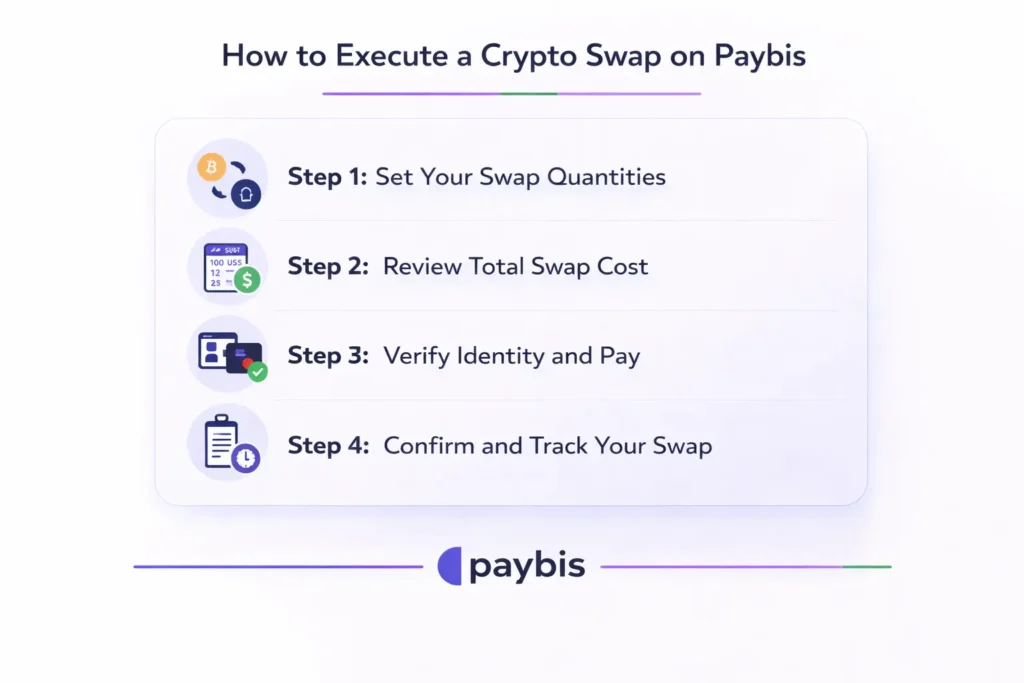
How to Execute a Crypto Swap on Paybis
For swapping from your Paybis wallet, see our wallet swap guide. If you’re using an external wallet, follow our external wallet swap guide.
Step 1: Set Your Swap Quantities
Open paybis.com or the Paybis app. You’ll see a simple calculator: enter the amount you want to send (in BTC, ETH, or dollars), select your destination crypto, and the calculator instantly shows how much you’ll receive. No order books, no trading pairs dropdown, no margin settings.
For BTC to ETH: Enter your BTC amount or equivalent dollar value, then select ETH as your destination. The How To Buy Ethereum on Paybis video shows the full flow.
For BTC to USDT: Select USDT as your destination. You’ll choose between TRC20 (Tron network, typically faster with lower fees) or ERC20 (Ethereum network, more widely compatible but fees can spike during busy periods on the Ethereum blockchain). Always confirm which network your destination wallet supports before choosing. Watch the USDT purchase tutorial for a step-by-step walkthrough.
For ETH to USDC: Select USDC as your destination. See the full list of Ethereum tokens on Paybis for all ERC20 tokens we support. Both USDT and USDC hold a $1 peg, but USDC comes from Circle, a US-regulated company with monthly public reserve attestations, making it the more compliance-focused option of the two.
Step 2: Review Total Swap Cost
We display the full fee breakdown before you enter payment details: Service Fee (starts from 1.49%, 0% on your first card transaction), Processing Fee (4.5-8.5% for card transactions over $50), and Network Fee (set by miners, shown live). The total appears in plain numbers. If it looks right, proceed. If not, close the tab with no charge.
Step 3: Verify Identity and Pay
If you’re a new user, upload a photo of your government ID and take a selfie. Verification typically completes in about 2 minutes. Then enter your Visa, Mastercard, or local payment method (such as PIX if you’re in Brazil) and complete the 3DS security check. That’s a one-time notification from your bank, delivered through text or app.
Important: Blockchain transactions are permanent. Once you confirm a swap and it processes, we cannot reverse it. Before confirming, double-check the destination wallet address (copy-paste, don’t type it manually), the network selected (TRC20 vs ERC20 for USDT/USDC), and the total cost shown on the confirmation screen.
Step 4: Confirm and Track Your Swap
Once payment is confirmed, your crypto moves to the wallet address you specified. We process the swap in under 1 minute, and settlement is near-to-instant depending on the blockchain. You’ll receive an email confirmation. If anything gets stuck, our 24/7 live chat connects you to a human support agent in 1-2 minutes on average. Watch the Paybis swap walkthrough for a full video guide.
“Paybis is so easy to use compared to many other companies in the same field. It is quick and you get your receipt and information right away. Simply the best.” – Verified user review of Paybis
Match Your Goals to the Right Crypto Swap
Protect Assets: Swap to Stablecoins
Holding savings in USDT or USDC effectively pegs those savings to the US dollar, protecting them from local currency volatility. We support local payment methods including PIX in Brazil, Webpay in Chile, and M-Pesa, so users in emerging markets can convert their local currency into a stablecoin without needing a US bank account.
Diversifying Your Crypto Holdings
Concentrating all your crypto in one asset means all your risk lives in one place. Splitting holdings between BTC (limited supply, inflation hedge) and ETH (utility-driven demand) spreads that risk across two assets with different growth drivers. We give access to 90+ cryptocurrencies across 180+ countries, so diversification doesn’t require multiple accounts on different platforms. If you’re just getting started, our guide to the best platforms to buy crypto under $100 walks through your options at smaller entry amounts.
How to Send Crypto Internationally
Swapping BTC into USDT and sending that USDT to a family member abroad is faster and cheaper than a traditional bank wire. Sending USDT costs a few dollars in network fees depending on the network chosen, compared to the fees and multi-day waits typical of international wire transfers. For help sending crypto after a swap, see our send and withdraw tutorial. You can also read our guide on how to send Bitcoin to another wallet for a step-by-step breakdown.
Smart Swaps for Shifting Prices
One important note for users in any country: in many jurisdictions, swapping one cryptocurrency for another is treated as a taxable event. The IRS guidance on virtual currency transactions states that exchanging one cryptocurrency for another is considered a disposal of property and may produce taxable gains or losses, even if no fiat currency is involved. Tax rules vary by country, so consulting a qualified tax professional in your jurisdiction before swapping is advisable.
How Crypto Swaps Work: Explained Simply
Available Crypto Pairs to Swap
We provide access to 90+ cryptocurrencies, covering all major pairs: BTC, ETH, USDT, USDC, SOL, LTC, and many others. A full list of Ethereum-based tokens is available in our Ethereum tokens guide. To understand the broader landscape of crypto infrastructure, our explainer on what the difference is between centralized and decentralized exchanges is a useful starting point.
Know Your Crypto Swap Fees Upfront
We break down every swap into three transparent fee lines:
- Service Fee: Starts from 1.49% (first card transaction is 0%)
- Processing Fee: 4.5-8.5% for card transactions over $50, depending on currency
- Network Fee: Set by blockchain miners, shown live in the quote
No hidden spreads. No surprise charges after checkout. We have 30,780+ Trustpilot reviews with a rating of 4.1 (as of March 2026), and fee transparency is one of the reasons users keep coming back.
How Soon Will Your Crypto Arrive?
- Processing time: Under 1 minute (card transactions when approved)
- Settlement time: Near-to-instant, depending on the blockchain
We process over $1.2 billion in annual transaction volume (last 12 months as of October 2025) and have served 5M+ retail users across 180+ countries. Both the FX Empire Paybis review and the Coin Bureau Paybis review confirm this speed from independent testing.
Here’s how we compare to Binance and Coinbase on the metrics that matter most to beginner swappers:
| Platform | Transaction Speed | Fee Transparency | Customer Support | Beginner Friendly |
|---|---|---|---|---|
| Paybis | Under 1 minute (card) | Full breakdown shown upfront | 24/7 live human, 1–2 min response | Yes |
| Binance | Varies by method | Fees shown, complex interface | Ticket-based support | No |
| Coinbase | Varies by method | Spread embedded in rate | Ticket-based, automated bots | Moderate |
“Paybis transactions are not difficult to make. It is very easy to understand how the transaction process works.” – Verified user review of Paybis
Use the Paybis calculator to check live rates on any crypto pair, see the full fee breakdown before committing, and complete your first swap with a 0% Paybis service fee on your initial card transaction.
Key Terminology
- Crypto pair: Two cryptocurrencies you can exchange directly for each other, such as BTC/ETH or BTC/USDT, without converting to fiat currency (regular money like dollars) in between.
- Stablecoin: A cryptocurrency designed to stay fixed at $1. USDT and USDC are the most widely used stablecoins, making them useful for locking in value without holding cash.
- Network fee: Blockchain miners charge this fee to process and verify your transaction. We do not collect it. The fee fluctuates based on how busy the blockchain network is at the time of your swap.
- Service fee: The fee we charge to facilitate the transaction. It starts from 1.49%, with the first card transaction charged at 0%.
- Processing fee: The fee charged by the external payment processor (such as your card network). For card transactions over $50, this is 4.5-8.5% depending on the currency used.
- ERC20: A token standard on the Ethereum blockchain. USDT and USDC can both exist as ERC20 tokens, compatible with the Ethereum network and its apps.
- TRC20: A token standard on the Tron blockchain. USDT is available as a TRC20 token, which typically offers faster transfers and lower fees compared to ERC20.
- Settlement: The moment your swapped cryptocurrency appears in your wallet. We process swaps in under 1 minute, and settlement happens near-to-instantly after processing, depending on the blockchain.
- Identity verification: You upload a government-issued ID and take a selfie to confirm your identity. Global anti-money-laundering rules require this step. We typically complete verification in about 2 minutes.
FAQ
What Is a Crypto Swap in Simple Terms?
You exchange one cryptocurrency directly for another, such as trading Bitcoin for Ethereum or USDT, without converting to cash first. You send one asset and receive another at the current market rate, with all fees shown before you confirm.
How Long Does a Crypto Swap Take on Paybis?
We process card transactions in under 1 minute. Settlement, meaning when the crypto arrives in your wallet, is near-to-instant depending on which blockchain is involved.
What Fees Will I Pay to Swap Bitcoin for Ethereum on Paybis?
For a $500 swap using a card, expect a 1.49% service fee ($7.45 after your first transaction), a 4.5-8.5% processing fee ($22.50-$42.50 depending on currency), and a live network fee shown at checkout. Your first card transaction has a 0% Paybis service fee.
Is Swapping Crypto the Same as Trading?
No. Trading on an exchange requires an account with order books, where you set prices and wait for another buyer or seller to match your order. A swap is an instant, fixed exchange at a quoted rate, with no trading knowledge needed.
Is Swapping One Cryptocurrency for Another a Taxable Event?
In many jurisdictions, yes. The IRS treats swapping crypto as a disposal of property that may produce taxable gains or losses. Tax rules differ by country, so consult a qualified tax professional in your location before swapping.
What's the Difference Between TRC20 and ERC20 for USDT?
TRC20 runs on the Tron network and typically offers faster confirmations and lower fees than ERC20. ERC20 runs on the Ethereum network, is more widely supported across apps, but can carry higher fees during busy periods. Always confirm which network your destination wallet accepts before choosing.
Can I Swap Crypto Using PIX in Brazil?
Yes. We support PIX as a payment method, which means users in Brazil can buy Bitcoin or other cryptocurrencies using their existing bank account through Brazil’s instant payment system. Full details are on our PIX purchase page.
What Happens If My Swap Transaction Is Rejected?
If we reject a transaction for security or compliance reasons, no charge is applied and your funds return to you. Contact our 24/7 live chat immediately for guidance on next steps.
Disclaimer: Don’t invest unless you’re prepared to lose all the money you invest. This is a high‑risk investment and you should not expect to be protected if something goes wrong. Take 2 mins to learn more at: https://go.payb.is/FCA-Info