Why USDC Is Gaining Ground in 2026
USDC’s circulating supply has grown roughly 73% over the past year. New rules in the US and EU are a large part of why.
- USDC’s market cap sits near $72 billion in August 2026, up about 73% from a year earlier.
- USDC transaction count rose 209% year over year in the first half of 2026, based on payment data from NOWPayments.
- New rules in the EU and US reward issuers with transparent, fully backed reserves, which favors USDC’s model.
- If you want in, you can buy USDC on Paybis.
Stablecoins are not all growing at the same pace. USDT still moves more money overall, but USDC has pulled ahead in growth rate for over a year now. That gap has widened further in 2026.
This piece covers what is actually driving that growth and what it does and does not mean for anyone holding USDC.
How Much Has USDC Grown This Year?
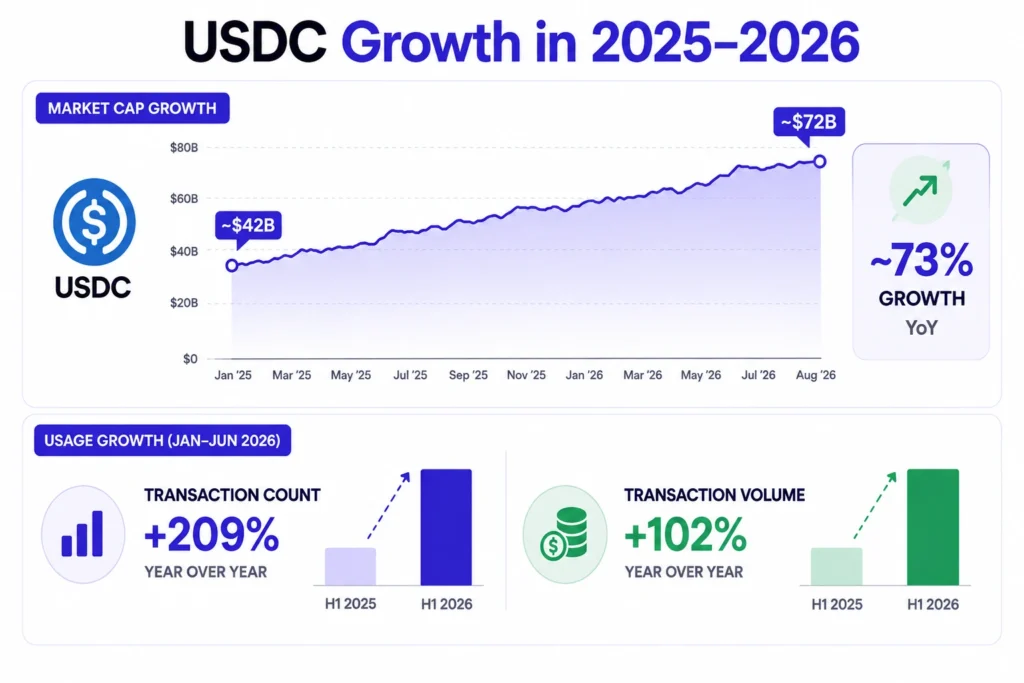
USDC’s market cap has climbed to around $72 billion in August 2026, up from about $42 billion at the start of 2025. That works out to roughly 73% growth over the past year.
The growth shows up in usage too. USDC transaction count rose 209% year over year in the first six months of 2026, according to payment data reported by NOWPayments. Transaction volume rose 102% over the same period.
The shift also shows up quarter to quarter. In the first quarter of 2026 alone, USDC’s supply grew by about $2 billion while USDT’s supply fell by roughly $3 billion, based on data from BitKE. That is not USDC’s usual pace, but it marks a clear change in direction.
Market cap and growth-rate figures are from CoinGecko and CryptoBriefing, as of mid-August 2026. These numbers move daily, so check a live tracker for the current figure.
What Is Driving USDC’s Growth?
Businesses are choosing USDC largely because of its reserve transparency and its footing under new regulation. Growth is concentrated on regulated platforms, payroll tools, and businesses that need a stablecoin their compliance team can sign off on.
That distinction matters. USDC’s growth is not happening evenly across the whole market. It is concentrated with platforms and businesses that specifically need a stablecoin built for a regulated environment, since that is where USDC’s reserve model and licensing carry the most weight.
Payment processors report similar patterns. More merchants and platforms are integrating USDC directly, rather than adding it as one option among many, because it simplifies compliance reporting on their end.
How Are New Regulations Playing a Role?
Two laws reshaped the stablecoin market in 2025 and 2026. The EU’s MiCA framework and the US GENIUS Act both reward issuers with full reserves and clear disclosure, and USDC already met most of that bar before either law took effect.
Circle secured an e-money license in France in mid-2024, which let USDC keep operating on licensed EU platforms once MiCA’s stablecoin rules took full effect. Issuers without a license of this kind lost access to major EU trading venues.
In the US, the GENIUS Act, signed into law in July 2025, now requires any dollar stablecoin issuer to hold full reserves in cash and safe, short-term government assets. Circle also picked up a limited-purpose trust charter from New York’s financial regulator on July 31, 2026, adding another layer of oversight to how it runs.
None of this makes USDC risk free. It does mean USDC was already built close to what regulators started requiring everyone else to do.
Is USDC’s Growth Just a Blip?
It does not look that way so far. The growth has held across several consecutive quarters and lines up with two separate regulatory changes, not a single news event.
A single quarter of growth could easily be noise. What stands out here is that USDC’s growth rate has stayed elevated across multiple quarters through 2026, alongside a steady stream of new licenses and disclosures from Circle.
That pattern does not guarantee future growth. Stablecoin adoption can shift quickly if rules change again, and past growth is never a promise of what comes next.
What Does This Mean for You?
On its own, this growth does not change what your USDC is worth. What it does show is that regulated platforms are increasingly building around USDC as a default dollar option.
If you use a licensed exchange or a payment platform based in the US or EU, USDC is more likely to be the stablecoin already built into that platform. That is a practical detail worth knowing, not a signal to act on.
If you want to hold USDC yourself, you can buy USDC on Paybis, a platform licensed under MiCA and PSD2.
Bottom Line
USDC’s supply has grown about 73% over the past year, reaching roughly $72 billion, well ahead of USDT’s growth rate. USDT still leads by total size, but new rules in the EU and US have pushed more regulated platforms toward USDC specifically.
None of this changes what your coins are worth today. It does explain why USDC keeps showing up as the default option on licensed platforms. To see exactly what backs each token, read what USDC is and what backs USDC. If you hold some, you can still sell USDC on Paybis.
FAQ
Why is USDC growing so quickly in 2026?
New rules in the EU and US reward stablecoin issuers with transparent, fully backed reserves. USDC already fit that model closely, which helped it gain ground as the rules took effect.
Does USDC's growth change its price?
No. USDC is designed to always trade at $1, regardless of how much its supply or trading volume grows.
Is USDC's growth guaranteed to continue?
No. Growth so far has held across several quarters, but stablecoin adoption can shift if rules or market conditions change. Past growth does not predict future growth.
Is USDC the largest stablecoin?
No. Other dollar stablecoins are larger by total market cap. USDC’s growth rate has simply outpaced the rest of the market recently.
Where can I buy USDC?
You can buy USDC on Paybis with a card or bank transfer, with the full cost shown before you confirm.
Disclaimer: Don’t invest unless you’re prepared to lose all the money you invest. This is a high‑risk investment and you should not expect to be protected if something goes wrong. Take 2 mins to learn more at: https://go.payb.is/FCA-Info