Best Crypto Exchanges for Beginners in 2026: Clear Fees, Easy Start, Trusted Platforms
Key Takeaways
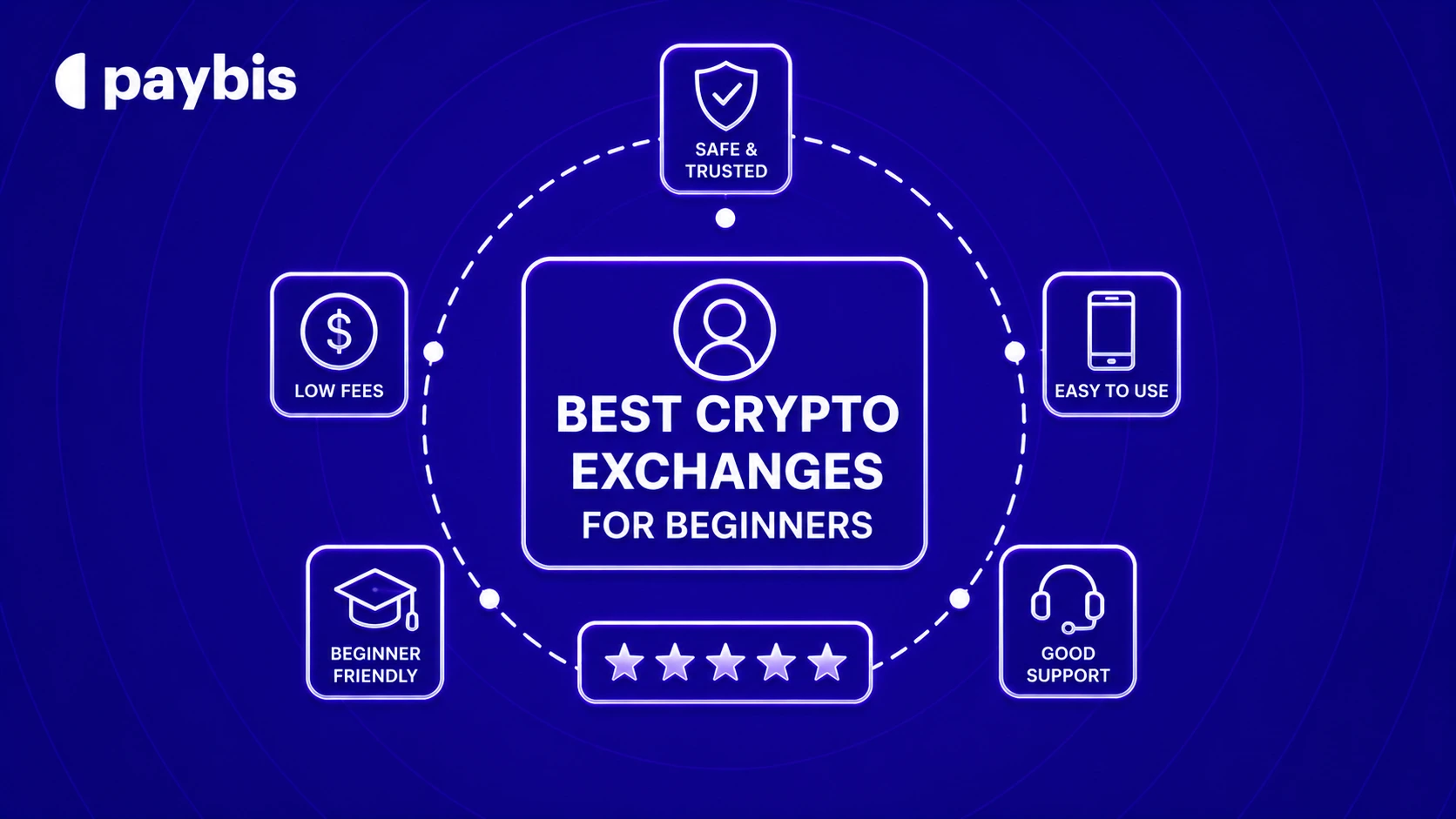
- The best crypto exchange for beginners combines clear fees, simple onboarding, and a way to get help if something goes wrong. Not every exchange that claims to be beginner-friendly delivers all three.
- Paybis charges 1.49% with 0% on your first card purchase of each cryptocurrency, shows all fees before you confirm, and has 24/7 live chat with a ~15 second average response time.
- Coinbase is the most beginner-friendly US exchange but also one of the more expensive ones: fees run 1.5%+ plus spreads on simple purchases.Kraken scores highest on security with a track record going back to 2011 and no history of customer funds being lost to a breach.
- Binance has the lowest trading fees at 0.1% spot, but the interface can be overwhelming for a complete beginner and the US version has a restricted feature set.
- The easiest crypto exchange for a first purchase is the one that shows the full cost before you confirm and delivers the crypto to a wallet you control.
- You can buy Bitcoin, buy Ethereum, and buy Solana on Paybis with fees shown before you confirm.
Crypto assets can increase or decrease in value. Paybis is a payment gateway, not an investment service. This content is for informational purposes only and does not constitute financial advice.
Quick Answer: For beginners in Europe and most of the 180+ countries Paybis serves, Paybis is the simplest way to buy crypto: fees start from 1.49% with 0% service fee on the first card purchase of each cryptocurrency with a card, every cost is itemized before you confirm, verification takes about 2 minutes when required, and 24/7 live chat answers in about 15 seconds. For US beginners who want the most guided app experience, Coinbase is the default choice. Kraken is the security pick, and Binance is the low-fee pick for users comfortable with a trading interface.
Choosing your first crypto exchange is not complicated once you know what actually matters. Most guides make it sound like you need to weigh hundreds of factors. You do not. For a beginner, three things determine whether an exchange works for you or drives you to quit before your first purchase is completed.
First, can you figure out what you are paying before you commit? Second, can you actually get money in and out using the payment methods you have access to? Third, if something goes wrong, is there a real human to help you?
Every exchange on this list does those three things reasonably well. They differ on fees, regulation, coin selection, and geographic availability. Here is how they compare.
This compares exchanges for a first crypto purchase. If you want the simplest, lowest-friction way to buy with fees shown upfront, start with Paybis below. If you want a trading interface with order books, Binance and Kraken are covered further down.
What Should Beginners Look for in a Crypto Exchange?
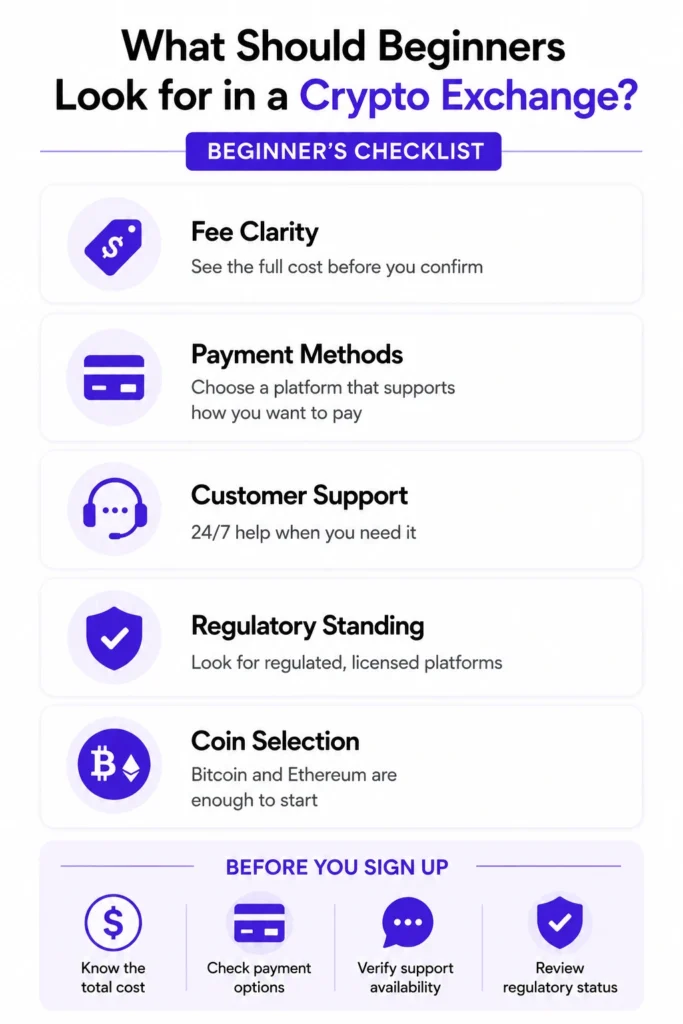
Before comparing specific platforms, it helps to know what you are actually evaluating. A few factors matter far more than others at the start.
- Fee clarity. Many exchanges show a low headline fee and then add a spread on top when you go to execute. The total cost of a purchase is what matters, not the advertised rate. Look for platforms that show the full cost before you confirm, not after.
- Payment method fit. The cheapest exchange is useless if you cannot fund it. Card payments are fast and available almost everywhere, but carry higher processing costs. Bank transfers like SEPA are cheaper but take a day. Check that the exchange supports the payment method you plan to use before going through signup.
- Support you can actually reach. Crypto platforms have a well-documented history of slow or absent customer support. For a beginner, a question about a pending transaction at 11pm on a Sunday needs an answer. Exchanges with 24/7 live chat with real response times are genuinely different from those that route support through a ticket system with 48-hour reply windows.
- Regulatory standing. In the EU, MiCA CASP authorization means the exchange has been formally reviewed by a financial regulator. Your funds must be held separately from the platform’s own assets, and fees must be disclosed upfront. Outside the EU, look for FinCEN registration in the US or FCA registration in the UK. A licence is not a guarantee, but it is a meaningful baseline.
- Coin selection. Most beginners start with Bitcoin or Ethereum. You do not need access to 500 altcoins on day one. Prioritize the first three factors above, and come back to coin selection when you actually need it.
Which Crypto Exchange Is Best for Beginners Overall in 2026?
1. Paybis: Best for Simple, Low-Cost Buying in Europe and Globally
Paybis is the most direct path from “I want to buy crypto” to “crypto is in my wallet” without surprises at checkout.
Fees:
- 1.49% service fee on standard purchases
- 0% service fee on your first card purchase of each cryptocurrency
- All fees itemized before you confirm
- Payment methods: 35 options including credit card, debit card, SEPA bank transfer, Klarna Pay by Bank, Apple Pay, Google Pay, PayPal, Skrill, and Neteller.
- Verification: Up to $1,000 per year with simplified verification. Above that, under 2 minutes.
- Support: 24/7 live chat, ~ 15-second average response time.
- Regulatory status: MiCA CASP licence (27-55/2026/6, Bank of Latvia, May 2026) covering all 27 EU member states, plus a PSD2 Payment Institution licence (27-55/2026/7). UK Financial Promotions (FCA, via Gateway21 approver): FRN 999557. FinCEN registration in the US. FINTRAC registration in Canada.
- Operating since: 2014. 7 million+ users (May 2026) across 180+ countries.
With a 4.2/5 (33,239 reviews, October 2026) Trustpilot score, Paybis sends crypto directly to whichever wallet address you provide. There is no requirement to hold funds on the platform. You buy, and it arrives in your wallet in under 10 minutes on a card purchase.
2. Coinbase
Coinbase is the default starting point for most US crypto beginners, and the reason is obvious the moment you sign up. The interface is clean, the onboarding is guided, and the number of confusing options is deliberately minimized.
- Fees: 1.5% plus spreads on simple purchases, or a flat fee of $0.99-$2.99 for purchases under $200. Advanced trading on Coinbase Advanced reduces this to 0.40% maker and 0.60% taker, falling with volume.
- Regulatory status: Largest US-regulated crypto exchange. USD cash balances are eligible for pass-through FDIC insurance up to $250,000 through partner banks. Crypto holdings are not FDIC insured and are covered only by a commercial crime policy against theft.
- Coin selection: 200+ cryptocurrencies.
- The downside: Coinbase is among the more expensive major exchanges for simple purchases. The fee structure across its different interfaces (standard app, Advanced Trade, instant buy) is genuinely confusing. Beginner-mode purchases can cost significantly more than trades on the Advanced interface for the same transaction.
3. Kraken
Kraken has been operating since 2011 and has never suffered a breach that put customer funds at risk. In an industry where major platforms have collapsed or been hacked, that track record matters more than most exchanges are willing to admit.
- Fees: 1% on Instant Buy plus a spread, with an extra fee for card funding. Kraken Pro starts at 0.40% maker and 0.80% taker.
- Instant Buy charges a fixed 1% trading fee plus a spread built into the quoted price. Funding by credit or debit card adds Kraken’s card deposit fee of 3.75% plus 0.25 in your currency, so a card-funded purchase lands near 5% before spread. Kraken Pro starts at 0.40% maker and 0.80% taker.
- Regulatory status: Registered in the US, with MiCA CASP authorization in Europe through the Central Bank of Ireland, passported across the EEA.
- The downside: Kraken is unavailable in New York and Maine. It also carries no insurance on crypto holdings and no FDIC coverage on cash balances, unlike Coinbase and Gemini. For beginners in those states, or those who specifically want insurance coverage, another platform is needed.
4. Binance
Binance is the largest crypto exchange in the world by trading volume, with 400+ cryptocurrencies and spot trading fees of 0.1%. For a beginner who has done a bit of research and wants access to a wider coin selection from the start, Binance offers more for less.
- Fees: 0.1% spot trading fee. Further discounts available using the BNB token.
- Coin selection: 400+ cryptocurrencies.
- The downside: The interface is dense. A beginner landing on Binance for the first time faces a dashboard designed for active traders, and the sheer volume of features can be genuinely disorienting. US users are limited to Binance.US, which has a restricted feature set compared to the global platform.
5. Crypto.com
Crypto.com built its product around a mobile app, and it shows. Trading, staking, rewards, and account management all work cleanly from a phone. For a beginner whose primary computing device is a smartphone, it is the most natural starting point.
- Users: 150 million users globally
- Features: Exchange, staking, crypto debit card, crypto-to-crypto swaps in a single app.
- The downside: The best rewards require locking CRO, and without it the benefits of some features are limited. The fee structure also spans two products: the app shows a card fee that varies by country only at checkout, while the separate Crypto.com Exchange publishes spot tiers starting at 0.25% maker and 0.50% taker.
Is a Crypto Broker or an Exchange Better for Beginners?
Searches for the best crypto broker for beginners and the best crypto exchange for beginners mostly point to the same decision, but the two models work differently. An exchange matches buyers and sellers on an order book, so the price moves while you decide, and the interface assumes trading knowledge. A broker or payment gateway sells you the crypto directly at a quoted price, so what you see is what you get.
For a first purchase, the broker model is simpler: one quoted price, one confirmation screen, no order types. Paybis works this way. It is a payment gateway, not a trading platform, which is why there are no charts or order books anywhere in the flow. Beginners who later want limit orders and spot trading can move to an exchange interface like Kraken Pro or Binance once the basics are familiar.
How Do Crypto Exchange Fees Compare for Beginners?
Here is what a $500 card purchase costs across the main options:
| Exchange | Simple Buy Fee | Effective Cost on $500 | Fee Clarity |
|---|---|---|---|
| Paybis | 1.49% service + 4.5-8.5% processing + network | ~$31-55 | Full breakdown shown upfront |
| Coinbase | 1.5% + ~0.5% spread (card up to 3.99%) | ~$10-22 | Varies by purchase method |
| Kraken | 1% + spread + card payment fee | ~$5 plus card fee | Transparent, published |
| Binance | 0.1% spot + card funding fee | ~$0.50 spot, more via card funding | Low but requires trading interface |
| Crypto.com | Card fee varies by country, shown in app before you confirm | Not published | Shown at checkout, not published upfront |
All figures are for a $500 card purchase unless noted. Card processing is the largest component on most platforms here, which is why the headline percentage is never the real cost.
One thing the table does not capture is whether fees are shown before or after confirmation. Paybis shows the full cost before the user commits. Coinbase’s effective cost varies depending on which buying interface is used, and the difference between the standard app and Coinbase Advanced is significant enough to be worth understanding before your first purchase.
Paybis also applies a 0% service fee on your first purchase of each cryptocurrency. That makes the first Bitcoin buy or the first Ethereum buy cheaper than every other option on the list. The advertised percentage is only half the picture: what matters is the amount of crypto that actually arrives after all fees and spread. Comparing that final number across platforms is the most reliable way to judge cost, because a lower stated fee with a wider spread can still deliver less crypto.
A low headline fee hides a spread.
Coinbase’s effective cost varies by which interface you use. Compare the crypto that actually arrives, not the advertised rate.
Verification stalls your first purchase.
Paybis verification takes under 2 minutes with a photo ID and a selfie.
No one answers when something goes wrong.
Paybis runs 24/7 live chat with a ~15 second average response time.
The platform isn’t licensed where you live.
Check for a MiCA CASP licence in the EU or FinCEN/FCA registration elsewhere. Compare licensed exchanges ›
Which Crypto Exchange for Beginners Has the Simplest Signup?
Speed and simplicity of signup vary more than most comparison guides acknowledge, and for many first-time buyers the easiest crypto exchange is simply the one that lets them finish this step in a couple of minutes.
- Paybis requires basic registration, and purchases up to $1,000 per year can be made with simplified identity verification, subject to limits that vary by country. Above that, full verification completes in under 2 minutes with a government-issued ID and biometric check. Once done, it covers all future purchases on the account.
- Coinbase walks users through guided onboarding with clear steps and typically completes standard verification within minutes. The process is well-optimized and rarely produces delays for straightforward applications.
- Binance has a similar verification flow, but the sheer volume of post-signup options can distract from simply completing a first purchase. Users sometimes end up exploring features before they have finished setting up the account basics.
- Kraken has simplified its onboarding considerably in recent years and now offers a basic tier that requires less verification than its full account level, which suits users who want to start small before committing to a full KYC process.
For the fastest path from zero to first purchase, Paybis and Coinbase are the two exchanges with the cleanest onboarding for a complete beginner.
How Do You Make Your First Crypto Purchase?
The process is nearly identical on any beginner-friendly platform. Using Paybis as the example:
1. Create an account with an email address.
2. Enter the amount in your currency and see the exact crypto you will receive, with the service fee, processing fee, and network fee itemized before you pay.
3. Choose a payment method (card, SEPA, Apple Pay, Google Pay, PayPal, and other options).
4. Verify identity if the purchase requires it (about 2 minutes with a government ID and a selfie).
5. Pay and receive the crypto at the wallet address you provided, typically within 10 minutes on a card purchase.
The step beginners most often get wrong is the wallet address: crypto sent to a wrong address cannot be recalled. Copy and paste the address, never retype it, and send a small test amount first if the purchase is large.
Which Crypto Exchange for Beginners Is Safest?
Safety in crypto means two distinct things: whether the exchange has been hacked, and whether your funds are legally protected if the exchange fails.
- On the no-breach track record, Paybis leads. It has been operating since 2014 without a security incident that put customer funds at risk. That is a distinction very few exchanges can honestly claim after more than a decade.
- On regulatory protection, Paybis and Coinbase sit in different positions that are both strong. Paybis’s MiCA CASP licence means client funds are legally required to be segregated from the company’s own assets. Coinbase, as a publicly listed US company, offers pass-through FDIC insurance on USD cash balances up to $250,000 and a commercial crime policy covering part of its custodial crypto against theft. Neither covers a fall in the value of crypto. Both provide meaningful protection in a sector where neither was standard until recently.
- On self-custody, Paybis sends purchases directly to the wallet address you specify. If you are using a hardware wallet or a software wallet you control, your crypto is never held on the platform. That is the most complete form of protection, because you eliminate exchange custody risk entirely. The Paybis guide to how Bitcoin works explains how wallet custody works if you are new to the concept.
Which Crypto Exchange for Beginners Is Best in Europe?
For EU beginners, regulatory standing is now a concrete, practical factor rather than a background consideration.
Since MiCA came into full force in December 2024, crypto exchanges serving EU users are required to hold a CASP licence. That licence means fund segregation is legally enforced, fees must be shown before confirmation, and the platform is under ongoing regulatory supervision. For a breakdown of which exchanges hold this authorization, the MiCA-licensed exchanges guide covers the full picture.
Paybis holds the MiCA CASP licence issued by the Bank of Latvia, covering all 27 EU member states, making it a strong choice for European beginners who want regulatory protection alongside low fees. SEPA bank transfer is available, which is the cheapest funding method for EU users. Klarna Pay by Bank is available in Germany, Austria, the Netherlands, Belgium, Sweden, Finland, and Spain.
Kraken also holds MiCA CASP authorization through the Central Bank of Ireland, passported across the EEA, and is a strong alternative for EU users, particularly those who prioritize its security track record. Bitstamp and Bitvavo are both EU-licensed and worth considering for European beginners specifically.
Which Crypto Exchange for Beginners Is Best in the UK?
UK beginners sit between the EU and US regimes. The UK’s own crypto regime is legislated but not yet live: the FCA authorization gateway opened on 30 September 2026, and the full regime starts on 25 October 2027. Until then, the FCA’s oversight covers financial promotions and anti-money laundering only. Platforms serving UK users must either be FCA-registered under the money laundering rules or have their promotions approved by an authorized approver. Checking a platform against the FCA register, and looking for the risk warning compliant platforms must display, is the fastest legitimacy test.
Paybis serves UK users with promotions approved under the FCA regime (reference: Gateway 21, FRN 999557), supports Faster Payments for funding in pounds, and applies the same upfront fee breakdown as everywhere else. Kraken and Coinbase are both FCA-registered and widely used in the UK. The practical differences for a UK beginner are funding method (Faster Payments beats card on cost) and support access. The step-by-step process is covered in the guide to buying crypto in the UK.
Which Crypto Exchange for Beginners Is Best in the US?
For US beginners, the regulatory landscape is different from Europe. No single licence covers the whole country. The relevant credentials are FinCEN MSB registration at the federal level, plus state-level Money Transmitter Licences.
Coinbase is the most widely available and most regulatory-compliant option for US beginners. It operates in all 50 states, offers pass-through FDIC insurance on USD cash balances up to $250,000, and has a track record of engaging constructively with US regulators. The fee premium over alternatives is real, but for a first-time buyer who wants the simplest experience, Coinbase remains the default recommendation from most US financial media.
Kraken is available in most US states but not New York or Maine. For users outside those states, Kraken’s draw is its security track record rather than a clear cost advantage. At entry-level volume, Kraken Pro charges 0.40% maker and 0.80% taker, and rates improve only with monthly trading volume.
Paybis holds a FinCEN MSB registration for US operations. US users can buy Bitcoin and buy Ethereum on Paybis with a card, PayPal, and other methods, with the same fee structure that applies globally.
Bottom Line
The best crypto exchange for beginners in 2026 depends on where you are and what you prioritize. In Europe, Paybis combines the lowest entry fees, the clearest pricing, MiCA CASP licensing, and direct-to-wallet delivery with 35 payment methods. In the US, Coinbase leads on simplicity and regulatory standing, with Kraken as the better option for anyone outside New York and Maine who prioritises a longer no-breach track record. Binance offers the lowest trading fees but demands more from a beginner in terms of navigating the interface. Whatever exchange you choose, confirm it shows you the full cost before you confirm, that it is licensed in your country, and that support is available when you need it.
FAQ
What Is the Best Crypto Exchange for a Complete Beginner?
For a complete beginner in Europe, Paybis. Clear fees shown before confirmation, 0% service fee on the first purchase of each cryptocurrency, 24/7 live chat, and MiCA CASP authorization covering all 27 EU member states. For a complete beginner in the US who wants the most guided experience, Coinbase. Its interface is the most deliberately simplified of any major exchange, and the regulatory standing is the strongest for a US-based platform.
Do I Need ID Verification to Buy Crypto as a Beginner?
On Paybis, purchases up to $1,000 per year with simplified verification. Above that, full verification takes under 2 minutes with a government-issued ID and a biometric check. On most other major exchanges, some form of identity verification is required before your first purchase. This is a regulatory requirement under AML rules, not a platform-specific policy. The verification process on established exchanges is now significantly faster than it was a few years ago.
What Crypto Should a Beginner Buy First?
This article does not offer investment advice. Bitcoin and Ethereum are the two most established cryptocurrencies by market capitalization and liquidity, and most beginners start with one or both. They are also the assets most widely supported across exchanges and wallets, which matters practically when you are new to managing crypto. You can read the Paybis guide to how Bitcoin works before deciding.
How Much Money Do I Need to Start Buying Crypto?
The minimum on Paybis is $5. Most major exchanges have similar minimums, typically between $1 and $10. There is no requirement to buy a whole Bitcoin or a whole Ethereum. Both assets are divisible into very small fractions, so a $20 or $50 first purchase is a practical starting point for anyone learning how the process works.
Is It Safe to Leave Crypto on an Exchange?
Keeping crypto on an exchange means the platform holds it on your behalf. If the exchange is hacked, mismanaged, or becomes insolvent, you depend on the exchange’s own protections to recover your funds. On MiCA-licensed exchanges in the EU, funds must be legally segregated from the company’s assets, which provides meaningful protection. A hardware wallet or software wallet that you control eliminates this risk entirely by removing the exchange from the custody picture. For small amounts or for beginners still learning, using a reputable licensed exchange is a reasonable starting point. For larger amounts, moving to self-custody is worth understanding and setting up.
Which Crypto Exchange Is the Most Trusted?
Trust has measurable components: regulatory licences, breach history, and verified user reviews. On those measures, Kraken has the longest no-breach record among trading exchanges (since 2011), Coinbase has the strongest US regulatory standing as a listed company, and Paybis combines a MiCA CASP licence, a PSD2 Payment Institution licence, FinCEN and FINTRAC registrations, no security breaches since 2014, and a 4.2/5 Trustpilot rating across 32,988 reviews (October 2026). No single platform is the most trusted on every measure, so match the credential to what you care about most.
What Is Better Than Coinbase for a Beginner?
It depends on what Coinbase is failing you on. If the problem is cost on simple purchases, Paybis shows the full fee breakdown before you confirm and waives its service fee on your first purchase of each cryptocurrency. If the problem is support, Paybis live chat answers in about 15 seconds at any hour. A full breakdown of options is in the Coinbase alternatives guide.
How Do You Buy Ethereum as a Beginner?
The process is the same as buying Bitcoin: choose the amount, see the full fee breakdown, pay with a card or bank transfer, and receive ETH at your wallet address. On Paybis you can buy Ethereum with the same 0% first-purchase service fee, and the same platform handles Bitcoin, Ethereum, and 90+ cryptocurrencies, so there is no need for a separate exchange per coin.
What Is the Best Crypto App for Beginners?
For beginners who want a dedicated mobile-first experience, Crypto.com is built around its app, and Coinbase’s app is the most guided for US users. Paybis works in the mobile browser and as an app with the same calculator-style flow: you send dollars, you get crypto, fees shown first. The best app is the one that shows the total cost before the final tap.
Can Beginners Swap One Crypto for Another?
Yes. Swapping converts one cryptocurrency directly into another without cashing out to dollars first. Paybis supports swaps such as BTC to ETH with the same upfront pricing as purchases. Beginners should check the quoted rate against the amount they actually receive, since swap pricing includes the spread.
Disclaimer: Don’t invest unless you’re prepared to lose all the money you invest. This is a high‑risk investment and you should not expect to be protected if something goes wrong. Take 2 mins to learn more at: https://go.payb.is/FCA-Info