Tax Implications of Crypto Swaps: What Beginners Need to Know
Key Takeaways: Swapping one cryptocurrency for another is a taxable event in most countries, including the US, UK, and Brazil. Tax authorities treat a crypto-to-crypto swap as selling the first coin and buying the second, triggering a capital gain or loss. The gain equals the fair market value (the price in your local currency at the time of the swap) minus the cost basis (original purchase price plus service, processing, and network fees). Platforms that disclose all fees upfront make tracking cost basis straightforward. Keep records of every swap: date, amount, fiat value, and fees paid. Ready to start with full fee transparency? You can buy Bitcoin with a bank account, with Paysafe Card, with BLIK, or buy Bitcoin Cash with Paysafe Card, all with fees disclosed upfront before every transaction confirms.
Swapping Bitcoin for Ethereum feels like a routine portfolio move. No cash lands in a bank account, so many crypto users assume no taxes are owed. That assumption is wrong, and it costs people real money every year.
A 2026 Crypto Tax Readiness Report found that 61% of American crypto investors are unaware of specific new IRS reporting rules for 2025 taxes. Tax authorities treat every crypto swap as a disposal, regardless of whether fiat currency ever touched an account. This guide explains exactly how crypto swap taxes work, how to calculate what you owe, and how to keep records that make filing straightforward.
Crypto Swap vs. Trade: The Key Differences
Crypto-to-Crypto vs. Crypto-to-Fiat
A crypto swap is an exchange of one cryptocurrency directly for another without first converting to local currency. Most beginners assume swaps are tax-free because no “real money” touched their account. Both swaps and fiat sales are taxable. The IRS established in Notice 2014-21 that cryptocurrency is treated as property, and any disposal, including exchanging one crypto for another, triggers a taxable event. The same principle applies under HMRC guidance in the UK and under Receita Federal rules in Brazil.
The table below shows how different crypto transaction types are treated:
| Transaction Type | Taxable Event? | Tax Trigger | Example |
|---|---|---|---|
| Crypto-to-crypto swap | Yes | Capital gain or loss at swap | Swapping BTC for ETH |
| Sell for fiat | Yes | Capital gain or loss at sale | Selling BTC for USD |
| Buy with fiat | No | Sets your cost basis | Buying BTC with a card |
| Transfer between your own wallets | No | No disposal occurs | Moving BTC to a personal wallet |
Everyday Crypto Swap Examples
Think of swapping crypto like trading a collectible car for a boat. The moment you hand over the car, tax authorities treat that as a sale at the car’s current market value, even if you never touched cash. As summ.com’s crypto swap tax guide explains, disposing of your original asset triggers the tax liability, regardless of what you receive in return.
If you bought 1 ETH for $2,000 and swapped it when ETH was worth $3,000, you have a $1,000 capital gain taxable in the year the swap occurred.
Understand When Your Crypto Swaps Are Taxable
Crypto Swaps: When Taxes Apply
You trigger a taxable event the moment you dispose of property. The second you give up ownership of one cryptocurrency in exchange for another, the IRS, HMRC, or your local tax authority treats that as a sale at the current market price. The IRS confirms that if you “exchange, sell, or otherwise dispose of” crypto, the event is taxable.
Capital Gains Explained for Crypto Swaps
Cost basis is what you originally paid for the crypto, including every fee charged at the time of purchase. If you bought 0.5 BTC for $10,000 and paid a $50 service fee plus a $10 network fee (the cost miners charge to process the transaction), your cost basis is $10,060.
Fair market value is the price of that crypto in fiat currency at the exact moment of the swap.
Capital gain or loss is fair market value minus cost basis. As IRS Topic 409 explains, that gain is taxable income in the year the swap occurred. If you’re still learning the fundamentals, the Paybis guide to learning about cryptocurrency is a helpful starting point before diving into tax mechanics.
Preparing Your Swap Figures for Filing
Track Your Crypto’s Buy Price
Platforms that bury fees inside spreads create a serious cost basis problem. Without clear fee documentation, you can estimate your cost basis using historical price data, but if you cannot substantiate your basis with records, you should treat it as $0 and report the entire proceeds as capital gain.
Paybis shows three specific fees before every transaction confirms: the Service Fee (starting from 1.49%), the Processing Fee (4.5-8.5% for card purchases over $50, depending on the currency), and the Network Fee (which varies based on blockchain congestion). Because all three appear upfront, your cost basis is always transparent and documentable. For step-by-step swap instructions, the Paybis wallet swap guide and the external wallet swap guide walk through every step.
Crypto Tax: Short vs. Long Gains
How long you held the asset before swapping determines how much tax you pay.
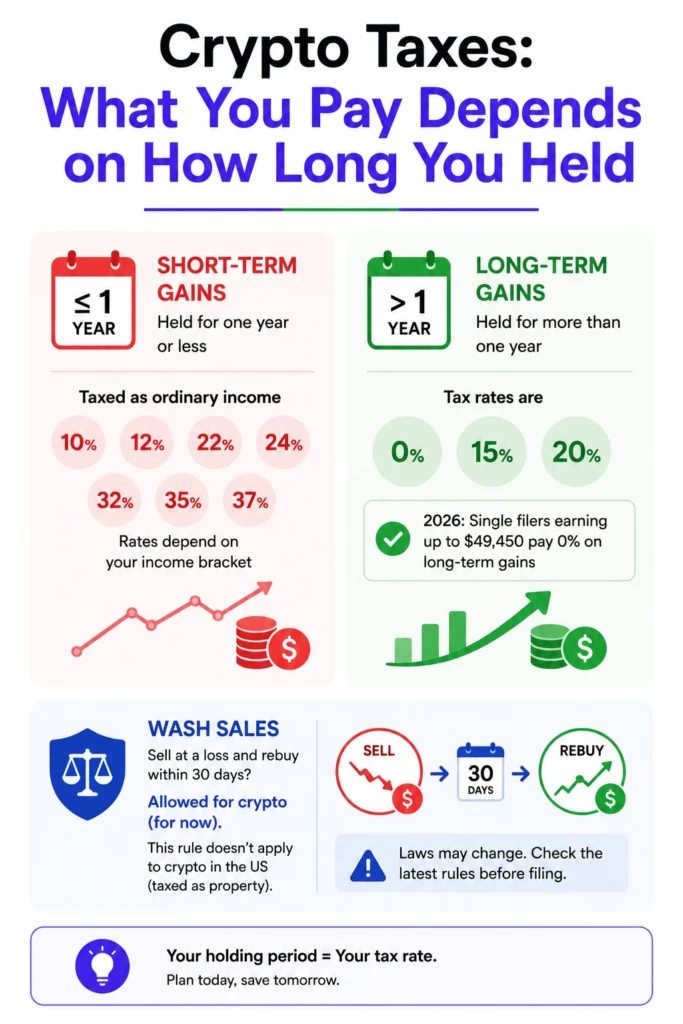
Short-term gains apply when you held the crypto for one year or less. The IRS taxes short-term gains at ordinary income rates: 10%, 12%, 22%, 24%, 32%, 35%, or 37%, depending on your income bracket.
Long-term gains apply when you held the crypto for more than one year. According to Bankrate’s capital gains tax data, long-term rates are 0%, 15%, or 20%. For 2026, single filers earning up to $49,450 in taxable income pay 0% on long-term crypto gains.
Wash sales: Under traditional securities law, selling an asset at a loss and immediately rebuying it blocks the loss deduction. As CoinLedger’s wash sale analysis explains, this rule currently does not apply to cryptocurrency in the US because crypto is taxed as property, not a security. You can sell crypto at a loss and rebuy it within 30 days and still claim the loss. Legislative discussions about closing this exemption are ongoing, so verify the current status before filing. Understanding which payment methods you can use to buy crypto also helps beginners plan their entry strategy with cost basis tracking in mind from day one.
Calculate Your Crypto Swap Tax
Here is a step-by-step calculation:
- Record the acquisition: You buy 1 ETH for $2,000, including $30 in fees. Cost basis = $2,030.
- Record the swap date and value: Six months later, 1 ETH is worth $3,500. You swap it for another token.
- Calculate the gain: $3,500 (fair market value) minus $2,030 (cost basis) = $1,470 gain.
- Identify the holding period: Six months means short-term. Tax rate matches your ordinary income bracket.
- Report on Form 8949: List the acquisition date, disposal date, proceeds, and cost basis as a line item.
Country-Specific Crypto Tax Rules
How US Crypto Swaps Are Taxed
The IRS requires crypto gains and losses to be reported on Form 8949 (Sales and Other Dispositions of Capital Assets). Those totals carry over to Schedule D (Capital Gains and Losses).
Starting in early 2026, some US taxpayers will receive Form 1099-DA (Digital Asset Proceeds from Broker Transactions). According to IRS final regulations on digital asset reporting, brokers must report gross proceeds for transactions made on or after January 1, 2025, and report cost basis for transactions from January 1, 2026. This is the first mandatory reporting form specifically for digital assets, which makes accurate records on your side equally critical. US users should also confirm state-level restrictions using the Paybis US crypto restrictions guide.
UK Crypto Tax for Swaps
In the UK, HMRC treats crypto swaps as taxable disposals. Swapping tokens, selling for fiat, spending crypto on goods or services, or gifting it to anyone other than a spouse all count as disposals. Every UK taxpayer receives a £3,000 annual tax-free capital gains allowance. Gains above this threshold are taxed at 18% for basic-rate taxpayers and 24% for higher-rate taxpayers in the 2025/26 tax year.
Brazil Crypto Swap Tax Obligations
In Brazil, the Receita Federal taxes crypto swaps as disposals. When you exchange BTC for ETH, the Receita Federal treats the BTC as sold at its Brazilian real (BRL) market value on the trade date. Any resulting gain is taxable if your total monthly crypto disposals exceed R$35,000. Net gains above this threshold are taxed at rates between 15% and 22.5%. Normative Instruction 1,888/2019 also requires self-reporting of off-exchange transactions above R$30,000 per month.
Paybis supports PIX as a payment method across its 20+ supported payment options, and all fees are disclosed in the local currency before every transaction confirms, making initial cost basis tracking straightforward from the first purchase.
Worldwide Crypto Swap Taxes
Paybis serves users in 180+ countries, and while specific rules vary by jurisdiction, the core principle is consistent: a swap is a disposal, and any gain is taxable in the year it occurs. The Paybis crypto taxes in Germany guide covers how holding period calculations affect tax rates in one of the EU’s most clearly defined crypto tax frameworks and illustrates why recording the acquisition date is such a critical data point for every swap. For users evaluating which platforms offer the most transparent fee structures across jurisdictions, the Paybis guide to lowest fee crypto exchanges provides a useful comparison.
How to Track Your Crypto Swaps for Taxes
Required Crypto Swap Tax Details
For every swap, record these five data points immediately after the transaction:
- Date of acquisition: When you originally bought the crypto being swapped away.
- Date of disposal: The date the swap was executed.
- Proceeds: The fair market value in fiat currency at the moment of the swap.
- Cost basis: The original purchase price in fiat, including all fees paid.
- Ticker symbols: The names and symbols of both cryptocurrencies involved.
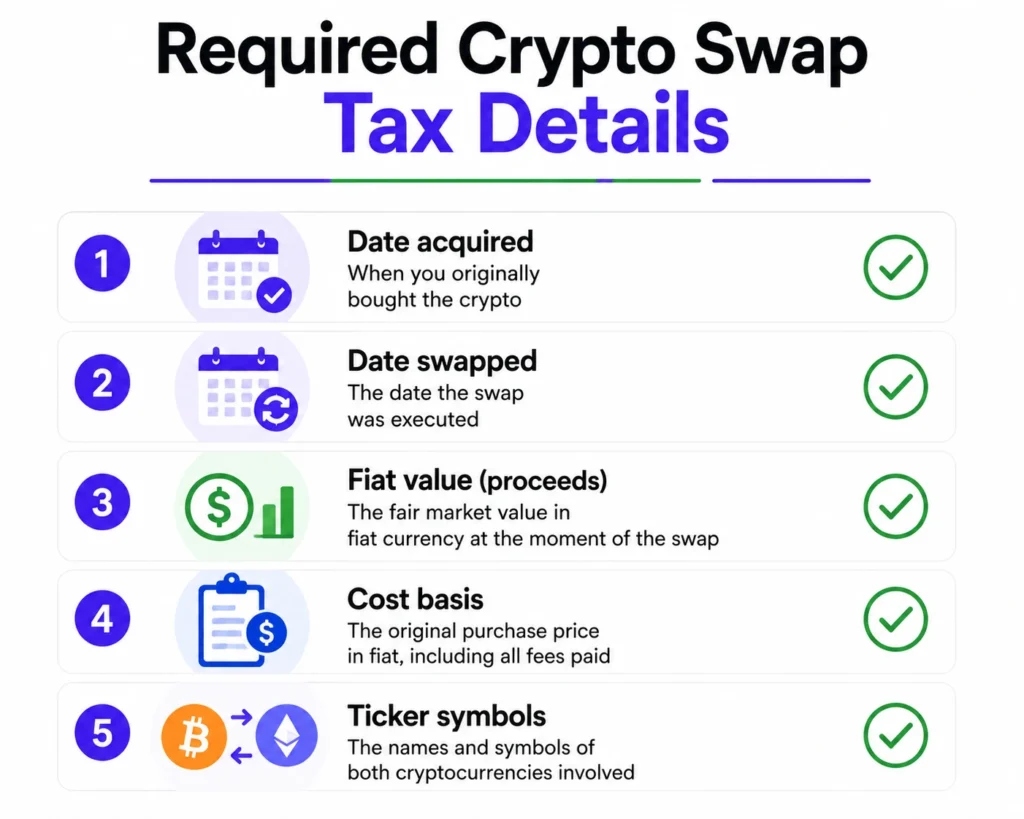
The IRS Form 8949 instructions require exactly this format, split into short-term (held 12 months or less) and long-term (held more than 12 months) categories.
What Tools Track Crypto for Taxes?
Centralized exchanges make tax reporting significantly simpler than decentralized exchanges. As CryptoTaxCalculator explains, most centralized exchanges allow users to download transaction history in CSV format for import into tax software. DEXs typically don’t require identity verification and don’t generate organized records, making manual reconciliation extremely difficult across multiple wallets and protocols. For a broader overview of the landscape, the Paybis guide to the best cryptocurrency apps for investing, trading, and tracking covers how to evaluate platforms on criteria that directly affect tax recordkeeping.
Paybis’s transaction history is accessible directly from the account dashboard. If you need help locating specific records, Paybis’s 24/7 live chat support responds within an average of 1-2 minutes. The Paybis video on crypto history and tax savings covers exactly what data to save and why timing matters.
Your Crypto Tax Record Timeline
- After every swap: Note the date, both tickers, and the fair market value in fiat at that exact moment.
- Monthly: Download your full transaction history and save the CSV file.
- January (after tax year closes): Import the complete year’s records into tax software.
- Before filing deadline: Review with a qualified tax professional if your swap volume was significant or your activity crossed multiple countries.
Pitfalls for Crypto Tax Beginners
Missing Records Mean Tax Trouble
Failing to report crypto transactions carries serious consequences. According to BoomTax’s crypto penalty guide, accuracy-related penalties run at 20% of the underpayment, failure-to-file penalties can reach 25%, and interest accrues on unpaid amounts from the original due date. In cases of willful evasion, fines can reach $250,000, and prison sentences of up to 5 years are possible. The same source notes that an IRS compliance review from 2023 found that only about 25% of crypto investors were voluntarily meeting their reporting obligations.
Tracking Your Crypto Cost Basis
The most common beginner mistake is forgetting to include fees in the cost basis. Every fee paid at purchase, including service fees, processing fees, and network fees, increases the cost basis and reduces the taxable gain. Platforms that embed fees inside opaque spreads make accurate cost basis calculations impossible after the fact.
Paybis discloses three distinct fee categories before every transaction confirms, so the true purchase price is always on record. Christine K. noted on G2:
“I just pick how much crypto I want, pay with my card (or Apple/Google Pay), and in about 10-15 minutes the coins are already in my wallet… Paybis makes buying crypto almost as easy as online shopping.” – Christine K. on G2
That simplicity extends directly into tax preparation: when the purchase process is clear, the cost basis record is automatic.
Avoid Tax Errors: When to Get Assistance
Managing Many Crypto Swaps
When swap volume grows, manual tracking becomes error-prone and crypto tax software is worth using. These tools connect to exchanges via API or CSV import, calculate gains and losses automatically, and produce Form 8949-ready reports. Paybis’s downloadable transaction history simplifies the CSV import process for any compatible software. Users who need help accessing records can reach the Paybis support team through 24/7 live chat, with average response times of 1-2 minutes. The Paybis sell cryptocurrency guide, and the Skrill and Neteller sell guide also walk through how to access transaction records.
Crypto Taxes Across Borders
Expats and international remittance senders face an additional layer of complexity, as tax residency rules vary significantly by country. Where the exchange is located may matter less than where the taxpayer lives. If you send crypto internationally as an alternative to traditional remittances, any token conversion along the way still triggers the same disposal rules. The Paybis platform-switching guide covers how platform transparency affects cost tracking and compliance across multiple jurisdictions. For users who want to understand the fundamentals before their first purchase, the Paybis cryptocurrency guide for US beginners is a useful starting point. It is also worth reviewing how often you can buy and sell on exchanges, as the frequency of trading directly affects your short-term vs. long-term gain calculations — the Paybis guide on how often you can buy and sell Bitcoin on exchanges addresses this in detail.
Choose a Trusted Crypto Tax Pro
For straightforward situations with a handful of swaps, self-filing with tax software is manageable. For anything involving multiple jurisdictions, high transaction volumes, or significant losses, a qualified crypto tax accountant is worth the investment. When hiring one, confirm they have specific experience with digital asset taxation and understand IRS Notice 2014-21, HMRC’s crypto disposal rules, Form 1099-DA requirements, and the current status of the crypto wash sale exemption.
Ready to buy or swap crypto with full fee transparency and organized tax records? Create a Paybis account, verify your identity in under 2 minutes, and see your complete cost breakdown before every transaction confirms. Service fees start from 1.49%, and 24/7 support is available in 9+ languages.
Key Terminology
- Cost basis: The total amount paid to acquire a cryptocurrency, including all fees (service fee, processing fee, and network fee). Used to calculate capital gain or loss when the asset is later disposed of.
- Fair market value: The price of a cryptocurrency in local fiat currency at the specific moment a swap or sale occurs. This figure serves as the “sale price” for tax calculation purposes.
- Capital gain: The profit realized when a cryptocurrency is sold or swapped for more than its cost basis. Short-term gains (held 12 months or less) are taxed at ordinary income rates of 10%-37% in the US. Long-term gains (held more than 12 months) are taxed at 0%, 15%, or 20%.
- Capital loss: The deficit realized when a cryptocurrency is sold or swapped for less than its cost basis. Losses can offset capital gains, and up to $3,000 per year in net losses can be deducted against ordinary income in the US.
- Form 8949: The IRS form used to report individual capital asset transactions, including crypto swaps. Each swap is listed as a separate line item with acquisition date, disposal date, proceeds, and cost basis.
- Schedule D: The IRS summary form for all capital gains and losses. Totals from Form 8949 carry over to Schedule D as part of a standard federal tax return.
- Form 1099-DA: A new IRS form that brokers must issue beginning with 2025 transactions, reporting gross proceeds from digital asset sales and exchanges to both the taxpayer and the IRS. Cost basis reporting begins with 2026 transactions.
- Wash sale rule: A US tax rule that blocks investors from claiming a capital loss on a security if they repurchase the same or substantially identical security within 30 days of selling it. This rule currently does not apply to cryptocurrency in the US, though legislative discussions about its future status are ongoing.
- Network fee: The cost paid to blockchain miners or validators to process and confirm a transaction on the blockchain. This fee is part of your cost basis when buying and is sometimes called a “gas fee” on the Ethereum network.
- Disposition: Any transfer of crypto ownership, including swaps, sales for fiat, spending, or gifting. Each disposition is a taxable event if a capital gain or loss results.
FAQ
Do I Pay Taxes If I Swap Bitcoin for Ethereum?
Yes. The IRS treats crypto swaps as taxable disposals, equivalent to selling Bitcoin at its current market value and purchasing Ethereum with the proceeds. You owe tax on any capital gain in the year the swap occurs, even if no fiat currency touched your bank account.
Can I Deduct Losses From Crypto Swaps?
Yes. If the fair market value at the time of the swap is lower than your cost basis, you have a capital loss. According to IRS Topic 409, capital losses offset capital gains in the same tax year, and up to $3,000 of net losses per year can be deducted against ordinary income in the US.
How Do I Access My Crypto Swap Tax Forms?
Log into your Paybis account and download the full transaction history from the dashboard, which includes the date, amount, fees, and crypto received for every transaction. Form 8949 requires these exact data points, and Paybis’s 24/7 live chat support can help you locate any specific records within an average of 1-2 minutes.
Do I Pay Tax on Crypto I Have Not Cashed Out?
No. Simply holding cryptocurrency is not a taxable event, regardless of how much the price has moved. Tax only applies when you dispose of the asset by selling, swapping, spending, or gifting it, and transferring crypto between wallets you own does not trigger a tax event.
Disclaimer: Don’t invest unless you’re prepared to lose all the money you invest. This is a high‑risk investment and you should not expect to be protected if something goes wrong. Take 2 mins to learn more at: https://go.payb.is/FCA-Info