Crypto Swap vs Traditional Exchange: When to Use Each (2026)
Key Takeaways:Crypto swaps execute instantly using smart contracts and liquidity pools, while traditional exchanges match buyers and sellers through order books. For casual buyers, payment gateways like Paybis offer instant card transactions, 2-minute verification, and all fees shown before confirmation. Traditional exchanges offer lower per-trade fees for high-volume traders but come with complex interfaces and multi-day bank transfer delays. We serve 5M+ users across 180+ countries, hold FinCEN and FINTRAC registration, and carry 31,000+ Trustpilot reviews with a 4.1 rating. You can buy bitcoin and store it in a secure wallet, withdraw Bitcoin to your bank account, buy Bitcoin with Paysafe Card, or use M-Pesa to fund your crypto purchase.
Most people just want to buy $100 of Bitcoin. Instead, you end up staring at order books, candlestick charts, and maker/taker fees you’ve never heard of, on a platform professional traders designed for themselves. This guide cuts through the noise. It explains exactly what makes a crypto swap different from a traditional exchange, how fees and speeds compare in real numbers, and which method fits your actual needs. By the end, you’ll know how to buy crypto in under 15 minutes without touching a single order book.
Crypto Swaps: Fast and Simple Digital Asset Trades
A crypto swap is a direct exchange of one cryptocurrency for another. No buyer hunting for a seller. No order types to configure. You send one asset, and a smart contract (self-executing code on a blockchain) instantly delivers the other based on current pool prices.
Platforms like Uniswap popularized this technology by introducing the Automated Market Maker (AMM) model. Instead of matching individual buyers and sellers, an AMM uses liquidity pools (shared pots of crypto deposited by other users) to set prices algorithmically. When a trade happens, the pool rebalances automatically. AMMs allow traders to “quickly open and close positions without worrying about order types, order matching, or other complexities. If you’re wondering how many dollars it takes to buy a Bitcoin or how many Bitcoins you can get for $100, the swap model makes it easy to find out instantly.
We extend this concept further by connecting fiat currencies (your bank account or Visa card) directly to crypto, bridging the gap between everyday money and digital assets. The result: you send dollars and receive Bitcoin, with no trading knowledge required.
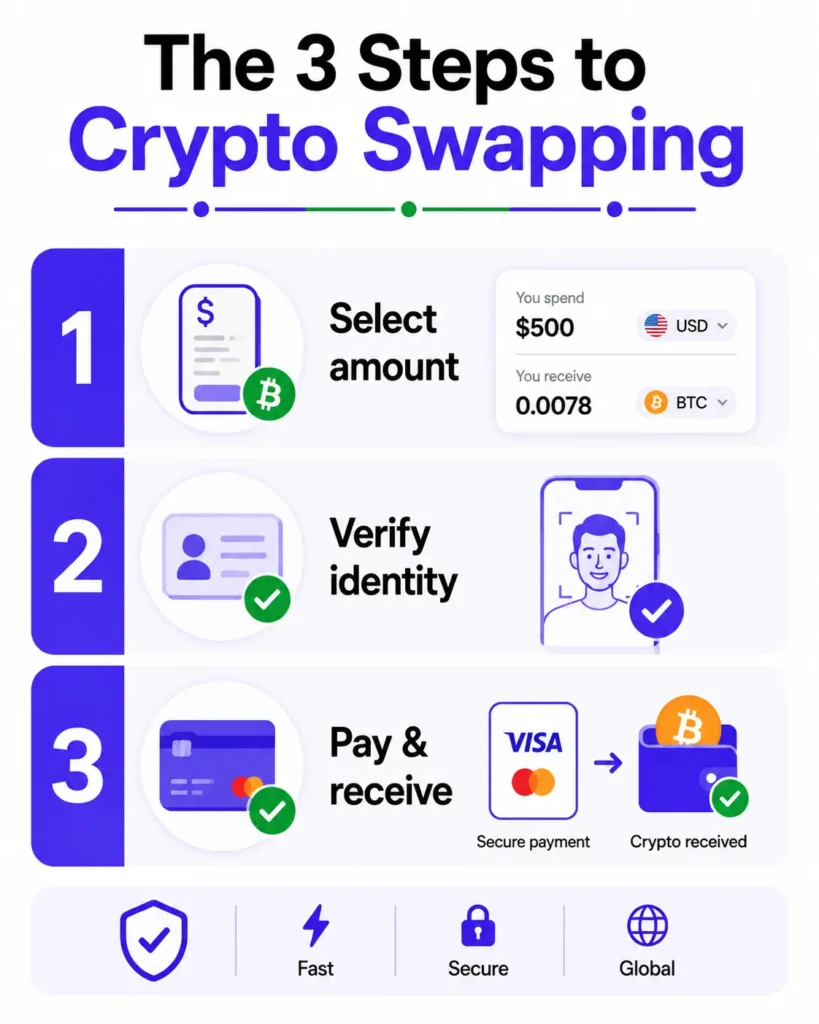
The 3 Steps to Crypto Swapping
The swap process strips complexity to its core. Here’s how it works on Paybis, from start to finish:
- Select your amount: Enter how many dollars you want to spend and choose your crypto. Our calculator shows exactly what you’ll receive, including every fee, before you confirm.
- Verify your identity: Upload a government-issued ID and take a selfie. For most users, verification completes in 2 minutes.
- Pay and receive: Enter your Visa or Mastercard details, complete the 3DS security check (a text or app notification from your bank), and crypto arrives in your specified wallet. Processing takes less than 1 minute, with settlement near-to-instant depending on the blockchain.
Compare this to traditional exchange onboarding, where users frequently wait 3-5 business days just for a bank transfer to clear on Coinbase before a single trade is possible. You can learn how to create and verify an account to get started quickly.
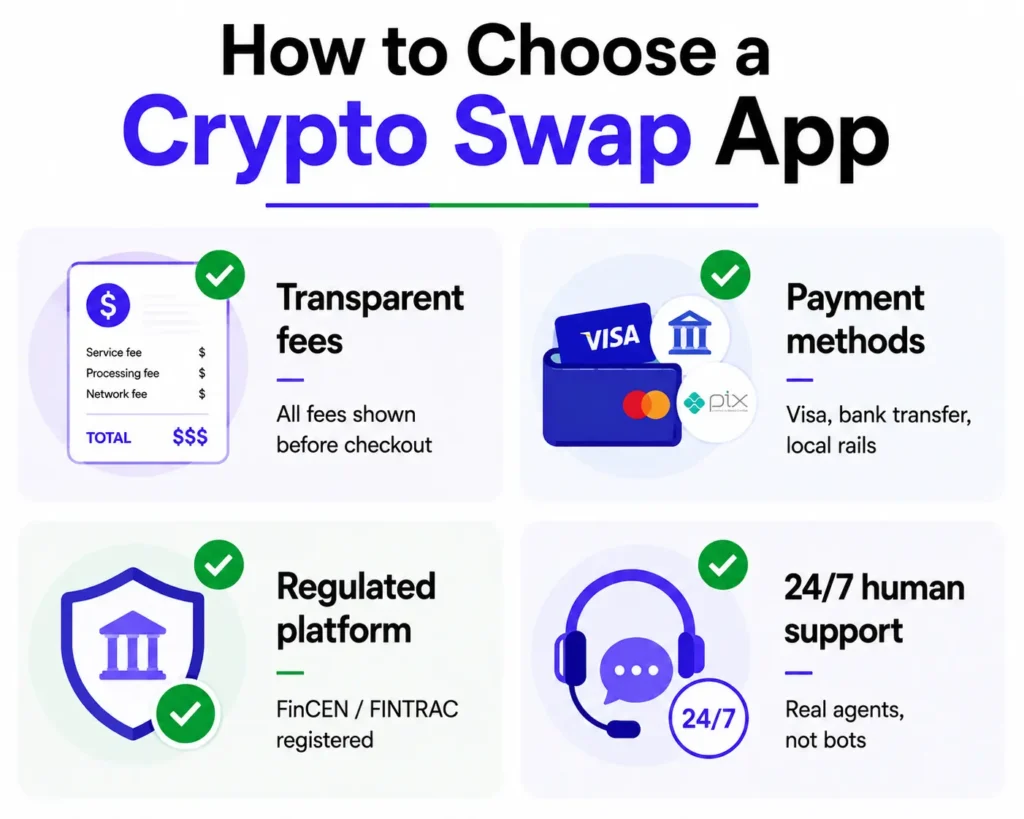
How to Choose a Crypto Swap App
Not all swap platforms deliver the same experience. When evaluating options, look for these criteria:
- Transparent fee display: All charges (service, processing, and network fees) must appear before you confirm, not after.
- Supported payment methods: Does it accept your Visa card, local bank transfer, or regional methods like PIX for Brazil?
- Regulatory standing: FinCEN or FINTRAC registration signals the platform operates under anti-money laundering compliance.
- Support availability: A 24/7 live chat with human agents, not a bot, matters when a transaction stalls at midnight.
The Paybis review on 99Bitcoins highlights fee transparency and speed as the platform’s defining strengths, particularly for first-time buyers.
Ideal Users for Crypto Swaps
Crypto swaps and payment gateways serve specific needs well. They’re built for users who:
- Want to own Bitcoin or Ethereum today, not after multi-day bank processing
- Buy occasionally and don’t need advanced trading tools
- Need to diversify a small portfolio quickly between established cryptocurrencies
- Live in regions where Paybis offers local payment methods that may have limited support elsewhere
“I just pick how much crypto I want, pay with my card (or Apple/Google Pay), and in about 10-15 minutes the coins are already in my wallet.” – Verified user review of Paybis
How to Use a Centralized Crypto Platform
A company operates a centralized crypto exchange (CEX) as a full trading platform that holds your funds and matches buy and sell orders in real time. The most well-known centralized exchanges fall into this category. They offer features built for active traders: spot trading (buying at current prices), futures contracts (agreements to buy or sell at a future price), margin trading (borrowing funds to increase position size), and staking (earning rewards by locking crypto).
These platforms support hundreds or thousands of trading pairs. Binance alone lists over 1,500. That breadth benefits professional traders. For a casual buyer who wants $200 of Bitcoin, it creates friction, not value. Understanding how often you can buy and sell Bitcoin on exchanges can help you decide which model suits your trading style.
How Funds Move on Exchanges
Traditional exchanges rely on order books: ledgers listing every open buy and sell order, sorted by price. A matching engine pairs buyers with sellers when their prices align. When a buy order and a sell order match in terms of price, the exchange executes the trade.
Swaps bypass this entirely. There’s no waiting for a counterparty. The liquidity pool provides instant pricing and execution. This difference in mechanics is why swaps settle in seconds while exchange orders can take longer during volatile markets.
Best for First-Time Crypto Buyers
Traditional exchanges are built for traders who already understand crypto mechanics. For first-time buyers, the learning curve is steep and the cost of mistakes is real. One wrong click on a margin trading platform can result in losses that exceed the original deposit.
We take a different approach: a calculator-style interface where your only inputs are the amount to spend and the crypto to receive. No order types. No charts. No 600 trading pairs to scroll through.
Crypto Swap vs. Exchange: What Sets Them Apart
The core difference comes down to mechanics and intent. Exchanges use order books and require buyers to find sellers. Swaps use liquidity pools and execute instantly. Here’s how the two models compare across the metrics that matter most to casual buyers:
| Feature | Crypto Swap / Gateway | Traditional Exchange |
|---|---|---|
| Verification time | Typically under 15 minutes | Varies by platform and volume |
| Settlement time | Near-to-instant | Blockchain-dependent (crypto-to-crypto) or 1–5 days (bank to crypto) |
| Fee transparency | All fees shown before confirmation | Spreads often embedded in quoted price |
| Interface complexity | Calculator (send X, get Y) | Order books, charts, trading pairs |
| Customer support | 24/7 live chat with fast response | Varies by platform |
| Payment methods | 20+ including local options | Typically ACH, wire, and major cards |
| Custody model | Funds sent to your wallet | Platform typically holds your funds |
| Best for | Casual buyers, beginners | Active traders, high-volume users |
Crypto Speed: Swap vs. Exchange
Speed is where gateways win decisively for casual buyers. We process card transactions in less than 1 minute, with blockchain settlement near-instant, depending on the network. As the Paybis blog explains, the first transaction typically completes within 15 minutes for users who pass automated KYC.
Coinbase’s bank transfer model requires ACH deposits to clear and become fully available, which typically takes 3-5 business days. That’s a structural limitation of the US bank transfer system, not a criticism of Coinbase specifically. For someone who decides to buy Bitcoin on a Tuesday, waiting until Monday isn’t a trade-off. It’s a complete blocker. If you want to understand how crypto exchanges handle bank transfers, our dedicated guide breaks it down in detail.
Crypto Swap and Exchange Fees Explained
Fee structures differ significantly between methods. Here’s the complete breakdown:Swap / Gateway fees (Paybis card purchase):
- Service Fee: 1.49% (first card transaction carries 0% Paybis service fee)
- Processing Fee: 4.5-8.5% for card transactions over $50, depending on currency
- Network Fee: Variable, set by blockchain miners (shown before confirmation, approximately $0.70-$3 for Bitcoin)
Traditional exchange fees (when already funded):
- Trading Fee: 0.1% per trade on Binance at base tier, 0.25-0.40% on Kraken Pro (per their published fee schedules)
- Spread: Often embedded in the quoted price, not shown as a separate line item on standard CEX interfaces
- Withdrawal Fee: Fixed per withdrawal, varies by crypto
The important distinction: exchange trading fees of 0.1-0.4% apply only once you’ve already funded your account. Getting funds into that account via ACH takes 3-5 business days. If you use a debit card on Coinbase to buy instantly, Coinbase’s debit card fee structure runs approximately 3.99% plus an embedded spread, and unlike Paybis, that spread is built into the quoted price rather than shown as a separate line item. For repeat Paybis customers, the total cost differs. Paybis charges a service fee starting from 1.49% plus a processing fee of 4.5–8.5%, while Coinbase charges a flat 3.99% on every card transaction with no service fee waiver. We show every charge itemized before you click confirm.
Crypto Custody: Your Control
When you deposit funds into a centralized exchange, the exchange takes custody of your assets and controls the private keys (the passwords that prove ownership). The crypto principle “not your keys, not your crypto” reflects a real risk: if an exchange is hacked or goes insolvent, exchanges can freeze user funds, or users can lose them entirely in insolvency.
We operate as a payment gateway rather than a custodial exchange. When your purchase completes, the crypto transfers directly to a wallet address you control. We process transactions quickly and don’t hold funds indefinitely like traditional exchanges. For users who keep crypto in the Paybis wallet, we use MPC (multi-party computation) technology, which splits private key control to eliminate single points of failure.
Diverse Ways to Pay for Crypto
Payment flexibility is a practical differentiator for users outside North America and Western Europe. We support 20+ payment methods across 180+ countries, including:
- Visa and Mastercard (credit and debit)
- PIX (Brazil’s instant payment system)
- SEPA bank transfers (European Union)
- M-Pesa (Kenya and Sub-Saharan Africa)
- Skrill and Neteller
- PayPal, Apple Pay, Revolut Pay
Coinbase’s payment options center on ACH, wire transfers, and debit cards, with limited regional support. For users in Brazil, Nigeria, or Southeast Asia, we’re often the only major platform that accepts their local payment method, as our on-ramp payment method comparison details.
Crypto Swaps: Best for Fast, Simple Transactions
For the majority of casual crypto buyers, a swap gateway is the right tool.
You Need Crypto Today Without Complexity
No account funding wait. No multi-day bank transfer. No trading interface to decode. Card purchases on Paybis are processed in under 1 minute, with blockchain settlement near-instant. For a first-time buyer, the only decisions are how much to spend and which crypto to receive. There’s nothing to misconfigure.
The FXEmpire Paybis review confirms that speed and immediate availability are the platform’s most consistent strengths in independent testing. Casual buyers who purchase occasionally don’t need a professional trading account. Maintaining a Binance account, navigating its interface, and learning maker/taker fees costs time and stress for no additional benefit. If you’re evaluating your options, understanding why crypto users switch platforms can help clarify what really matters when choosing where to buy.
Stuck? Get 24/7 Human Support
When a transaction fails, the support model matters more than any fee percentage. We staff live chat 24 hours a day, 7 days a week, with an average response under 2 minutes. Support runs in 9+ languages including English, Spanish, French, German, Portuguese, and Russian.
Binance’s support system has drawn criticism despite 24/7 availability. Coinbase relies on ticketing systems and automated deflection for most support inquiries.
“Paybis is an honest crypto exchange company that is easy to work with.” – Edward F. Reilly on Trustpilot
Why Choose a Traditional Crypto Exchange
Traditional exchanges serve specific users well. Here’s when they’re genuinely the right choice.
For Frequent, High-Volume Trading
Active traders making multiple transactions per week at high volumes pay significantly less on exchanges. Binance charges 0.1% per spot trade at its base tier, while Kraken Pro starts at 0.25-0.40% for takers (per their published fee schedules). For traders already funded on the platform, these rates are a fraction of card-based gateway fees. The trade-off is real: you pay with setup time, a learning curve, and bank transfer delays to get those lower rates. Some traders also explore ways to make passive income with cryptocurrency alongside active trading strategies.
For Complex Trading Strategies
Limit orders (buying only if Bitcoin drops below $X), stop-loss orders (selling automatically if price falls), and futures contracts require a full exchange. These tools don’t exist on swap gateways because casual buyers don’t need them.
Understanding the Fee Trade-Off
Card-based gateway fees cover what they deliver: instant processing (under 1 minute), 2-minute identity verification, and 24/7 human support in 9 languages. Exchange trading fees of 0.1-0.4% apply only to the trade itself and assume you’ve already waited days for your bank transfer to clear and learned the interface. The right comparison isn’t just percentages. It’s the total cost in time, complexity, and dollars of getting crypto into your hands today.
Expect Identity Check Delays on Exchanges
Traditional exchanges are not immune to verification delays. Coinbase verification can range from 10 minutes to 48+ hours depending on ID quality and system load. Binance has a documented history of account locks during peak periods. Our automated identity verification — KYC (Know Your Customer), requiring a government-issued ID and selfie — completes for most users in under 2 minutes.
Compare Costs: Crypto Swap vs. Exchange
Your $500 Bitcoin Cost Breakdown
Here’s the exact cost of buying $500 of Bitcoin on Paybis with a debit card after the first transaction (which carries a $0 Paybis service fee):
| Fee Type | Paybis (card) | Coinbase Debit Card | Coinbase ACH + Trade |
|---|---|---|---|
| Service / Trading Fee | $7.45 (1.49%) | ~$20 (3.99%) | ~$0.50–2.50 (0.1–0.5%) |
| Processing / Spread | $22.50–$42.50 (4.5–8.5%) | ~$2.50 (0.5% spread, embedded) plus card fee above | Minimal |
| Network Fee | Variable (~$0.70–$3 for Bitcoin) | Varies | Varies |
| Fee Visibility | All fees itemized upfront | Spread hidden in price | Transparent via Pro interface |
| Settlement Time | Under 15 minutes | Near-instant | 3–5 business days to fund |
All three of our fee lines appear on screen before you click confirm. Nothing changes at checkout. Coinbase’s debit card option is cheaper in percentage terms, but the spread is embedded in the quoted price rather than itemized, meaning users discover the true total only at confirmation. Coinbase ACH plus a spot trade is the cheapest by percentage, but the 3-5 day funding wait eliminates same-day purchase for new users.
What Value Do Higher Fees Buy?
Our card fees are higher than exchange trading fees in percentage terms. What those fees cover: instant processing (under 1 minute), 2-minute identity verification, 90+ cryptocurrencies, and 24/7 human support in 9 languages. It’s the difference between a direct flight and two connecting flights. The direct option costs more, but you arrive today.
Solving Common Crypto Transaction Issues
Avoiding Crypto Swap Scams
We have operated since 2014 with zero major security breaches affecting customer funds. Our regulatory registrations include FinCEN (MSB #31000272911973) in the US, FINTRAC (M22061209) in Canada, and VASP registration (RDWW-805) with Poland’s Revenue Chamber. We hold PCI DSS Level 1 certification, the highest standard for payment card data handling. Before you buy, it’s worth knowing how to spot and avoid crypto scams so you can transact with confidence on any platform.
“Security features (2FA, clear KYC) are treated as core features, not afterthoughts. Fees and exchange rates are displayed transparently before confirmation, making it easy to understand exactly what you…” – Joon Huh on Trustpilot
Ready to buy crypto now? Create your account, complete identity verification in under 2 minutes, and see your exact total cost before you pay. Fees start from 1.49%.
Key Terminology
- Crypto Swap: A direct trade of one cryptocurrency for another (or fiat to crypto) executed instantly via smart contracts and liquidity pools, with no order book or counterparty matching required.
- Traditional Exchange: A platform that matches individual buy and sell orders through an order book. Users fund accounts and place trades at specified prices. Coinbase, Binance, and Kraken are examples.
- AMM (Automated Market Maker): An algorithm that sets token prices based on the ratio of assets in a liquidity pool. AMMs power decentralized swap platforms like Uniswap.
- Liquidity Pool: A shared reserve of two or more cryptocurrencies locked in a smart contract. Swap platforms draw from these pools to execute instant trades without needing a human counterparty on the other side.
- Order Book: A live ledger listing every open buy and sell order on an exchange, organized by price. A matching engine pairs compatible orders to execute trades.
- Smart Contract:Self-executing code stored on a blockchain that automatically carries out an action (like swapping tokens) when conditions are met, with no human intermediary.
- Network Fee: The fee paid to blockchain miners or validators to process and confirm a transaction. This fee is set by network demand, not the platform, and fluctuates with blockchain congestion.
- Service Fee: Paybis’s commission on each transaction, starting from 1.49%. The first credit or debit card transaction carries a 0% Paybis service fee.
- Processing Fee: The fee charged by the payment processor for handling a card transaction. On Paybis, this runs 4.5-8.5% for card transactions over $50, depending on currency.
- Custodial vs. Non-Custodial: A custodial platform (like most CEXs) holds your private keys and therefore your funds. A non-custodial model (like our gateway approach) sends crypto directly to a wallet you control after purchase.
- KYC (Know Your Customer): Identity verification required by regulatory compliance. Users upload a government-issued ID and take a selfie to verify their identity before making crypto purchases.
FAQ
What is the difference between a crypto swap and a traditional exchange?
A crypto swap executes instantly using smart contracts and liquidity pools (shared pools of tokens that set prices algorithmically), requiring no counterparty match. A traditional exchange uses an order book to match individual buyers and sellers at agreed prices, which takes longer and requires understanding of trading mechanics.
How long does it take to buy crypto with a swap gateway like Paybis?
Verification takes under 2 minutes for most users, and card transactions process in under 1 minute with blockchain settlement near-to-instant depending on the network. Most first-time buyers complete the full process within 15 minutes.
Are crypto swap fees higher than exchange trading fees?
Card-based gateway fees run 5-10% of the total because they bundle the payment processing cost (what your card network charges) with the service fee. Exchange spot trading fees run 0.1-0.4% per trade, but apply only after you’ve funded your account. Bank transfer funding can take 3-5 business days. If you buy instantly with a debit card on Coinbase, the total cost is comparable, though less transparently disclosed.
Do I need identity verification to use a crypto swap platform?
We require identity verification for compliance with anti-money laundering regulations. The process takes under 2 minutes: upload a government-issued ID and take a selfie. Our KYC requirements guide explains the specific rules around verification thresholds.
What happens if my swap transaction is rejected?
If we reject a transaction for security or compliance reasons, no charge applies and funds return to your original payment method. We don’t disclose specific rejection reasons to prevent bad actors from gaming the compliance system, but our 24/7 live chat can walk you through next steps in under 2 minutes.
Disclaimer: Don’t invest unless you’re prepared to lose all the money you invest. This is a high‑risk investment and you should not expect to be protected if something goes wrong. Take 2 mins to learn more at: https://go.payb.is/FCA-Info