Is Crypto Swapping Safe? Security Risks and How to Swap Securely
Key Takeaways: Crypto swapping is safe when you use a regulated, transparent platform with 24/7 human support. Most losses come from phishing attacks, hidden fees, and smart contract bugs on unregulated decentralized platforms, not sophisticated hacking. Paybis holds FinCEN (US) and FINTRAC (Canada) registration, displays every fee before you confirm payment, and provides live chat in 9+ languages with under 2-minute response times. For first-time buyers in Brazil, LatAm, Africa, and Asia, that combination separates a safe first purchase from a costly mistake. I
Scammers steal millions of dollars from crypto wallets every year, and most victims never encountered a sophisticated cyberattack. They clicked one wrong link, trusted a fake interface, or got blindsided by fees that appeared only after payment went through. Cryptocurrency scams received at least $14 billion on-chain in 2025, a significant jump from $9.9 billion in 2024, according to Chainalysis.
Swapping crypto doesn’t have to be a high-stakes gamble. By understanding the common traps, like fake interfaces, hidden fees, and broken automated code, you can protect your funds. This guide breaks down how to spot a scam, the difference between centralized and decentralized swaps, and how to execute a secure transaction in minutes. Whether you want to swap BTC to ETH or start your crypto swapping journey, knowing the risks first is what keeps your funds safe.
What Is Crypto Swapping?
Swapping crypto means exchanging one cryptocurrency directly for another without converting to local currency first. Think of it like trading baseball cards directly with a friend: you hand over one card and immediately get another back, without selling yours for cash first.
Two types of exchanges matter for first-time buyers:
- Fiat-to-crypto: You use traditional money (dollars, reais, euros) to buy Bitcoin or Ethereum.
- Crypto-to-crypto swap: You already hold one cryptocurrency and exchange it directly for another, without touching your bank account.
That difference matters for safety. Fiat-to-crypto purchases on regulated platforms come with identity verification and consumer protections. Crypto-to-crypto swaps on decentralized platforms often come with neither. If you’re comparing your options, it helps to understand everything you need to know about buying Bitcoin before choosing a platform or method.
The Biggest Security Risks When Swapping Crypto
The fear of losing money to a scam or a broken transaction is legitimate, and specific enough to be manageable once you know what to look for.
Phishing and Fake Exchange Interfaces
Scammers build websites that look almost identical to real exchanges, with one small difference in the URL. A well-documented tactic involves cloning a legitimate exchange site and targeting anyone who mistyped the address by a single letter. Enter your login credentials and your funds go straight to the attacker.
AI-powered phishing attacks made this significantly worse in 2026, with scam networks offering pre-built fake exchange templates, automatic domain setup tools, and detection-evasion features that make fraudulent sites nearly indistinguishable from legitimate ones.
Protect yourself by typing exchange URLs manually every time, never clicking links from emails or DMs, and verifying regulatory registration numbers in the footer before entering any personal information. Our guide on how to spot and avoid crypto scams covers these red flags in detail.
Smart Contract Vulnerabilities Explained
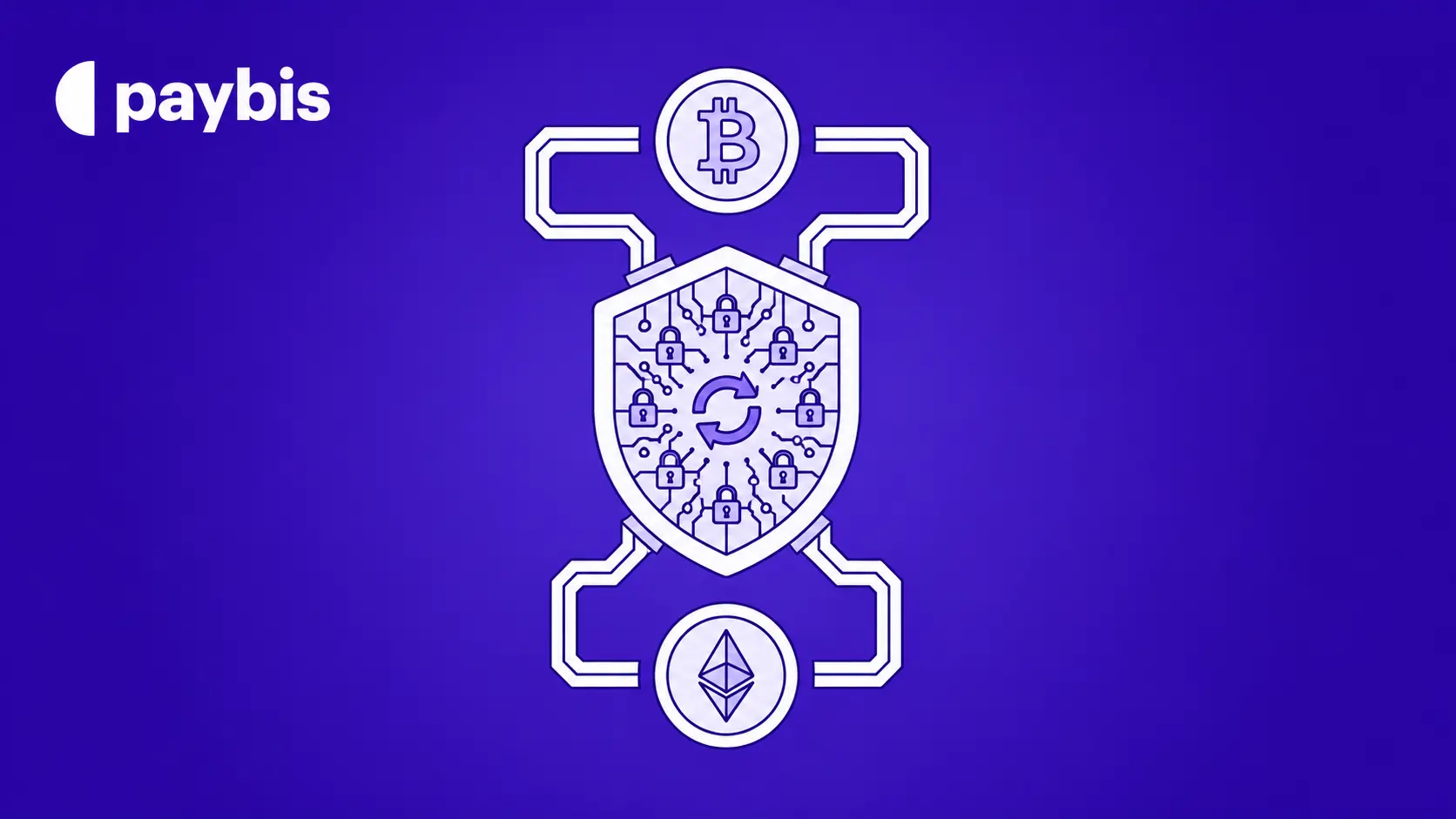
A smart contract is automated code that runs on a blockchain and executes transactions when specific conditions are met. When that code has a flaw, attackers exploit it to drain funds permanently. Because blockchain transactions are irreversible, once a smart contract is deployed, it cannot be patched or altered. The flaw stays live until the contract is removed entirely, and there is no customer support to call when things go wrong.
On a regulated centralized platform, a support team investigates failed transactions. On a decentralized exchange, the responsibility falls entirely on the user.
Hidden Fees and Slippage Traps
Slippage occurs when the price of a token changes between the moment you start a swap and when it finalizes, meaning you receive fewer tokens than expected. On decentralized platforms with low liquidity, slippage costs can reach 1-5% on large orders. When spread fees, withdrawal fees, and conversion fees stack on top, what looks like a $500 purchase becomes a $547 charge with no warning at checkout.
Legitimate platforms show every fee before you confirm. If any part of the cost is hidden until after you click pay, that is a red flag. You can use the Binance Coin calculator as a reference tool to benchmark expected costs before entering any payment details.
Centralized vs. Decentralized Swaps: Which Is Safer?
The choice between a centralized exchange (CEX) and a decentralized exchange (DEX) is one of the most important safety decisions a first-time buyer makes.
| Factor | Centralized Exchange (CEX) | Decentralized Exchange (DEX) |
|---|---|---|
| Who holds your funds | The platform (with security measures) | You, via your own wallet |
| Customer support | Yes, typically 24/7 | None – no company to contact |
| Regulatory compliance | FinCEN, FINTRAC, Know Your Customer (KYC) required | Typically none |
| Smart contract risk | Lower – platform manages execution | Higher – funds depend on code quality |
| Best for | Beginners, everyday buyers | Advanced users comfortable with self-custody |
DEXs offer greater privacy because they typically do not require identity verification, and users trade directly from their own wallets. That privacy comes at a cost: if a smart contract has a bug, or if you send funds to the wrong address, nobody can help recover them.
CEXs are generally more beginner-friendly and offer higher liquidity, with safety nets including 2FA, cold storage, and support teams available when things go wrong. Paybis’s help documentation explains how custodial risks are addressed within the Paybis wallet for users who want the full picture before signing up. For a broader look at how exchanges compare on security track records, the safest crypto exchanges security features and hack history breakdown is worth reading before you decide.
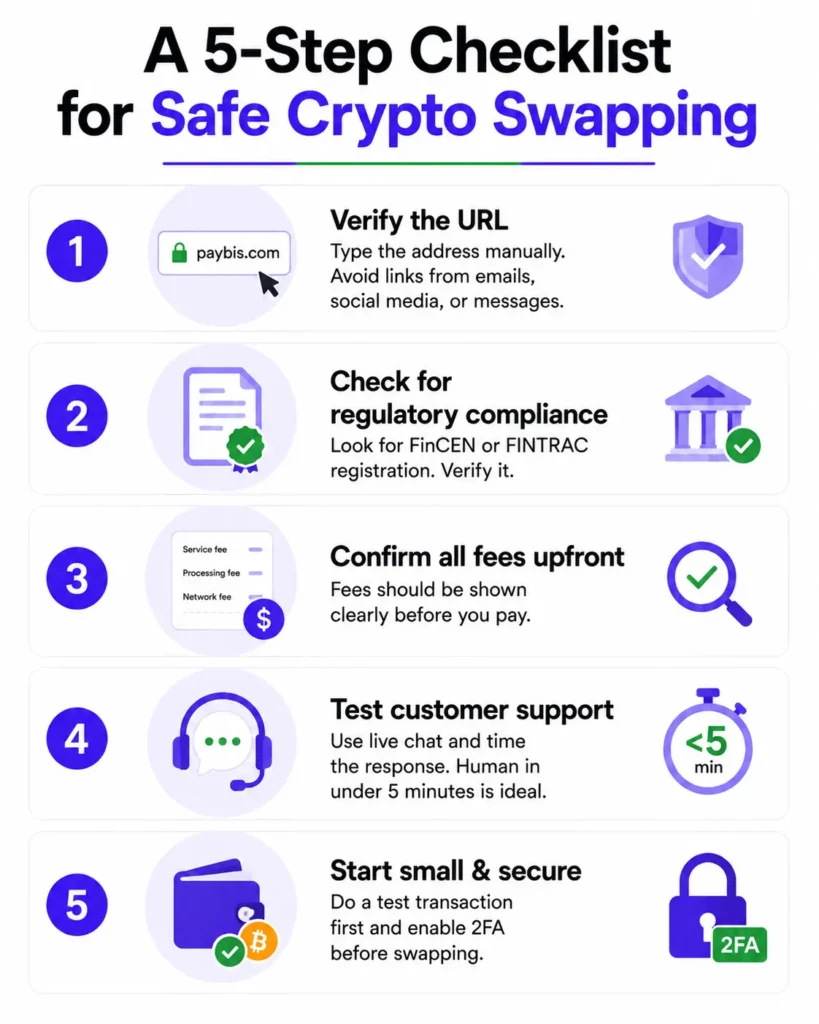
A 5-Step Checklist for Safe Crypto Swapping
You can spot red flags before depositing a dollar. Each step below combines the verification action with the warning sign it helps you avoid.
Verify the URL. Type the exchange address manually every time. One letter difference – such as “payb1s.com” instead of “paybis.com” – signals a fake site. Never follow links from emails, social media, or messaging apps.
Check for regulatory compliance. Scroll to the footer and look for FinCEN or FINTRAC registration numbers. Verify the number directly on the official FinCEN MSB search tool. If the search returns no results, do not proceed. Paybis is registered with FinCEN (US entity 31000272911973) and FINTRAC (CA entity C100000646), and holds PCI DSS Level 1 certification – the highest standard for payment processing security.
Confirm all fees upfront. Before entering payment details, the platform should display the service fee, processing fee, and network fee (the cost the blockchain charges to process your transaction) as separate line items. If fees only appear at the payment confirmation screen, the platform is deliberately hiding costs. You can review exactly how to swap crypto from your Paybis wallet and swap using an external wallet in the help center.
Test customer support before you buy. Open the live chat and ask a simple question: “What payment methods do you accept?” Time the response. A human answer in under 5 minutes is a green flag. A bot that loops through the same FAQ articles without connecting you to a human is a warning sign. Review the transfer warnings and guidance to understand what to expect from your first transaction.
Start with a small test transaction. On your first use of any platform, buy the minimum amount available. Confirm the crypto arrives in your wallet before committing a larger sum. Enable two-factor authentication (2FA) on your account before making any transaction.
Comparing Crypto Swap Platforms for Safety and Speed
| Criterion | Paybis | Binance | Coinbase |
|---|---|---|---|
| Regulatory registration | FinCEN (US), FINTRAC (Canada), PCI DSS Level 1 | Registered in multiple jurisdictions; regulatory scrutiny in some markets | Nasdaq-listed, strongest US compliance |
| Fee transparency | All fees shown before payment confirmation | Fees added at multiple stages | Spread embedded in quoted price, visible in order preview |
| Local payment methods | 20+ including PIX (Brazil), Webpay (Chile), FPS (UK) | Wide reach but inconsistent local support | Slower bank transfers; limited local payment methods in many markets |
| Customer support speed | 24/7 live chat, under 2-minute response, 9+ languages | Long wait times, inconsistent quality | Automated bots, no direct human access |
| Verification speed | Under 2 minutes | Inconsistent, with frequent account locks | Typically 10+ minutes, often longer |
| Security breach history | Zero since founding in 2014 | History of security incidents | 2025 insider data breach affecting ~70,000 users |
The Benzinga review of Paybis highlights upfront fee disclosure as a core differentiator, confirming the platform shows all costs before any payment details are entered. The FXEmpire analysis confirms Paybis’s focus on speed and accessibility for global users. The Coin Bureau review describes Paybis as one of the fastest options for first-time buyers in markets where other platforms are unavailable or restricted.
How Paybis Protects Your Crypto Swaps
On Binance, first-time buyers face 600+ trading pairs and verification that takes hours. On Coinbase, bank transfers take 3-5 business days and support routes to automated bots. When a transaction shows “pending” for two hours with no human to call, you don’t care about fee structures – you want your money back.
Paybis protects users across four specific areas.
Regulatory compliance with a 12-year track record. Paybis has operated since 2014 with zero major security breaches affecting customer funds. The Paybis safety overview details FinCEN registration, FINTRAC registration, and PCI DSS Level 1 certification – all requiring mandatory compliance with Bank Secrecy Act requirements, regular government audits, and legal frameworks that provide genuine consumer protection.
Transparent fees before confirmation. For a $500 Bitcoin purchase with a credit card after your first transaction, the Paybis calculator shows: Service Fee ($7.45 at 1.49%), Processing Fee ($22.50-$42.50 at 4.5-8.5% depending on currency), and Network Fee (varies based on Bitcoin blockchain congestion at the time of transaction). Total: approximately $531.45-$555.45, shown as separate line items before you enter any payment details. First-time card buyers pay zero Paybis service fee – only processing and network fees apply. If you want to understand how different payment options stack up in cost and convenience, this overview of top payment methods for buying crypto is a useful reference.
24/7 human support in 9+ languages. When something goes wrong, Paybis connects you to a human agent in under 2 minutes. If a transaction is rejected for security reasons, your funds return automatically with zero charges.
“site has a top notch live support with real people that solves any problems in minutes have dealt with them alot and always got it resolved promptly unlike skrill who are still ignoring my support calls even tho paybis has a higher crypto fee then skrill the live support with real people makes it worth it keep delivering this perfect service” – LagToScam on Trustpilot
“I can’t say enough good things about Paybis. It is an outstanding crypto service provider in every way. It is very easy, smooth and fast. I only use Paybis now.” – Tom Williams on Trustpilot
The experience described in those reviews matches what 30,780+ Trustpilot reviews with a rating of 4.1 or “Great” reflect at scale, 75% are 5-star. G2 users confirm the same pattern.
Local payment methods across 180+ countries. Paybis supports PIX in Brazil, Webpay in Chile, FPS in the UK, and 20+ additional payment methods across 70+ fiat currencies. The platform has processed $1.2B+ in annual transaction volume (last 12 months as of Oct 2025) across 5M+ retail users, with 90+ cryptocurrencies available. Users in Africa looking for the best local options can also consult the guide to the best crypto exchanges for Africa for region-specific guidance. If you prefer to hold funds outside the platform, Paybis provides full instructions for withdrawing to an external wallet at any time. Use the Paybis fee calculator to see the exact cost of your swap before you create an account or enter a single payment detail.
The Takeaway on Crypto Swap Safety
Crypto swapping is safe when you use a platform that shows all fees upfront, holds verifiable regulatory registration, and connects you to a human when something goes wrong. Decentralized exchanges offer lower fees and more privacy, but they require technical expertise and provide zero customer support if funds disappear into a smart contract bug or a wrong wallet address.
For first-time buyers who need crypto today, the practical choice is a platform that supports local payment methods, completes identity verification in under 2 minutes, and has operated with zero security breaches since 2014. Open the Paybis live chat and ask a question before you buy. The response arrives in under 2 minutes. That response time tells you more about platform safety than any feature list ever will.
Key Terminology
- Smart contract: Automated code deployed on a blockchain that executes transactions when specific conditions are met. Once deployed, the code cannot be altered, which means bugs or vulnerabilities remain active until the contract is removed and redeployed entirely.
- Network fee: The cost charged by the blockchain itself to process your transaction. This fee is set by the network, not by Paybis or any exchange, and fluctuates based on how busy the blockchain is at the moment of the transaction.
- Custodial wallet: A wallet where the platform holds your cryptocurrency on your behalf, similar to how a bank holds your cash. Regulated platforms protect custodial funds using cold storage and MPC (multi-party computation) technology. You can review custodial wallet risks in full detail before signing up.
- Slippage: The difference between the expected price and the actual price you pay when swapping crypto. Most common on decentralized exchanges with low trading volume when the market moves during execution.
FAQ
What happens if my crypto swap is rejected for security reasons?
Your funds return to you automatically with zero charges applied. Contact the Paybis 24/7 live chat for help identifying the reason and which alternative payment method to try next.
How is swapping crypto different from trading crypto?
Trading converts crypto to fiat currency first and then uses that fiat to buy a different coin, meaning you pay fees at two separate steps. A swap exchanges one cryptocurrency directly for another in a single transaction.
How long does a crypto swap take on Paybis?
Identity verification takes under 2 minutes. Card transactions process in under 1 minute. Settlement is near-to-instant and depends on the specific blockchain network for the cryptocurrency involved.
What payment methods does Paybis support for swaps in Brazil and LatAm?
Paybis supports PIX (Brazil), Webpay (Chile), Visa/Mastercard cards, SEPA, Skrill, and Neteller, among 20+ methods. Check the full supported payment methods before signing up.
Disclaimer: Don’t invest unless you’re prepared to lose all the money you invest. This is a high‑risk investment and you should not expect to be protected if something goes wrong. Take 2 mins to learn more at: https://go.payb.is/FCA-Info