Is Your Crypto Exchange Secure? How to Verify Regulatory Status and Security Certifications
– Before depositing funds or uploading your ID to any crypto exchange, verify its regulatory registration in official government databases: FinCEN for the US, FINTRAC for Canada, and the FCA for the UK.
– Cross-reference the license number shown on the exchange’s website against the official database entry; a matching legal entity name confirms the registration is real, not decorative. Paybis supports buying Bitcoin with ACH transfer for US users after passing these same checks.
– Click the PCI DSS badge directly; a legitimate badge links to the PCI Security Standards Council’s external validation page, not the exchange’s own marketing content. Paybis also lets you buy Litecoin with PayPal under the same PCI DSS Level 1 protections.
– Search the exchange name plus “hack” in Google News filtered to the past five years and cross-reference on CoinDesk and CoinTelegraph before trusting any platform with card details. If you prefer prepaid options, you can buy Bitcoin with Paysafe Card on Paybis.
– Paybis passes each of these tests: active FinCEN, FINTRAC, and FCA registrations, PCI DSS Level 1 certification, and an 11-year operating history with no security breaches since 2014.
Crypto assets can increase or decrease in value. Paybis is a payment gateway, not an investment service. This content is for informational purposes only and does not constitute financial advice.
You are about to upload your driver’s license and enter your Visa card details into a crypto website. How do you know it won’t disappear with your money tomorrow? Professional-looking websites are straightforward to fake, and while regulatory licenses and security certifications can be counterfeited, legitimate credentials always appear in government databases you can check yourself. This guide walks you through exactly how to verify those credentials, step by step, before you create an account anywhere.
How Paybis Passes Every Safety Test
Before explaining the full verification process, here is the answer to the question you came here to ask: Is Paybis specifically safe? Here are the credentials, and every one of them is publicly verifiable right now.
Licences & Registrations
Paybis holds active government licences and registrations across multiple jurisdictions. You can verify each number in under two minutes using the official databases linked below.
- MiCA CASP authorisation (EU): issued by the Bank of Latvia, passporting across all 27 EU member states.
- Payment Institution (PI) licence (EU): issued under PSD2 by the Bank of Latvia.
- FinCEN (US Money Services Business): US entity #31000272911973, PL entity #31000277275964. Verifiable at the FinCEN MSB registry.
- FINTRAC (Canada): PL entity C100000816, CA entity C100000646, registration M22061209. Verifiable at the FINTRAC MSB registry.
- FCA (UK): [FRN to be supplied] (see flag below).
- PCI DSS Level 1: the highest compliance level for handling credit card data.
These licences and registrations mean Paybis operates under anti-money laundering (AML) and identity verification (KYC) requirements enforced by government regulators in each jurisdiction. As an EU-authorised Crypto Asset Service Provider, Paybis is also subject to capital adequacy, asset custody, and consumer protection rules. Failure to comply makes these registrations subject to regulatory enforcement action.
PCI DSS Level 1 Compliance
Every time you enter your Visa or Mastercard details on Paybis, your card number, expiry date, and CVV are processed under PCI DSS Level 1 compliance. This is the highest certification available for payment card security and requires annual on-site audits by a Qualified Security Assessor, as explained by ZenGRC’s PCI compliance guide. You can verify the certification by clicking the PCI DSS badge in the website footer, which links directly to the PCI Security Standards Council’s validation page.
No Security Breaches Since 2014 and 31,425+ User Reviews
Paybis has operated for over 11 years with no security breaches since 2014. With 5M+ retail users and $1.2B+ in annual transaction volume (last 12 months as of October 2025), that clean record has held at real scale. Paybis holds 31,425+ Trustpilot reviews with a rating of 4.1 out of 5 as of May 2026. Users consistently highlight speed, fee transparency, and responsive support.
“Paybis offers transactions in a quick and easy format with thorough security measures. I’ve been using their app for quite some time and have had no issues.” – Amanda Stringfellow on Trustpilot.
Test Support Before You Deposit
Message the 24/7 live chat before you create an account. Ask: “Has Paybis ever experienced a security incident affecting customer funds?” and “Where are customer funds held?” Average response time is 1 to 2 minutes, and you’ll get a direct answer from a human agent, not a bot.
Ready to verify Paybis and buy Bitcoin safely? Your first card transaction carries a $0 Paybis service fee. Create your account at Paybis and complete identity verification in approximately 2 minutes.
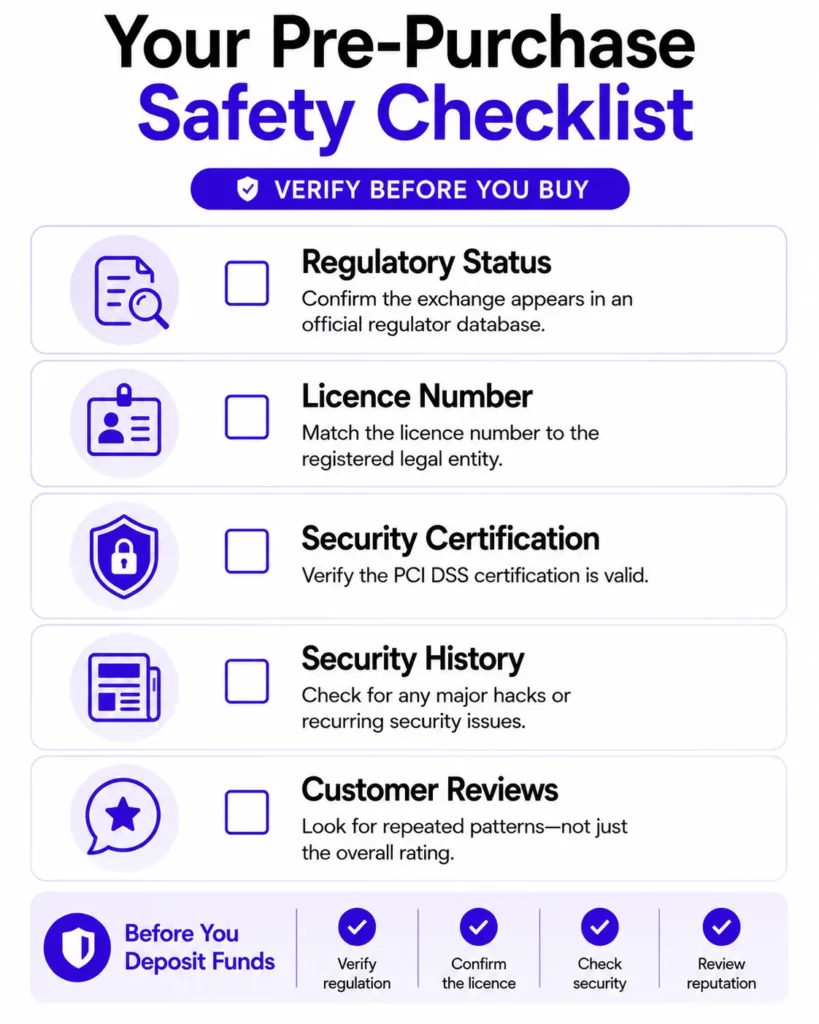
Your Pre-Purchase Safety Checklist
Use these steps before depositing funds or uploading your ID to any crypto exchange. Apply them to Paybis, or to any platform you’re evaluating.
- Regulatory database check: Search the exchange’s legal name in the FinCEN MSB registry (US), FINTRAC registry (Canada), or FCA register (UK). Confirm the registration appears in the database.
- License number cross-reference: Find the license number in the website footer. Enter it directly into the official database and confirm it matches the registered legal entity name.
- PCI DSS badge click-through: Locate the PCI DSS badge and click it. Confirm it links to the PCI Security Standards Council’s validation page showing the certificate holder’s name and current status.
- Hack history search: Search “[exchange name] + hack” in Google News filtered to the past five years. Cross-reference on CoinDesk and CoinTelegraph. Negative reviews alone are not a reliable signal, what matters is whether complaints follow a consistent pattern.
- Trustpilot pattern scan: Read the most recent 20 reviews, not just the overall score. Watch for repeated patterns around “stuck funds,” “locked accounts,” or “no response from support lasting multiple days.”
“I’ve been using Paybis for over a year now. I’m brand new this crypto stuff, but this company has been straightforward, easy to use, and reliable. If you’re a newbie like me, it’s easy to use.” – Moose on Trustpilot.
Which Crypto Exchanges Are Regulated?
Regulatory registration means a government authority has reviewed an exchange’s business practices and required it to follow AML and KYC laws. Registered platforms must report suspicious transactions and keep records accountable to regulators. Unregistered platforms answer to no one.
When FTX collapsed in November 2022, billions in user funds were misappropriated. When Mt. Gox suffered a prolonged theft from 2011 through 2014, resulting in the loss of approximately 650,000 Bitcoin, users had no government-backed protection and no regulatory body auditing the platform’s reserves. If you want to understand more about Bitcoin’s history and why these events matter, the history of Bitcoin provides essential context. The lesson is not that crypto is inherently unsafe. It is that platforms operating without regulatory oversight create conditions where user funds have no protection when things go wrong.
Before uploading a government-issued ID to any site, understand the risks of an unlicensed platform: your personal data could be sold or used to open fraudulent financial accounts in your name, and there is no legal mechanism to demand accountability if the platform disappears. Legitimate exchanges registered with FinCEN or FINTRAC are legally required to protect your data under national AML and KYC laws.
How to Check Official Regulatory Databases: US, Canada, and UK
United States (FinCEN): Go to the FinCEN MSB Registrant Search, enter the exchange’s legal name, and click the result to view the full registration record. FinCEN updates the registry weekly, and new businesses are typically added within two weeks of filing their registration form.
Canada (FINTRAC): Access the FINTRAC MSB registry, which is updated monthly and fully searchable by business name or registration number. Any platform offering services to Canadian users must register with FINTRAC before operating.
United Kingdom (FCA): UK users can verify exchanges at the FCA Financial Services Register. Any UK-facing platform that cannot point to an active FCA entry or alternative regulatory approval is operating outside the law for UK financial promotions. Paybis’s FCA reference number is detailed in the UK crypto buying guide.
Real vs. Fake License Badges: What to Look For
Legitimate exchanges display their registration numbers in the website footer or on a dedicated “Legal” or “Compliance” page. Find the number, go directly to the official government database, and search it. If the number returns a matching legal name, the registration is real.
Watch for these red flags on fake or unverified badges:
- The badge is an image rather than a clickable link to the issuing authority’s website
- The license number shown returns no results in the official database
- The legal entity name on the website does not match the registered name in the database
- The regulatory body cited does not exist as a real government agency
If any of these apply, stop. Report the platform to the FTC at reportfraud.ftc.gov and the FBI’s Internet Crime Complaint Center.
Before creating an account anywhere, also search “[exchange name] + scam” and “[exchange name] + regulatory status” in Google. Cross-reference results on Reddit forums like r/cryptocurrency, where users report problems quickly. The FBI’s IC3 portal logs thousands of crypto fraud reports annually and publishes alerts about active scam operations. It is also worth reviewing how Bitcoin transactions are traceable to understand the on-chain accountability that supports regulatory compliance.
Security Certifications That Prove Platform Safety
Third-party security certifications are independent audits conducted by accredited organizations that verify a platform’s technical infrastructure meets defined safety standards. These are not badges that a company designs itself. They require passing external tests, and they must be renewed. The most important one for first-time card buyers is PCI DSS Level 1.
PCI DSS Level 1: What It Protects
PCI DSS Level 1 applies to platforms processing roughly six million card transactions annually and requires the most rigorous security controls available, including annual on-site audits by a Qualified Security Assessor, as ZenGRC explains. When you enter your Visa card details on a PCI DSS Level 1 compliant platform, your card number, expiry date, and CVV are encrypted and processed under controls that independent auditors have verified. Paybis holds this certification, and you can confirm it by clicking the badge in Paybis’s footer, which links directly to the PCI Security Standards Council’s validation page.
To verify any exchange’s PCI DSS status, click the badge on their site. If clicking it opens an image file, does nothing, or redirects to the exchange’s own marketing page, the badge is not independently verified. This single test eliminates a large number of fraudulent platforms in seconds. For a broader look at how payment methods compare on security and convenience, see the Paybis guide on alternative payment methods vs. credit cards.
How to Check an Exchange’s Hack History
Past behavior is the most reliable predictor of future security in crypto. An exchange that has experienced a major breach and continued operating with minimal changes has demonstrated exactly what happens when its defenses fail.
Search “[exchange name] + hack” and “[exchange name] + security breach” in Google News and filter for results from the past five years. Cross-reference on CoinDesk and CoinTelegraph, which consistently cover major exchange security incidents. A credible exchange will have either no breach results or will have publicly disclosed and resolved any incidents with documented user compensation. For deeper reading on threats beyond exchange-level breaches, the Paybis guide on cryptojacking and how to protect yourself covers individual device-level risks that every crypto user should understand.
“Zero major hacks since founding” means no incident in which customer funds were lost, stolen, or misappropriated through a security failure at the platform level. It does not mean the platform has never faced an attempted attack. It means those attempts have not succeeded. Paybis has no security breaches since 2014. In an industry where major exchange failures continue to occur, an 11-year clean record is a concrete, verifiable data point.
Before depositing significant funds on any exchange, ask the support team directly: “Has this platform ever experienced a security incident that affected customer funds?” and “Where are customer funds held, in cold storage (offline, not connected to the internet) or hot wallets (online)?” A legitimate platform answers both questions directly.
How Reputable Exchanges Protect Your Funds
Proof of Reserves is a transparency mechanism that uses cryptographic auditing to verify an exchange holds enough assets to cover all customer deposits. As CoinTracker explains, an independent auditor captures an anonymized snapshot of all user balances, organizes them into a Merkle tree structure, and compares signed total reserves against total customer liabilities to confirm 1-to-1 backing. This makes it mathematically verifiable that every dollar deposited is actually held by the exchange, not loaned out or misappropriated.
One important point to understand before your first deposit: cryptocurrency is legally classified as property, not as a deposit under banking law. As noted by the Ledger Academy, this means no government-backed deposit insurance, such as the US FDIC’s $250,000 per-depositor protection at banks, applies to crypto held on an exchange. Reputable platforms protect user funds primarily through cold storage, meaning the majority of assets are held in offline wallets that remote attackers cannot reach because there is no internet connection to exploit. This is why cold storage combined with regulatory registration and independent security audits is the industry standard for user protection.
Protect your own account with two steps: use a unique password you have never used anywhere else, and enable two-factor authentication (2FA) using your phone. Paybis uses email verification for every login, sending a one-time password to your registered address, and 2FA apps generate a six-digit code every 30 seconds for additional account security.
How to Verify Security on Other Platforms
The same verification process applies to any exchange. Coinbase is publicly traded on NASDAQ, holds FinCEN registration, and carries strong US regulatory standing. Where it differs from Paybis is primarily in speed and support: Coinbase ACH (Automated Clearing House) bank transfers typically take 1 to 3 business days to settle, with an additional holding period before you can withdraw crypto. For a direct comparison of how these platforms handle user issues, see the Coinbase support vs. Paybis support breakdown. Paybis card transactions process instantly (under 1 minute) with no holding period for verified users.
Binance offers trading fees as low as 0.1% but its regulatory status varies significantly by country. In Canada, Binance withdrew services in 2023 and is not registered with FINTRAC, meaning Canadian users have no local regulatory protection. In the US, Binance.com is not available to retail users. Paybis, by contrast, operates a unified platform in 180+ countries with consistent FinCEN, FINTRAC, and FCA registrations.
Kraken has operated since 2011 and carries a strong security track record. Its primary trade-off for first-time buyers is a dual-product structure: an “Instant Buy” interface and a professional trading platform with different fee tiers that many beginners find confusing to navigate.
If speed, simplicity, and regulated access in 180+ countries matter more to you than the absolute lowest possible trading fees, Paybis is built for that use case. Verify Paybis’s credentials using the checklist above, then create your account and complete your first purchase with a $0 Paybis service fee on your initial card transaction.
Verify ID Upload Legitimacy Before You Sign Up
Legitimate exchanges require government ID because AML and KYC laws make it a legal requirement, not an optional preference. FinCEN and FINTRAC registered platforms are legally obligated to verify user identities and report suspicious activity. This verification process, while sometimes inconvenient, is the exact mechanism that makes an exchange accountable to regulators. An exchange that does not require ID verification is almost certainly not registered with any government authority.
Paybis completes identity verification in approximately 2 minutes using a photo ID and selfie. The full process is covered in the Paybis step-by-step verification guide. The PayPal crypto compliance guide explains in plain terms why identity checks protect your money rather than threatening it. For those new to crypto who are also wondering how many cryptocurrencies are available to buy, the guide on how many cryptocurrencies are there provides useful context before your first purchase.
“The Paybis app it’s the easiest I’ve ever used it was the easiest I got to get verified it was the easiest to just complete the account setup and then I did use it one time and it was the easiest I’ve had some easy apps before but this is the easiest” – Tammy on Trustpilot.
Check an exchange’s regulatory registration once before your first deposit, and again any time you read news about regulatory action or licensing changes affecting that platform. For an exchange you use regularly, an annual check confirms the registrations remain current.
Paybis is registered with FinCEN, FINTRAC, and approved for the UK financial promotions regime as documented in their respective government databases. With PCI DSS Level 1 compliance, no security breaches since 2014, and 24/7 live chat support in 9+ languages, Paybis meets every criterion on the verification checklist above. Verify Paybis’s credentials and start your first purchase with a $0 Paybis service fee on your initial card transaction.
Key Terminology
- Cold Storage: An offline security method that keeps the majority of exchange funds in wallets not connected to the internet. Because there is no internet connection, remote attackers cannot reach the funds. Most reputable exchanges hold the majority of user assets in cold storage as the primary defense against theft.
- FinCEN (Financial Crimes Enforcement Network): The US Treasury Department agency that registers and regulates Money Services Businesses, including crypto exchanges. FinCEN registration requires compliance with AML and KYC laws, meaning the exchange must verify user identities and report suspicious transactions to the government.
- Proof of Reserves: A cryptographic audit process that independently verifies an exchange holds enough assets to cover all customer deposits. Using a Merkle tree structure, a third-party auditor confirms that total reserves match total user liabilities, proving the exchange can cover all withdrawals.
- 2FA (Two-Factor Authentication): An extra security step that requires two forms of verification before accessing an account, usually a password plus a code sent to a phone or authentication app.
- AML (Anti-Money Laundering): Rules and monitoring systems used to detect and prevent illegal activities like money laundering, fraud, and terrorist financing through financial transactions.
- KYC (Know Your Customer): The identity verification process that regulated exchanges are legally required to complete before allowing users to transact. Under FinCEN and FINTRAC regulations, this typically involves submitting a government-issued photo ID and a selfie. KYC rules exist to prevent fraud, money laundering, and the use of financial platforms for illegal activity.
- PCI DSS Level 1: The highest certification for payment card security, requiring annual independent audits. It protects your Visa and Mastercard details during every transaction using encryption and security controls verified by a Qualified Security Assessor.
FAQ
How Do I Check If a Crypto Exchange Is Registered with FinCEN?
Go to the FinCEN MSB Registrant Search, enter the exchange’s legal name, and click the result to view its full registration record.
How Long Does Paybis Identity Verification Take?
Verification takes approximately 2 minutes using a government-issued photo ID and a selfie. This process is required under FinCEN and FINTRAC regulations and protects both the user and the platform from fraud. The system uses automated photo recognition to verify your identity, and most verifications complete immediately during account setup.
Is Crypto Covered by FDIC Deposit Insurance?
No. The FDIC insures bank deposits, not cryptocurrency. Crypto is legally classified as property, not a deposit under banking law. Platforms like Paybis protect user funds through cold storage, PCI DSS Level 1 compliance, and strict AML and KYC practices rather than government deposit insurance.
What Should I Do If I Think a Crypto Exchange Is a Scam?
Stop sending money immediately and do not provide additional personal information. Report the platform to the FBI’s Internet Crime Complaint Center at ic3.gov and the FTC at reportfraud.ftc.gov. Filing with both agencies increases the likelihood your complaint reaches the right investigators.
How Do I Verify a PCI DSS Badge on a Crypto Website Is Real?
Click the badge directly. A legitimate PCI DSS badge links to the PCI Security Standards Council’s validation page, where you can confirm the certificate holder’s name, certification level, and current status. If the badge does not link to an external validation page, it cannot be independently verified.
Disclaimer: Don’t invest unless you’re prepared to lose all the money you invest. This is a high‑risk investment and you should not expect to be protected if something goes wrong. Take 2 mins to learn more at: https://go.payb.is/FCA-Info