Crypto Withdrawal Fees Explained: What You’ll Actually Pay
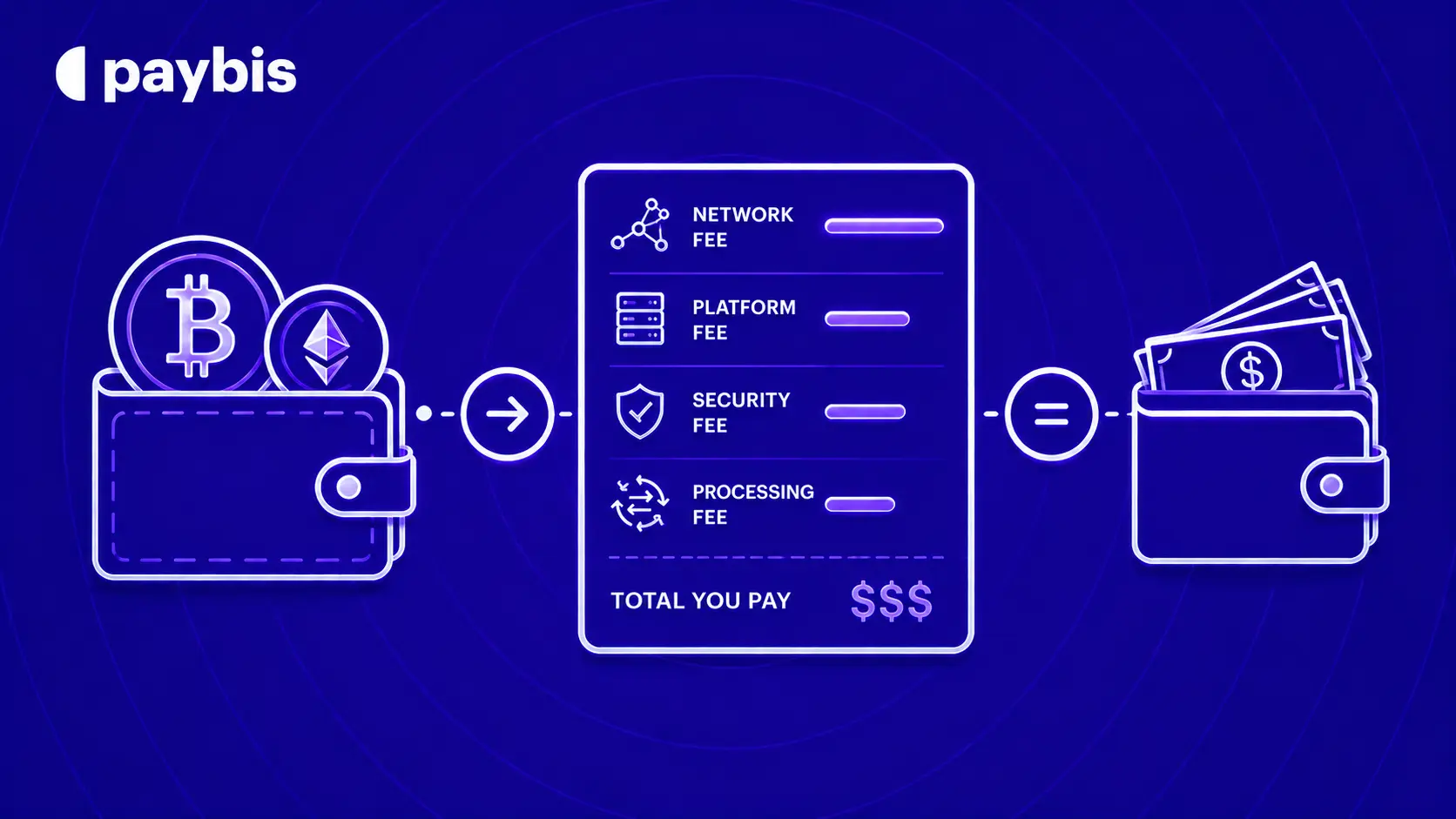
– Every crypto withdrawal carries up to four separate fee layers: network fees, exchange service fees, price spreads, and bank processing charges.
– Network fees fluctuate based on blockchain congestion. Bitcoin currently averages $0.28-$0.82 per transaction, while Ethereum averages $0.16-$0.22 under normal conditions but can spike to $3-$15 during peak traffic.
– “Zero-fee” platforms typically hide their true costs inside the quoted exchange rate through a practice called a spread. A 1.5% spread on a $500 purchase costs $7.50 that never appears on any fee receipt.
– Paybis itemizes all three fees (service, processing, and network) before you confirm payment, with no embedded spreads. You can buy Bitcoin with ACH transfer, withdraw Bitcoin to your bank account, buy Bitcoin Cash, or buy Bitcoin Cash with Paysafe Card, all with fees shown upfront before you confirm.
Crypto assets can increase or decrease in value. Paybis is a payment gateway, not an investment service. This content is for informational purposes only and does not constitute financial advice.
You withdraw $200 of Bitcoin, but only $170–$183 arrives in your bank account, depending on your payment method and current network conditions. The missing amount wasn’t stolen. It was distributed across a network fee, an exchange service fee, and likely a spread that was never itemized on any receipt.
Most platforms show one number at checkout and charge another. This guide breaks down the four core crypto withdrawal fee types, walks through the exact math on real transactions, and shows how to calculate your true round-trip cost before you click confirm.
Understanding Crypto Withdrawal Costs
When you withdraw crypto, you pay two distinct cost types: flat exchange fees and dynamic network costs. Exchange fees are set by the platform and stay predictable. Network fees (called gas fees on Ethereum) are set by the blockchain itself and change in real time based on congestion.
Paybis sets its service fee from 1.49% but cannot fix the network fee, which updates automatically at transaction time. Paybis’s help center explains which fees Paybis doesn’t control in plain language, including bank-side charges that fall outside the platform entirely.
When You Pay Withdrawal vs. Trading Fees
Most people think about fees only at the moment they click “withdraw.” Fees actually accumulate across three separate events: buying crypto, trading it, and withdrawing it to fiat or an external wallet. Understanding the “total round-trip cost” means adding up fees at every stage. For a broader look at how payment methods affect your overall cost, the PayPal vs. credit card for buying crypto guide is a useful starting point.
Paybis’s fee transparency breakdown walks through exactly how this math works in practice. The step-by-step Bitcoin withdrawal guide also demonstrates this visually for first-time users.
Identify the 4 Core Crypto Withdrawal Fees
Every withdrawal touches four cost layers. Understanding each one is the first step to calculating your true payout.
Network Fees (Blockchain Transaction Costs)
A network fee (also called a gas fee on Ethereum) is the cost that blockchain validators charge to process and confirm your transaction. Think of it like a highway toll: the more traffic on the road, the higher the toll.
As of May 2026, current average fees sourced from Mempool.space and Etherscan are:
| Network | Asset | Typical Range (USD) |
|---|---|---|
| Bitcoin | BTC | $0.28 – $0.82 |
| Ethereum | ETH | $0.16 – $0.22 avg; higher during peak congestion |
| Ethereum | USDC ERC20 | $2.00 – $10.00 |
These fees go directly to blockchain validators, not to the exchange. No platform can eliminate them, only display them honestly. Paybis shows the current network fee before you confirm every transaction.
Crypto Withdrawal Service Fees
A service fee is what the exchange charges for processing your transaction. It is the platform’s actual revenue. Some exchanges charge a flat fee (Binance charges 0.0004 BTC for Bitcoin withdrawals), while others charge a percentage of the transaction amount.
Pro rata fees are percentage-based charges that scale with transaction size. Paybis’s 1.49% service fee on $100 costs $1.49, while on $1,000 it costs $14.90. This structure is more transparent than flat minimums, which can represent a disproportionately high percentage on small withdrawals. The Paybis withdrawal video shows exactly what the Paybis fee breakdown looks like at checkout.
What Are Crypto Price Spreads?
A spread is the difference between the real-time market price of a cryptocurrency and the price an exchange shows you at checkout. As CoinAPI explains, it is the gap between what buyers are willing to pay and what sellers are willing to accept.
Here is how it costs you money in practice. If Bitcoin trades at $50,000 on the open market but your platform quotes $50,750 at checkout, that $750 difference is the spread. The platform never calls it a fee, but you pay it just the same. Coinbase’s spreads typically run 0.50-2.00%, embedded in the purchase price rather than itemized separately. On a $500 transaction, a 1.5% spread costs $7.50 that never appears on any fee line. As this video on exchange profits demonstrates, spreads are one of the most common ways platforms generate revenue without the charge appearing on a receipt. The best BitPay alternatives for first-time crypto buyers guide shows how spread-based pricing compares across platforms.
Bank & Card Withdrawal Fees
Once crypto converts to fiat, traditional banking fees apply when moving money to your bank account. According to Plaid’s ACH research:
- ACH transfers: Free to under $5, settle in 2-3 business days.
- Wire transfers (domestic): $15-$30, settle within one business day.
- Wire transfers (international): $30-$50, plus a 1-4% FX markup embedded in the exchange rate.
- Card payouts: Up to 1.5% of the amount (Coinbase’s US rate), with a minimum fee.
Paybis help center lists all fees outside the control, including bank-side charges, so you know what to expect even after a transaction leaves the platform.
See Your Exact Crypto Withdrawal Charges
The math of a crypto withdrawal is straightforward once you know which numbers to plug in. Here are three worked examples showing exactly how fees reduce your final payout.
Calculating $200 Bitcoin Transfer Fees
Starting amount: $200 in Bitcoin, converting to cash via a card payment on Paybis.
- Service Fee (1.49%): $200 x 1.49% = -$2.98
- Processing Fee (6.5% mid-range for cards over $50): $200 x 6.5% = -$13.00
- Network Fee (BTC, approximate current average): -$0.55 (mid-range based on current $0.28–$0.82 range)
- Bank Fee (ACH, no charge): $0.00
- Approximate total received: around $170-183.
That works out to roughly a 6-10% effective cost depending on payment method and network conditions. Every number in this example appears at checkout before you confirm, with no spreads embedded in the rate.
Avoid Surprise ETH Withdrawal Fee Spikes
Ethereum is more volatile in its fee behavior than Bitcoin. During normal conditions, ETH network fees average $0.16-$0.22 according to Etherscan. During high-traffic periods (major DeFi activity, market volatility), those fees jump to $3-$15 per transaction.
The practical fix is checking Etherscan’s gas tracker before withdrawing. If fees are elevated, waiting 2-4 hours typically brings them down. The Bitcoin withdrawal step-by-step walks through how to pick the right timing for any withdrawal.
Withdrawal Fees: Small Vs. Large Amounts
Fee structures hit small withdrawals harder when they include flat minimums. A $1 flat withdrawal fee on a $20 transaction represents 5% of the total. That same $1 fee on a $500 transaction is just 0.2%.
Paybis’s 1.49% service fee scales proportionally, which is fairer for small amounts. However, processing fees for card transactions (4.5-8.5% depending on currency) apply to all amounts over $50, making cards a higher-cost method than bank transfers for larger withdrawals. For EU users, a SEPA (Single Euro Payments Area) bank transfer carries just a 0.99% service fee plus 0.05% processing (minimum €2), making it the most cost-effective option. Selling crypto for bank transfer covers the full process.
How to Calculate Your Total Withdrawal Cost
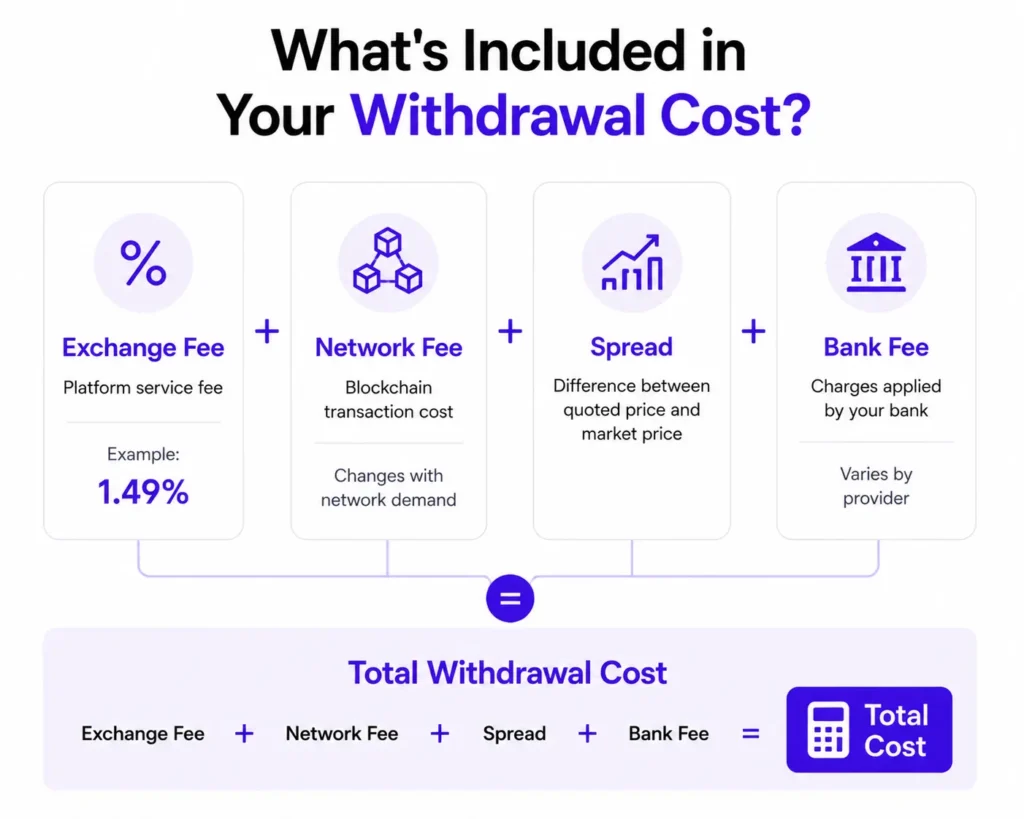
Before confirming any crypto withdrawal, run through these four checks. Each one catches a cost that platforms don’t always surface clearly.
- Exchange fee: Find the service fee percentage on the official fee schedule. Paybis’s fee page shows the service fee starting from 1.49%, plus payment-method-specific processing fees, before you begin a transaction.
- Network fee: Check live blockchain costs at Mempool.space for Bitcoin or Etherscan for Ethereum. Paybis also displays the current network fee in real time at checkout, updated automatically based on actual blockchain demand.
- Spread: Compare the exchange’s quoted price against CoinGecko or CoinMarketCap. If a platform quotes $51,000 per BTC and the market shows $50,500, the $500 gap is roughly a 1% spread. Paybis doesn’t embed spreads in its quoted prices. The price you see is the market price.
- Bank fee: Check your bank’s fee schedule before selecting a withdrawal method. Paybis’s help article on third-party fees lists bank-side charges that fall outside its control.
Crypto Exchange Fee Structures Explained
Fee comparisons require looking at the full cost structure, not just the headline trading fee. Here is how Paybis’ costs compare to three major alternatives in terms of the total cost of a withdrawal. The best Bitcoin trading platforms guide provides additional context on how different exchanges structure their fees overall.
Paybis Cost Breakdown & Charges
Paybis’s fee structure, as confirmed by FXEmpire’s 2025 review and 99Bitcoins’ 2025 review, is fully itemized before payment:
- Service Fee: 1.49% (0% on your first card transaction)
- Processing Fee: 4.5-8.5% for card transactions over $50, depending on currency
- Network Fee: Real-time blockchain cost, updated automatically at transaction time
- Spread: None. Paybis doesn’t embed markups in the quoted price.
On a $500 card purchase after the first transaction, total costs run approximately $530-$550, depending on currency and network conditions. That range appears before you click confirm. Coin Bureau’s 2026 review highlights this upfront transparency as a core differentiator among crypto payment platforms.
Coinbase Crypto Withdrawal Charges
Coinbase charges instant card withdrawal fees of up to 1.5% plus a minimum of $0.55 in the US. ACH transfers are free but take 3-5 business days to settle. Wire transfers carry a $25 fee.
Beyond stated fees, Coinbase embeds a price spread of approximately 0.50-2.00% in the quoted purchase price. On a $500 transaction, that spread adds $2.50-$10.00 in cost that never appears on the fee breakdown. The 3-5 day ACH wait also means your cash is inaccessible while the transfer clears.
Binance Crypto Exit Fees: What You Pay
Binance’s trading fee is as low as 0.1% for standard spot orders, making it attractive for active traders. That rate applies to its professional trading interface, not simple buy/sell flows. Withdrawal fees are charged as flat amounts per cryptocurrency: currently 0.0002 BTC (~$1.20) for Bitcoin, though this may vary based on network conditions.
Binance’s interface is built for active traders. For users who just want to convert and cash out, navigating to the correct withdrawal screen and selecting the right network adds friction that can result in costly errors. Paybis’s Kraken vs. Binance breakdown illustrates this complexity in detail.
How to Minimize Crypto Withdrawal Fees
Reducing withdrawal costs is mostly a matter of timing, network selection, and batching. Here are the most effective strategies. Actionable checklist:
- Check live network fees before initiating any withdrawal.
- Use bank transfer (SEPA or ACH) instead of card payouts for larger amounts.
- Withdraw USDT via TRC20 rather than ERC20 to cut network fees significantly.
- Batch multiple small transactions into one larger one.
- Use Paybis’s first-transaction offer (0% service fee on your first card purchase).
- Withdraw during off-peak hours when Bitcoin and Ethereum networks are less congested.
- Verify your bank’s receiving fee before selecting a withdrawal method.
Find the Best Time to Withdraw Crypto
Bitcoin and Ethereum fees drop during periods of low network activity. Off-peak periods (weekends and evenings in major US and European markets) typically produce lower BTC and ETH fees compared to weekday peak hours.
For Ethereum specifically, checking Etherscan’s gas tracker before withdrawing takes seconds and can potentially save several dollars per transaction during high-congestion events. The Paybis US crypto withdrawal guide covers how to time withdrawals for optimal network conditions.
Batch Withdrawals to Cut Per-Transaction Costs
Every withdrawal triggers a fresh network fee and a fresh service fee, regardless of size. Consolidating five $50 withdrawals into a single $250 transaction pays those fixed costs once instead of five times.
The impact is sharpest on bank transfer payouts where flat fees apply. A $25 domestic wire fee consumes 50% of a $50 withdrawal but only 5% of a $500 one. Batching is therefore the single most effective lever when you cannot avoid wire transfer fees. Structuring a single sell transaction via bank transfer covers the full process.
Use Bonuses to Reduce Withdrawal Fees
Paybis waives its service fee entirely on your first card transaction. You still pay the processing fee (4.5-8.5% depending on currency for transactions over $50) and the network fee, but Paybis’s margin is zero on that first transaction. The DigiChick’s 2025 tutorial covers exactly how to use this offer. New users wondering who can buy Bitcoin will also find useful eligibility and onboarding information before getting started.
Know Your True Crypto Withdrawal Costs
Several cost categories sit outside the main fee table but can be significant, particularly for users withdrawing on weekends or converting between currencies.
The True Cost of Exchange Spreads
A 1.5% spread on a $500 purchase costs $7.50. A 2% spread costs $10.00. Neither amount shows up on a fee receipt. As the CoinAPI spread definition explains, the spread is the gap between the price a market maker will buy at and the price they’ll sell at. Exchanges advertising “zero fees” typically earn revenue entirely through this markup.
The practical test: compare the exchange’s quoted BTC price against CoinGecko. A 1% or higher gap indicates an embedded spread. If you’re still researching how many dollars to buy a Bitcoin, understanding spread costs is essential to knowing your true entry price.
Cost of Weekend Withdrawal Delays
Blockchain networks run 24/7. Traditional bank ACH and wire systems do not. ACH payments initiated on Friday evening typically don’t settle until Monday, according to Plaid’s ACH research. That 2-3 day window leaves your cash inaccessible.
Crypto-to-crypto transfers are unaffected by banking hours, as the guide on sending Bitcoin to another wallet demonstrates. Fiat card payouts from selling crypto, however, follow standard banking settlement windows of 1-3 business days Monday through Friday.
Your True Currency Conversion Cost
Withdrawing to a currency different from the platform’s base currency adds another cost layer. Traditional banks embed a 1-4% FX markup into the exchange rate on international wire transfers, separate from any stated transfer fee. Paybis’s business wallet accounts offer zero FX fees on multi-currency cross-border payments. For context on how international credit card payments work within crypto platforms, that guide covers the mechanics in detail.
Understanding Withdrawal Minimums
Exchanges set minimum withdrawal amounts to ensure the network fee doesn’t exceed the transaction value. Binance’s minimum is currently 0.0004 BTC for Bitcoin. Minimums protect the user as much as the platform. Trying to withdraw $2 worth of Bitcoin when the current average network fee is $0.82 results in the fee consuming more than 40% of the transaction.
When Withdrawals Go Wrong: What to Do
Transaction failures are a reality of crypto. Here is what to do at each stage and how Paybis handles issues differently.
Reduce Your Crypto Network Fees
If a withdrawal shows a high network fee at checkout, the simplest fix is to wait. Bitcoin fees fluctuate throughout the day, and a 2-4 hour delay during peak congestion can cut the fee significantly based on Mempool.space historical data. For Ethereum, Etherscan’s gas tracker provides live data. Selecting a cheaper network for the same asset is the most reliable cost reduction regardless of timing.
Typical Crypto Withdrawal Times
| Method | Processing Time | Settlement |
|---|---|---|
| Paybis card transactions | ~30 sec (repeat purchases) | Typically 1–3 business days to card |
| Coinbase ACH to bank | Varies | Typically 3–5 business days to bank |
| Binance crypto withdrawal | Minutes | Depends on blockchain |
| Wire transfer to bank | Same day (domestic) | Same day (domestic) / 1–5 days (international) |
Paybis has 31,490+ Trustpilot reviews with a 4.1 rating (as of May 2026), and its Google Play app holds a 4.4–4.6-star rating (verify at publish), with users consistently citing speed as a primary strength. Paybis’s corporate withdrawal guide covers the full process for business accounts.
Weekend Crypto Withdrawal Costs
Crypto networks charge the same fees on Saturday as on Tuesday. Traditional banks do not process ACH or wire transfers on weekends, so fiat withdrawals initiated Friday evening typically don’t settle until Monday.
Crypto-to-crypto transfers are unaffected by banking hours. Fiat payouts to bank cards, however, follow standard banking settlement windows of 1-3 business days. Paybis’s platform is available 24/7, any day of the week.
Paybis Support and Security When Withdrawals Go Wrong
If a withdrawal fails or a charge is unclear, Paybis’s 24/7 live chat (average response time 1-2 minutes) connects you to a human agent, not a bot. Coin Bureau’s 2026 review rates Paybis’s support quality as a standout feature. Paybis is FinCEN-registered (Financial Crimes Enforcement Network), FINTRAC-registered (Financial Transactions and Reports Analysis Centre of Canada), and PCI DSS Level 1 compliant (Payment Card Industry Data Security Standard). Paybis has processed over $5.4B in lifetime volume across 5M+ users in 180+ countries with no security breaches since 2014.
Paybis displays your exact service fee, processing fee, and network fee before you confirm any transaction. Create your account and complete 2-minute ID verification (photo ID and selfie) to see the full cost breakdown in real time. First-time card users pay a 0% service fee on their initial transaction.
Key Terminology
- Gas fee: The Ethereum-specific term for a network fee. Gas prices are measured in gwei and converted to USD at the time of each transaction.
- Spread: The difference between the real-time market price of a cryptocurrency and the price quoted by an exchange at checkout. Spreads are not itemized as fees but reduce the amount of crypto you receive.
- Anti-Money Laundering (AML): Laws and procedures designed to prevent criminals from hiding illegally obtained money through financial systems or transactions.
- Slippage: The difference between the expected price of a trade and the actual execution price, caused by rapid price movement between quote and execution. Common on larger orders during volatile markets.
- Custodial wallet: A wallet where the platform holds the private keys on your behalf. Paybis offers a custodial wallet that holds your crypto until you withdraw it to an external address.
- Authorization Hold: A temporary charge placed on your card or bank account to verify available funds before a transaction is completed.
FAQ
Can You Avoid Crypto Withdrawal Fees Entirely?
No. Every blockchain transaction requires a network fee paid to validators, and every exchange charges at least a service or processing fee. You can reduce fees significantly by selecting cheaper networks, withdrawing during off-peak hours, and using platforms with no embedded spreads.
What Is the Cheapest Way to Withdraw Crypto to Cash?
Using a SEPA bank transfer on Paybis costs a 0.99% service fee plus 0.05% processing (minimum €2), making it the lowest-cost fiat withdrawal method Paybis offers. For card payouts prioritizing speed, your first card transaction carries a 0% service fee, with only the processing fee (4.5-8.5% depending on currency) and network fee applying.
How Much Does It Cost to Withdraw $200 in Bitcoin?
With a card on Paybis: $2.98 service fee (1.49%) + $13.00 processing fee (6.5% mid-range) + ~$0.50 network fee (approximate current average) = roughly $16.48 in total fees, leaving approximately $183.52. Adding a $25 domestic wire fee to receive the cash drops the total to approximately $145–$158.
Why Do "Zero-Fee" Crypto Platforms Still Cost Money?
Platforms advertising zero fees generate revenue through price spreads, embedding a 0.5-2% markup directly into the quoted exchange rate. Paybis itemizes fees separately and doesn’t hide spreads in the quoted price, so the rate you see is the actual market rate.
Disclaimer: Don’t invest unless you’re prepared to lose all the money you invest. This is a high‑risk investment and you should not expect to be protected if something goes wrong. Take 2 mins to learn more at: https://go.payb.is/FCA-Info